233. The day is of infinite length for him who knows how to appreciate and use it. ~Johann Wolfgang von Goethe

Image

Take time to think; it is the source of power.
Take time to play; it the secret of perpetual youth.
Take time to read; it is the fountain of wisdom.
Take time to pray; it is the greatest power on earth.
Take time to love and be loved; it is a God-given privilege.
Take time to be friendly; it is the road to happiness.
Take time to laugh; it is the music of the soul.
Take time to give; it is too short a day to be selfish.
Take time to be charitable; it is the key to heaven.
~Author Unknown

For everything there is a season, and a time for every matter under heaven: a time to be born, and a time to die; a time to plant, and a time to pluck up what is planted; a time to kill, and a time to heal; a time to break down, and a time to build up; …  ~Ecclesiastes 3:8  ✝

232. Adopt the pace of nature:  her secret is patience.  ~Ralph Waldo Emerson

Image

How good it is to center down!  To sit quietly and see one’s self pass by!  The streets of our mind seethe with endless traffic; our spirits resound with clashings, with noisy silences, while something deep within hungers and thirsts for the still moment and the resting lull.  We look at ourselves in this waiting moment–the kinds of people we are.  The questions persist; what are we doing with our lives? What is the end of our doings?  Where is my treasure?  As we listen, floating up through all the jangling echoes of our turbulence, there is a sound of another kind–a deeper note which only the stillness of the heart makes clear.  It moves directly to the core of our being.  Our questions are answered, our spirits are refreshed, and we move back into the traffic of our daily rounds with the peace of the Eternal in our step.  How good it is to center down!  ~Excerpt from For the Inward Journey by Howard Thurman, American author, philosopher, theologian, educator

Happy is the one who listens to me, watching daily at my gates, waiting beside my doors.  ~Proverbs 8:34  ✝

231. I keep six honest serving-men, they taught me all I knew; their names are What and Why and When and How and Where and Who. ~Rudyard Kipling

Curiosity has its own reasons for existing.
One cannot help but be in awe
when he contemplates the mysteries
of eternity, of life, of the marvelous structure of reality.
~Albert Einstein

Image

Gardening fosters curiosity, and the “curiouser” I get about nature, the more I want to know; the more I learn, the more in awe I am of Creation’s wonders and mysteries.  That’s why in winter when there are fewer daylight hours and less busyness in my days, I try to spend more time lingering and reflecting on the who, the what, the where, the when, and the how of life here on planet earth.  And I believe my musings on such matters are what keep my mind alert and open, my heart softened and quickened, and my soul ever-searching and longing for its eternal home.  Moreover, the more profound the conundrum I encounter the more humbled I am by how small and limited I am in comparison to how big and powerful the universe, and therefore, God is.

Who can measure His majestic power?  And who can fully recount His mercies?  ~Sirach 18:5  ✝

230. He who marvels at the beauty of the world in summer will find equal cause for wonder and admiration in winter… ~John Burroughs

Nature looks dead in winter because
her life is gathered into her heart.
She withers the plant down to the root
that she may grow it up again fairer and stronger.
She calls her family together
within her inmost home to prepare them
for being scattered abroad upon the face of the earth.
~Hugh Macmillan

Image

This time of year there’s a separateness in the garden which I rather like, but I’ve heard others say that they detest the bleak lifelessness of winter.  When asked why, they’ll tell me it’s because it fills them with a sense of loneliness or it speaks too strongly of death.  I, on the other hand, find a comforting orderliness in its realm because I can see the garden’s defining lines again after they’d been blurred or even obliterated in some cases by summer’s reckless, spreading abandon.   And when I’m out working in the winter garden as I was today, I don’t feel any sense of sadness; the feeling I get is more of a silent, but willing withdrawal–a retreat back to a trusted, reviving source.  It seems to me that the barren remains stand self-assuredly in an awareness of Creation’s ever-faithful, annual renewal and somehow understands winter’s lesson of waiting with expectancy and hope.

As long as earth endures, seedtime and harvest, cold and heat, summer and winter, day and night, shall not cease.  ~ Genesis 8:22  ✝

229. So, like a forgotten fire, a childhood can always flare up again within us. ~Gaston Bachelard

To speak truly, few adult persons can see nature.
Most persons do not see the sun.
At least they have a very superficial way of seeing.
The sun illuminates only the eye of the man
but shines into the eye and heart of the child.
The lover of nature is he whose inward and outward senses
are still truly adjusted to each other;
who has retained the spirit of infancy even into the era of manhood.
~Ralph Waldo Emerson

Image

God sometimes reaches out at the most unexpected times to capture our hearts and attention, and not infrequently does He do that by using one of Creation’s eye-catching spectacles.  When a moment like that happens, it’s much like when a lover surprises his beloved by pulling a handful of flowers from behind his back.   And every time I’m delighted by the Holy One in such a way, I fall in love with Him all over again.  A friend of mine recently shared a moment like that with me, and as I read her description, I realized that understanding God’s parables can occur when the innocence of childhood floats up back up in our present realities.

On this cool, crisp morning, I arose before the sun and
went out my front door to look for the newspaper.
But that’s not what caused me to stop in my driveway, paper forgotten.
Overhead, Ursa Major and other stars twinkled brightly,
framed only by a few thin, wind-shaped clouds.
And at a time of the year when children take center stage,
I thought of the innocence in all of us.
For it was not my intellect that held me spellbound
but my own innocence, untarnished by age.
In that moment, caught by the wonder of nature,
blessed with its beauty, I felt magical.
~Emily Seate

Who is this that appears like the dawn, fair as the moon, bright as the sun, majestic as the stars in procession?  ~Song of Solomon 6:10  ✝

228. Christmas is a necessity. There has to be at least one day of the year to remind us that we’re here for something else besides ourselves. ~Eric Sevareid, CBS new journalist

Image

Every happening, great and small,
is a parable whereby God speaks to us,
and the art of life is to get the message.
~Malcolm Muggeridge,
English journalist, author, media personality, and satirist

Purporting that life is “a tale told by an idiot signifying nothing” or that it’s merely the result of events that can be explained through science or reason falls short of compelling realities to the contrary.  If mortals were simply intellectual beings, they’d not emote, express feelings, or commit loving acts that are seemingly inspired in some inscrutable place within their physical being.  These things, like all happenings in Creation, are symbolic narratives designed to teach or illustrate truths about the Ancient of Days who not only created us but also wired humans with the capacity to feel, to express emotions, and to extend kindnesses to one another.  So the sacred isn’t merely above us but forever within the entire body of Creation, and discovering the sacrosanct in it can’t help but stir in the descendants of Adam a sense of connection and belonging to a higher Power.  The resources and bounty of planet earth alone give us plenteous reasons to sense the presence of a Holy Benefactor and feel His gracious, creative, and loving hands at work in our lives.  But for me what sparks an even stronger desire within my human heart to seek the Creator is that God expanded the narrative and clearly revealed Himself when He sent His Son to be our Savior; Jesus is our memory, and in coming to offer us salvation, He reminds us of who we are and to whom we belong.

I keep asking that the God of our Lord Jesus Christ, the glorious Father, may give you the Spirit of wisdom and revelation, so that you may know him better.  ~Ephesians 1:17   ✝

227. This, this is Christ the King, whom shepherds guard and angels sing; haste, haste to bring him laud, the babe, the son of Mary. ~William C. Dix

Image

May your home be a sanctuary
wherein you feel the continual presence of Yeshua, the Christ.
May you feel His mantle of love perpetually
surrounding you and all those you love.
May there be forgiveness and healing wherever there is brokenness.
May your life be long and yield a multitude of days
filled with laughter, love, and well-being.
May your world be blessed with plentitude and joy.
May there always be love in your heart; in your soul, may there be peace;
and in your mind may tranquility reign.
May each season of the coming years bring you
the best they have to proffer.
May you never be lacking enough and never want for more.
On rainy or troubling days may there be rainbows,
physical or spiritual, to gladden your eyes and heart and spirit.
As you listen for the sacred incantations of heaven’s orbs
may your hear the “echoes of the spheres”
speak of the Holy One and His goodness and mercy.
O come let us adore Him! He has come! The Messiah has come!

For I am convinced that neither death, nor life, nor angels, nor rulers, nor things present, nor things to come, nor powers, nor height, nor depth, nor anything else in all creation, will be able to separate us from the love of God in Christ Jesus our Lord.  ~Romans 8:38-39  ✝

226. Christmas is a necessity. There has to be at least one day of the year to remind us that we’re here for something else besides ourselves. ~Eric Sevareid

Screen Shot 2015-12-16 at 2.35.11 PM.png

A man is at his finest towards the finish of the year; He is almost what he should be when the Christmas season’s here; Then he’s thinking more of others than he’s thought the months before, And the laughter of his children is a joy worth toiling for. He is less a selfish creature than at any other time; When the Christmas spirit rules him he comes close to the sublime. When it’s Christmas man is bigger and is better in his part; He is keener for the service that is prompted by the heart. All the petty thoughts and narrow seem to vanish for awhile And the true reward he’s seeking is the glory of a smile. Then for others he is toiling and somehow it seems to me That at Christmas he is almost what God wanted him to be. If I had to paint a picture of a man I think I’d wait Till he’d fought his selfish battles and had put aside his hate. I’d not catch him at his labors when his thoughts are all of pelf, On the long days and the dreary when he’s striving for himself. I’d not take him when he’s sneering, when he’s scornful or depressed, But I’d look for him at Christmas when he’s shining at his best. Man is ever in a struggle and he’s oft misunderstood; There are days the worst that’s in him is the master of the good, But at Christmas kindness rules him and he puts himself aside And his petty hates are vanquished and his heart is opened wide. Oh, I don’t know how to say it, but somehow it seems to me That at Christmas man is almost what God sent him here to be. ~Edgar A. Guest

“Therefore the Lord Himself will give you a sign: Behold, a virgin will be with child and bear a son, and she will call His name Immanuel. ~Isaiah 7:14   ✝

225. Stripes that are red like the blood shed for me. ~Author Unknown

There’s a song in the air!
There’s a star in the sky!
~Joseph G. Holland

Image

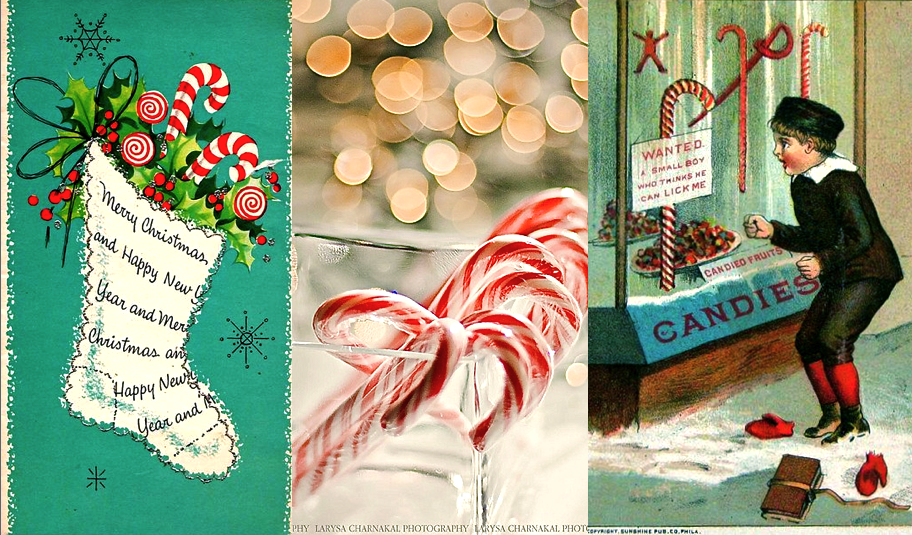
The strongest connection one might make between the origins of the candy cane and any intentional Christian association is to guess that possibly some unknown person, at some indefinite time, took a long-existing form of sweet (i.e., straight white sticks of sugar candy) that was already associated with Christmas and produced bent versions of it to represent a shepherd’s crook and/or make it easier to hang on Christmas trees, but even that general association is nothing more than mere supposition with no supporting evidence behind it.  This is charming folklore, but one should not lose sight of the fact that such stories of the candy cane’s origins are, like Santa Claus, myths and not “true stories.”

There is one verifiable (albeit indirect) religious connection associated with the modern candy cane, however.

In 1919 Bob McCormack began making candy canes for local use and sales in Albany, Georgia, and by the middle of the century his company (originally the Famous Candy Company, then the Mills-McCormack Candy Company, and later Bob’s Candies) had become one of the world’s leading candy cane producers. But candy cane manufacturing initially required a fair bit of labor that limited production quantities (the canes had to be bent manually as they came off the assembly line in order to create their ‘J’ shape,) and it was McCormack’s brother-in-law, a Catholic priest named Gregory Harding Keller, who came up with the solution: Father Keller invented the Keller Machine that automated the process of shaping straight candy sticks into candy canes.   ~Barbara Mikkelson

The woman said to him, “I know Messiah is coming” (who is called Christ).  “When he comes, he will proclaim all things to us.”  ~John 4:25  ✝

224. There is a bird that God has blessed, she wears this honor on her chest… ~Rick Fernandez, Sr.

When father takes his spade to dig
then the Robin comes along;
And sits upon a little twig
And sings a little song.

Or, if the trees are rather far
He does not stay alone,
But comes up close to where we are
And bobs upon a stone.
~“The Robin” by Laurence Alma-Tadema

Image

Since the mid 19th century in the UK and in Ireland, the robin has been strongly associated with Christmas; its image has been used on Christmas cards and on postage stamps.  Legend has it, according to an old British folk tale, that when Jesus was dying on the cross, the Robin, then a simply brown bird, flew to his side and sang into his ear in order to comfort him in his pain. The blood from his wounds stained the Robin’s breast, and thereafter all Robins have borne the mark of Christ’s blood upon them.  More than likely however, the association with the robin and Christmas may have come from the fact that postmen in Victorian Britain wore red jackets and were nicknamed “Robins.”

Now may the God of peace, who brought back from the dead our Lord Jesus, the great shepherd of the sheep, by the blood of the eternal covenant, make you complete in everything good so that you may do his will, working among us that which is pleasing in his sight, through Jesus Christ, to whom be the glory forever and ever.  Amen.  ~Hebrews 13:19-21  ✝