200. For flowers that bloom about our feet; for tender grass, so fresh, so sweet; for song of bird, and hum of bee; for all things fair we hear or see, Father in heaven, we thank Thee! ~Ralph Waldo Emerson

Thanksgiving is the holiday of peace,
the celebration of work and the simple life. . .
a true folk-festival that speaks
the poetry of the turn of the seasons,
the beauty of seedtime and harvest,
the ripe product of the year –
and the deep, deep connection
of all these things to God.
~Ray Stannard Baker (David Grayson)

Image

At the beginning of time the Lord set the wheels in motion for the making of continual banquets for man and creature alike.  And so in light of His abundant provisions and as the Canticle of Creation plays on, it is time to pause and give thanks to our gracious Benefactor.  The year is drawing to its appointed end and before it sinks into winter, the Sabbath of the year, we must look around and take stock of the Lord’s never-ending activity in Creation and be thankful for the constancy of His love and beneficent involvement in each of our lives.  W. J. Cameron said, “. . .a thankful heart hath a continual feast,” and so with beholden hearts, let us give praise and thanks for our Heavenly Father, His Grace, and His goodness.  I pray that this be a blessed time of thanksgiving for all of you and those you love; may all the roads you travel be, now and forever, filled with grace and peace and love.

If I have enjoyed
the hospitality of the Host of the universe,
Who daily spreads a table in my sight,
surely I cannot do less
than acknowledge my dependence.
~G. A. Johnston Ross

Enter His gates with thanksgiving and His courts with praise; give thanks to Him and praise His name.  ~Psalm 100:4  ✝

Rambling Thoughts

This is a reblog from Annette’s Garden at: http://wp.me/p32RMi-cI
Image

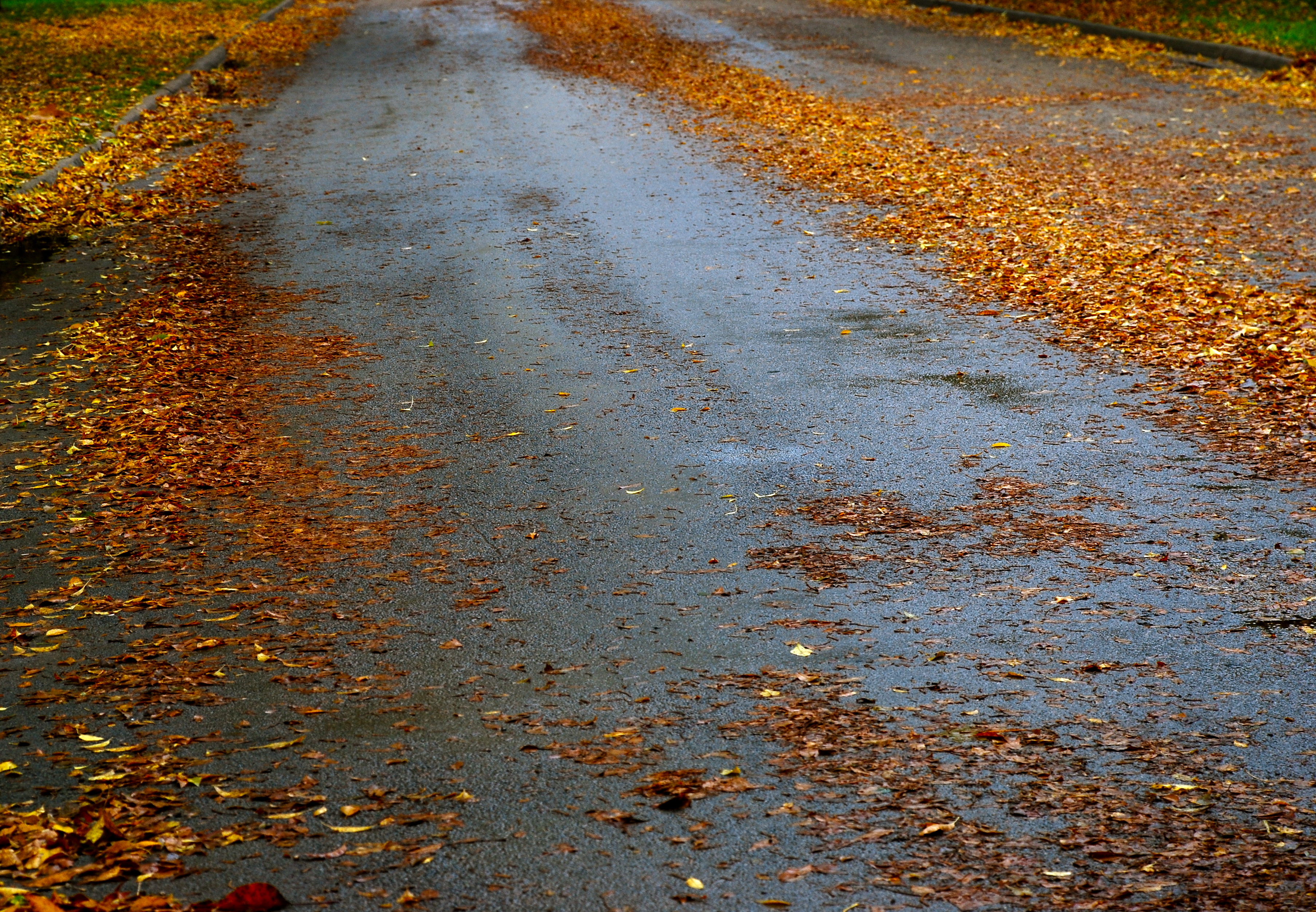
In autumn, when the trees cry colourful leaves and the vibrant spirit of summer is only a memory, thoughts go on a ramble. Time for reflection and contemplation. A damp, heavy quietness settles on the garden. The work is done, we can sit back and watch. When I plant bulbs in the autumn, and there seem to be more and more each year, I always wonder how many more springtimes I will live to see. I don’t ask as a result of depression (I’m not a child of sadness!), but because I think of these bulbs that fill me with such happiness. First when I’m planting then later, when in the comfort of my armchair in front of the fire -longing in my eyes- they fill my head with fields of colour and scent and carry me through the season which I never came to love, although it has its beauty too. It must be the bulbs that fill me with wantonness and unreasonable hope. The expression “to be happy like a child” comes to my mind but kids are not happy and innocent like they used to be. If you’re faced with the first murder during breakfast and with Jingle Bells and plastic Santas climbing ridiculously into chimneys from September onwards how could you possibly hold on to that pure and carefree joy? As for myself, I find lots of happiness in the little treasures and secrets nature and garden hold for me. All the same, there’s something morbid about this question, and I admit that I never ask myself at other times of the year. How many summers or autumns will I live to see? No way. But maybe the reason for planting these crazy amounts of promising bulbs and corms lies in my hidden wish that the older I get the more spectacular spring ought to be. Recently I read a quote by Henry David Thoreau which follows me ever since: The mass of men lead lives of quiet desperation. Thoreau said this in the 19th century but it is still true. The reason for this lies in the continuous remoteness and alienation from nature which in its most dramatic case leads to people perceiving nature as an enemy or danger. Pristine nature has become rare and if it’s really wild, we meet it with fear and suspicion. Seeing and hearing have also become rare skills. We’re constantly exposed to noise, being lulled and deadened. Even the news are hammered into us to the sound of percussions so that there’s no risk of us coming to our senses or to be bored. Tranquility is out. A friend of mine told me about a visitor from Canada who switched on a tape each night at bedtime: She couldn’t bear the quiet, only with the constant noise was she able to sleep. Cathy at http://wordsandherbs.wordpress.com/ did a great post dealing with the subject of hearing a while ago, and I hope she will share the link once she reads this. To hear and I mean TO HEAR is by no means taken for granted anymore. There’s so much to hear when you listen to supposed quiet. Have you ever tried? The silence that makes you feel like you’re deaf has become rare. Where I live, in the middle of the woods, it can still happen. It descends like a comfortable blanket. No fear, no panic just peace. Some shake their heads asking how can you possibly live here? We shake our heads knowing that every explanation would fall into nothingness. The general rush and fear of missing out on something are so widespread that many cannot understand how satisfying it is to fill the basket with firewood to heat the house, to collect eggs from your hens and to tend the garden. To hear nothing and to work in the garden are today’s last luxuries. During our hikes we sometimes meet extreme mountainbikers rushing down steep slopes with fierce expression, or cool guys on rattling motorbikes, modern Marlborough-Cowboys. None of them knows the intriguing scents and sounds of the forest, sees the pink mushroom in the undergrowth, the tree creeper searching the bark for insects or hears the melancholic song of the robin. Kids don’t know anymore that milk comes from cows. A vegetarian friend of mine suggested recently that one could keep milking cows without letting them have calves. Once I watched children beating newly planted fruit trees with sticks until the bark had come off while their mother watched them proudly. Great to see kids fulfilling themselves. Nature is retreating more and more and can only be found where access is hard or impossible or where there’s nothing to exploit. Would we ask men their definition of nature – what would the answer be? I fear the answer a lot more than visitors the solitude of my wood. Why should men protect something they’re not aware of and don’t see, never mind appreciate? When man moves away from nature, he loses his roots, becomes depressed and unhappy. I could never be without my garden and nature, my sanity depends on them. I draw energy, courage and meaning out of them. Okay, some things don’t work out in the garden but I’m never disappointed and depressed. Still nothing fills me with more hope and optimism. A life of quiet desperation? That’ll never be an issue for someone who hasn’t lost touch with his/her roots.

181. How could such sweet and wholesome hours be reckoned but with herbs and flowers. ~Andrew Marvel

Natural object themselves
even when they make no claim to beauty,
excite the feelings, and occupy the imagination.
Nature pleases, attracts, delights,
merely because it’s nature.
~Karl Wilhelm Humboldt

Image

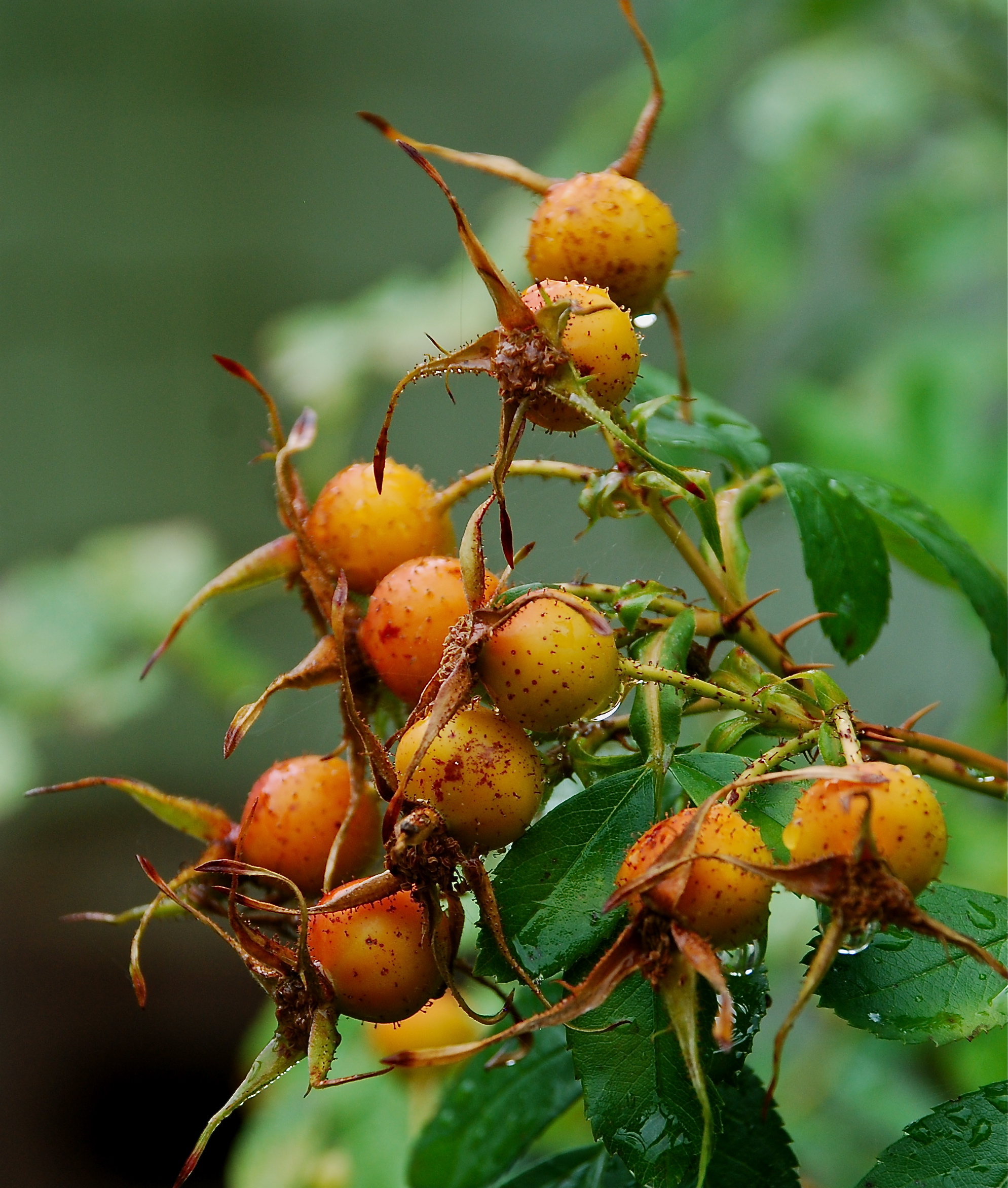
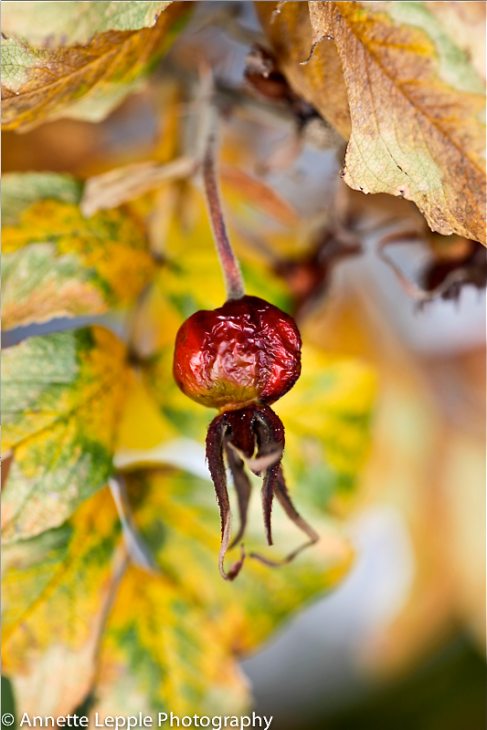
The most common attractions of the rose are the prettily colored flowers and the sweet to spicy fragrances.  On some roses there are also brightly colored hips that not only decorate bare canes in winter but also provide feasts for overwintering birds.  These hips are the pomaceous fruits of the rose, and they vary in size and shape and color.  Some of the first rosary beads were fashioned out of dried rose hips, and they have been used as well to make jellies, jam, marmalade, teas, soup, and medicinal compounds.  They also played an important role during World War II because they are very rich in Vitamin C.  It seems the people of Great Britain were encouraged to gather wild-grown rose hips to make a syrup for their children since German submarines were sinking commercial ships making it very difficult to import citrus fruits from the tropics.

Looking with expectancy for things that excite, I venture out into my gardens almost daily, weather permitting.  To that end I am seldom disappointed even on drippy days like this one.  Today’s find were some gold-orange-reddiish rose hips, and though they make no claim to great beauty, I was thrilled to see them once again.  After photographing them and beginning this post I began pondering what a difference for the better it might make if I greeted every new day’s living with the same attitude.  What an impact might it have on those around me if I met them filled with joy and expected the best from the encounter.  Once again I see how God’s Eden is not only a great sustainer but also an excellent teacher.

The seed will grow well, the vine will yield its fruit, the ground will produce crops, and the heavens will drop their dew.  ~Zechariah 8:12  ✝

176. For the mind disturbed, the still beauty of dawn is nature’s finest balm. ~Edwin Way Teale

Slow buds the pink dawn like a rose
from out night’s gray and cloudy sheath;
softly and still it grows and grows,
petal by petal, leaf by leaf.
~Susan Coolidge

Image

Tired of tossing and turning, I got up out of bed and went in to rock in my favorite chair.  Not wanting to miss the “slow budding” of dawn’s light, however, I first raised the bamboo shade in front of the glass, patio-doors.  After a short wait a faint pinkish glow appeared low on the horizon in the eastward sky, and as the sun inched up and up and up, a ray of golden light poured through an opening centered in the heart of a tall tree framed against it just above a neighboring housetop.  The branches of the tree then took on a hallowed appearance so much so that a bird atop the roof and two squirrels sitting very still in nearby branches looked like parishioners in pews awaiting the high priest.  Later, as the sun climbed high enough for night’s curtain to be lifted completely off earth’s stage, it was apparent that all who’d seen this amazing “salutation of the dawn” were summoned to make ready for the new day.  The first to respond was a flock of birds darting willy nilly across the pastel blue sky in search of food, but beneath them as more and more drops of light appeared like jewels aloft in the bamboo I knew that despite a restless night the time for me to rise had come as well.

If I rise on the wings of dawn, if I settle on the far side of the sea, even there Your hand will guide me, Your right hand will hold me fast.  ~Psalm 139:9-10  ✝

162. All was silent as before — All was silent save the dripping rain. ~Henry Wadsworth Longfellow

But the true lover of rain…has a deep inner enjoyment of the rain, as rain, and his sense of its beauty drinks it in as thirstily as does the drinking earth.  It refreshes and cools his heart and brain; he longs to go forth into the fields, to feel its steady stream, to scent its fragrance; to stand under some heavy-foilaged chestnut-tree, and hear the rushing music on the crowded leaves.  ~John Richard Vernon

**One of my readers just sent me to a website which has a slowed down audio clip of crickets chirping.   It’s amazing to hear that they sound like an angelic choir reminiscent of gregrorian chanters.  If you’d like to listen, you’ll find it at:  www.soundcloud.com/acornavi/robert-wilson-crickets-audio

Image

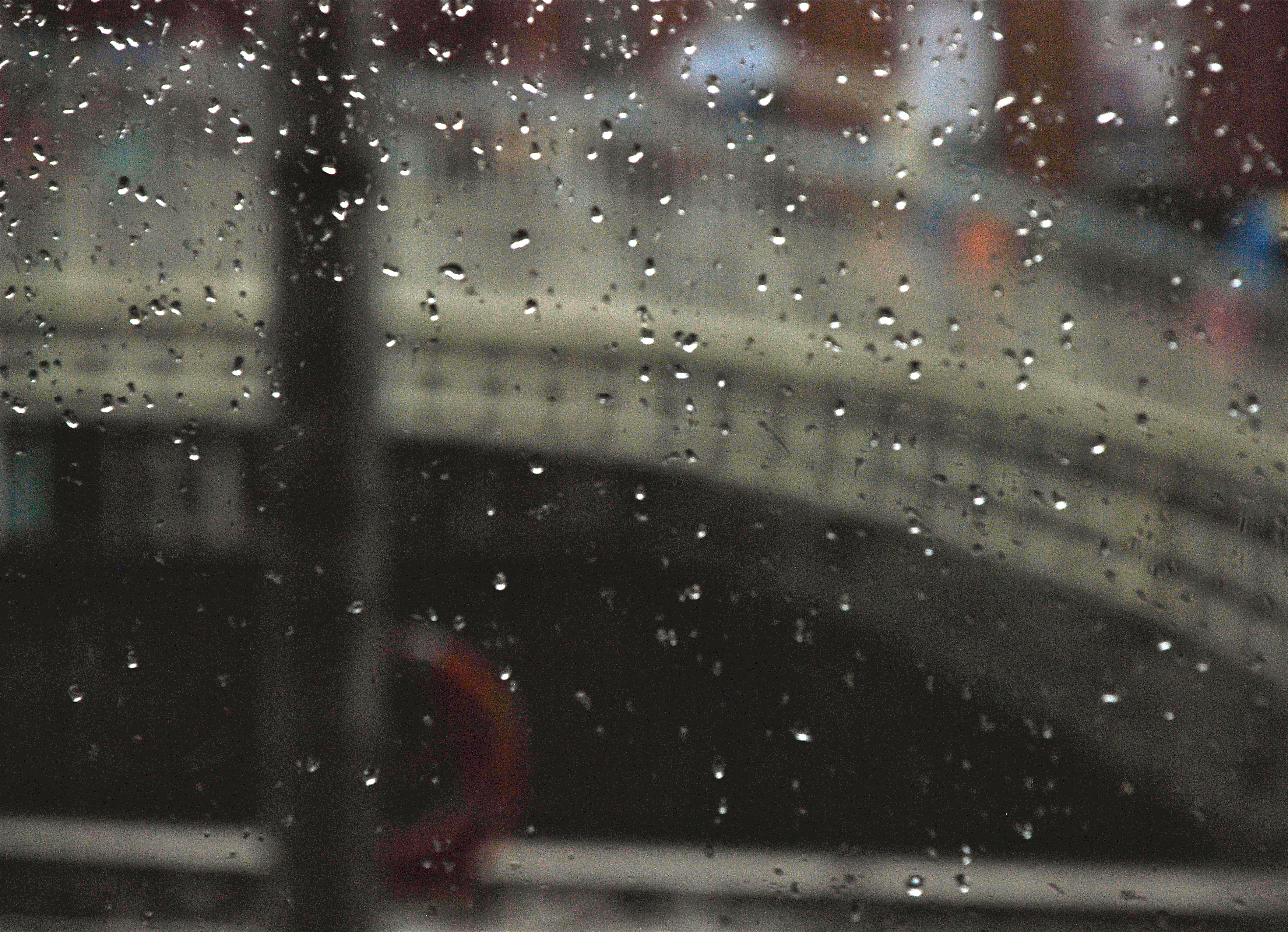
I like to think of the universe as a cosmic temple and of planet earth as a sanctuary in that temple.  Though not given the power of speech as such, rain and other weather-related phenomena exhibit distinctive voices under heaven’s dome, and as they fall from earth’s chaotic atmosphere, they often blend their unique voices with other holy sounds in the natural world.  I believe that in that sacred chorus is a call to humanity to seek the Maker of the temple because God not only hardwired man with a desire to connect with other human beings but also with a  longing to seek and connect with Him whose breath gave him life. To that end man was given eyes to witness the sacraments of heaven and earth, ears to hear the chants of their hallowed voices, intellect to question and understand much of what is seen and heard, and a heart that in due time turns from irreverence to longing.  Tecumseh, a leader of the Shawnee, said, “Nature is so powerful, so strong.  Capturing the essence is not easy – your work becomes a dance with light and the weather.  It takes you to a place within yourself.”

Let my teaching fall like rain and my words descend like dew, like showers on new grass, like abundant rain on tender plants.  ~Deuteronomy 32:2  ✝

151. The human spirit needs places where nature has not been rearranged by the hand of man. ~Author Unknown

We need the tonic of wildness. . .
We can never have enough nature. . .
We need to witness our own limits transgressed,
and some life pasturing freely
where we never wander.
~Henry David Thoreau

Image

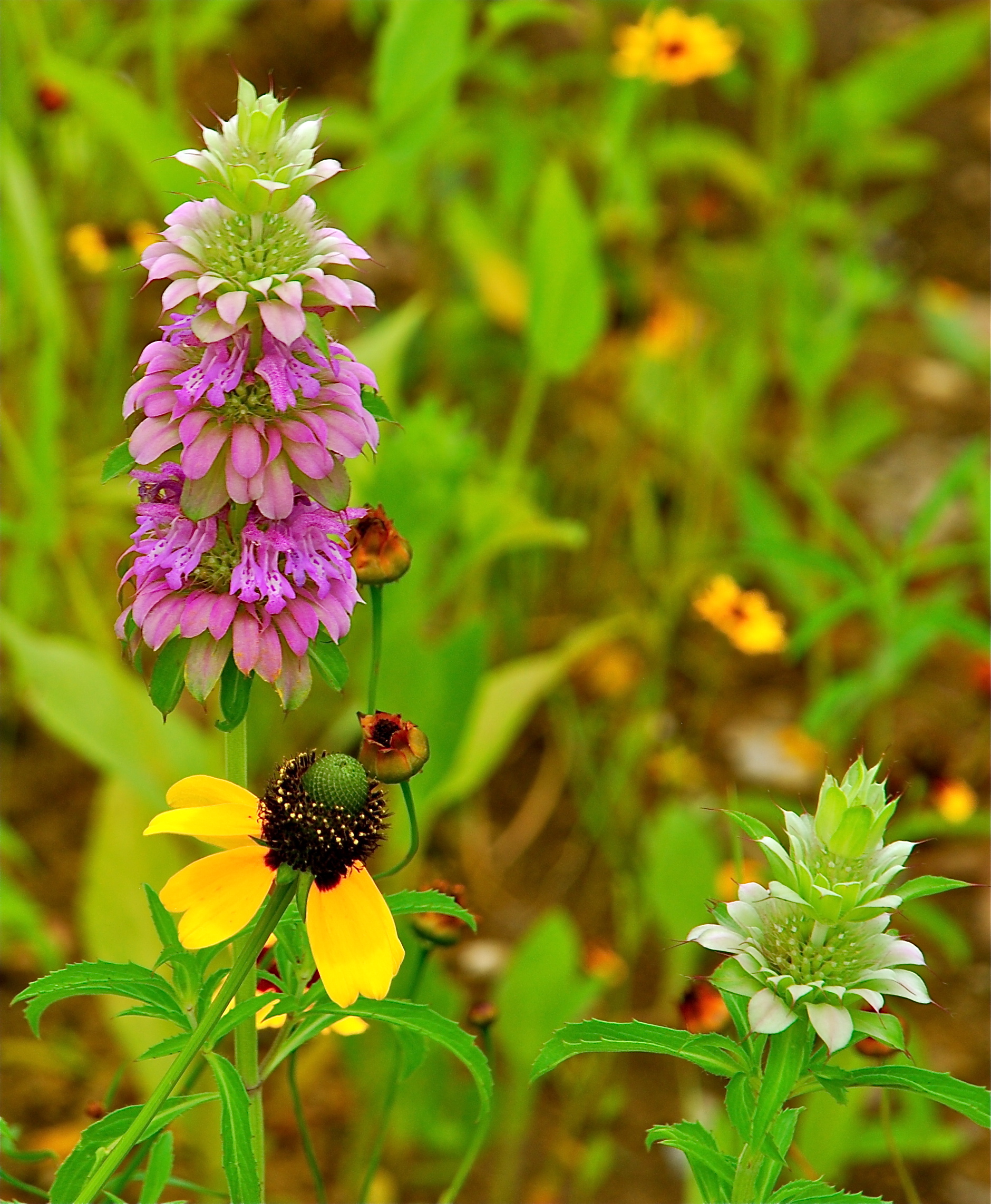
The flowers in these photos are not refined nor polished like the ones often planted and sown in garden plots, but in their wildness and in spite of their neglect they possess a kind of rough elegance.  The fact that they are abused by the elements and thrive in poor terrain increases their charms even more.  In their unbridled wildness they refuse to pass into nothingness and continue to attract, please, and delight mortals as well as wildlife. They may “make no claim to beauty;” but nevertheless, elements of beauty are inherently present in their countenance.  And their presence speaks as loudly of their Maker as anything else in Creation.

You crown the year with Your bounty, and Your carts overflow with abundance.  The grasslands of the wilderness overflow; the hills are clothed with gladness.  ~Psalm 65:11-12

149. It would be worthwhile having a cultivated garden if only to see what autumn does to it. ~Alfred Austin, British poet laureate

Lord, it is time.
The summer was very big.
Lay thy shadow on the sundials,
and on the meadows let the winds go loose.
~Ranier Maria Rilke

Image

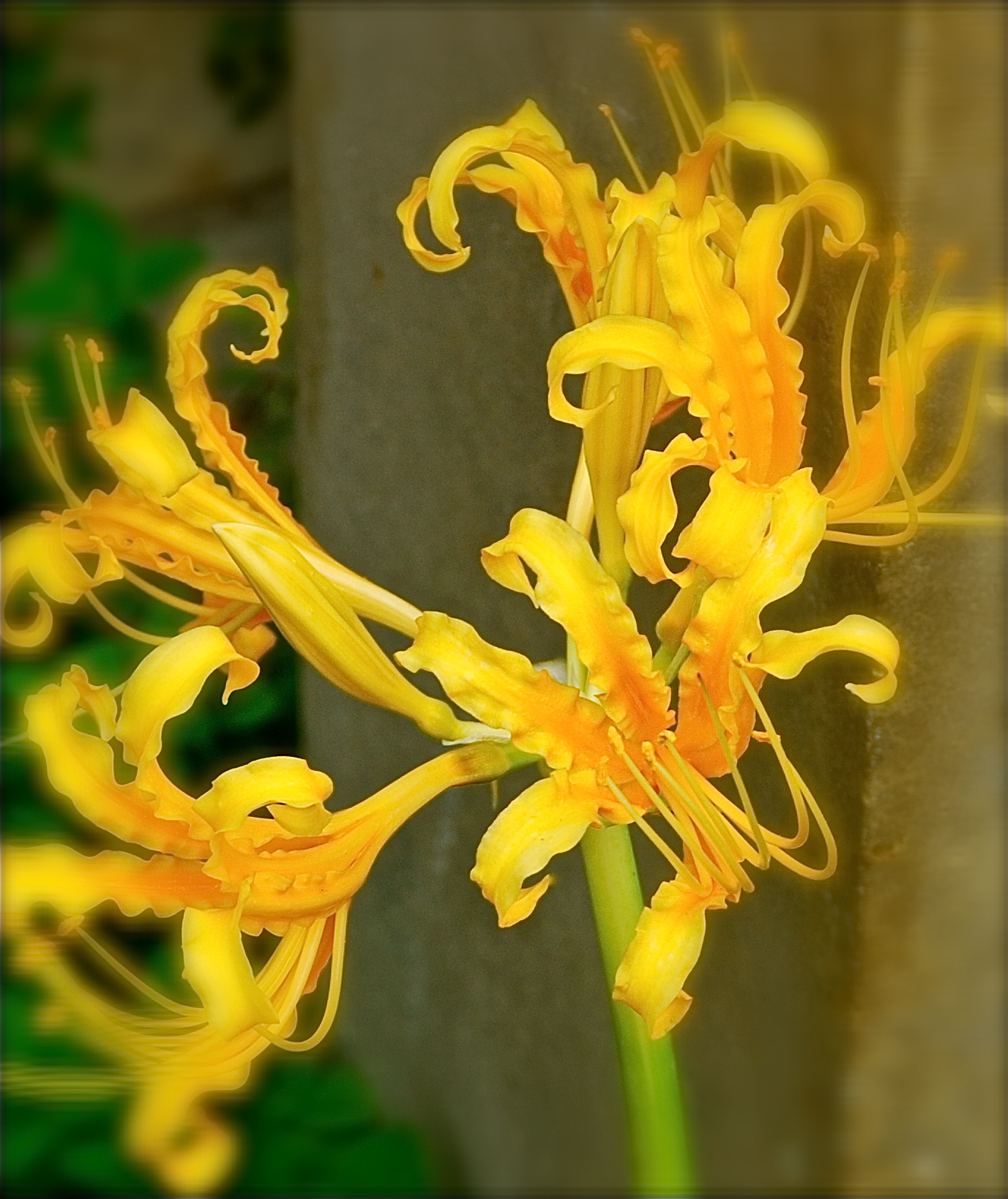
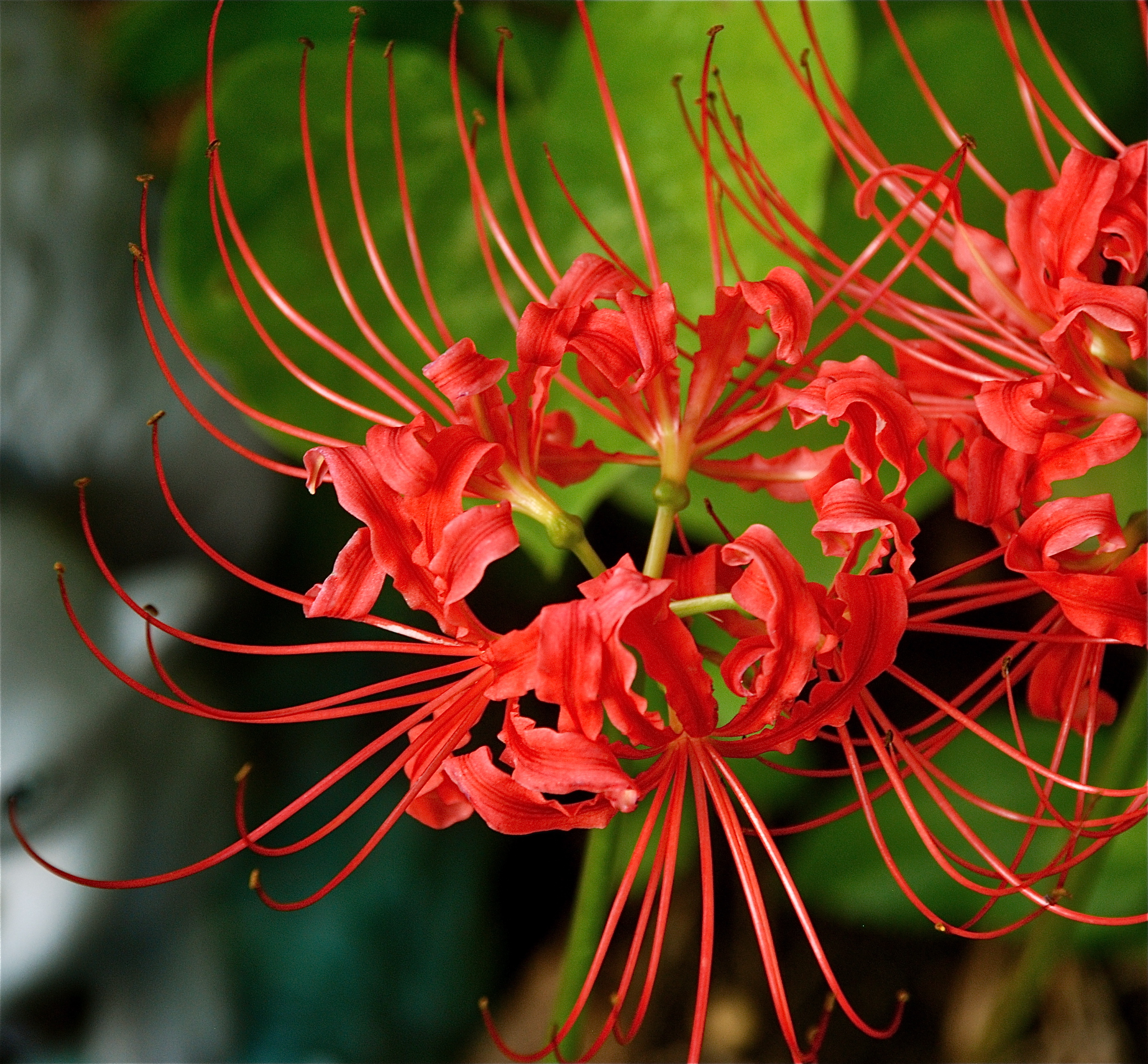
The beauty in the photo above, like the summer sun, is the color of gold.  And her petals have slightly wavy edges that seem to mimic the summer’s waves of heat that lead up to her appearance in the garden where she winks at people passing by with her long, wispy eyelash-like stamen.  In Latin the word “stamen” means “thread of the warp,” and it was Emerson who birthed the idea that “days are made on a loom whereof the warp and woof are past and future time.”  Apparently what he said ‘tis true since these threads of the warp are definitely forerunners of the future.  When they appear in the garden, hurricane season has begun and autumn is drawing near.  But who is she, this fair maiden dressed so elegantly in gold?  She and others like her are called Golden Spider Lilies, Naked Lilies, Surprise Lilies, Golden Hurricane Lilies, and/or Lycoris.  But whatever one calls them, they’re always dressed in their rich, apricot-yellow-orange finery, and their blooms which appear late in the summer after their leaves have disappeared create a lovely sweeping quality in the garden.  The official name of the species is Lycoris aurea, and it originated in China where it is known as “Hudixiao” (Suddenly The Soil Shines).  But she is not an only child; for she has an amazing sibling, Lycoris radiata, the Red Spider Lily.

Image

Now look again at the yellow one.  I deliberately blurred the outer edges of the photograph so the heart she was forming in the middle was more noticeable.

Acknowledge and take to heart this day that the Lord is God in Heaven above and on earth below.  There is no other.  ~Deuteronomy 4:39  ✝

146. Beauty. . .is the shadow of God on the universe. ~Gabriela Mistral

The human body needs food to be nourished, but the spirit needs to be fed in other ways. One thing it needs is beauty, and nature has a vast array of beautiful places in which the spirit can be nurtured and healed if need be. I’ve found that time spent in any of earth’s sanctuaries provides me with a better perspective about a whole host of things.  When the senses are heightened and ordered, what’s really important in life becomes ever so much clearer.

Image

Rachel Carson alleged that “those who dwell among the beauties and mysteries of the earth are never alone or weary of life.” She’s right because when one is alone in any of nature’s courts, if He is called upon and welcomed, it’s easy to become aware of the Lord’s presence. More importantly if one listens carefully in the midst of the natural world’s profound silences, he/she can hear the Lord speak.

Very early in the morning, while it was still dark, Jesus got up, left the house and went off to a solitary place, where he prayed.  ~Mark 1:35  ✝

128. The very act of planting a seed in the earth has in it something beautiful. I always do it with a joy that is largely mixed with awe. ~Celia Thaxter

Every friend is to the other a sun,
and a sunflower also.
He attracts and follows.
~Jean Paul Richter

Image

Over the years, I tried starting a few things from seed but never on a large scale.  Then a year or so back after I pulled up and out two poorly producing raised beds, I claimed the space beneath them that fall as seed beds.  In one I sowed poppies and in the other I sowed larkspur and was thrilled at the success of both the following spring.  After the poppies and larkspur were spent that spring, I sowed several types sunflowers in their stead so that I’d have homegrown food for my birds during the winter months.  Again I had great success, and so now, though not on as large a scale, I have several places around the yard where I reserve space for sowing morning glories, poppies, larkspur, and sunflowers.  And I have to say that the process still affects me in the same way as Celia Thaxter.  There is just something so terribly awesome about putting a tiny, almost nondescript seed in the ground and then after a period of watering and waiting discovering the tiniest of green shoots emerging from the blank soil.

The land produced vegetation: plants bearing seed according to their kinds and trees bearing fruit with seed in it according to their kinds. And God saw that it was good.  ~Genesis 1:12  ✝

76. Through the dancing poppies stole a breeze most softly lulling to my soul. ~John Keats

Of all the wonderful things in the wonderful universe of God,
nothing seems to me more surprising than the planting of a seed
in the blank earth and the result thereof.
Take the Poppy seed, for instance: it lies in your palm,
the merest atom of matter, hardly visible, a speck, a pin’s point in bulk,
but within it is imprisoned a spirit of beauty ineffable,
which will break its bonds and emerge from the dark ground
and blossom in a splendor so dazzling as to baffle all powers of description.
~Celia Thaxter

Image

I love poppies, not just the flowers but also the lovely, fat pods that contain the future of the species.  The plants that put on silky, paper-thin blossoms can grow to be 3 or 4 feet tall here if the “hardly visible” seeds are sown in the fall.  So it is that in late October I toss out seeds from the ones I harvested from last’s years pods, and then all winter long I wait for the beauties which “baffle description” to make their appearance in my garden.  As winter moves along, I keep myself reassured by going out to check on them after especially frigid days or after occasional snowfalls to make sure the burgeoning “babies” have not succumbed to the elements.  And each time I go out, I almost squeal with delight when I discover that most of them, if not all, are still slowly but surely growing bigger and stronger.  Then sometime in the early spring the day comes when the waiting is over and standing before me are the first fruits of my labors and watchfulness.  Like dainty chalices, the cup-like flowers open up and drink in the day’s light while penning God’s autograph on the “scenes” of yet another springtime.  Day by day after each individual flower’s petals fall to the ground, the intriguing seed pods take their place, and as temperatures climb, they begin to ripen.  Some of these I eventually let fall to the ground to self sow; the remainder I gather and keep safe and dry until autumn comes and it is again time for me to partner with Creation and scatter abroad the “merest atoms” of such beautiful matter.

For as the soil makes the sprout come up and a garden causes seeds to grow, so the Sovereign Lord will make righteousness and praise spring up before all nations.  ~Isaiah 61:11