
When father takes his spade to dig
then Robin comes along;
And sits upon a little twig
And sings a little song.
~Laurence Alma-Tadema
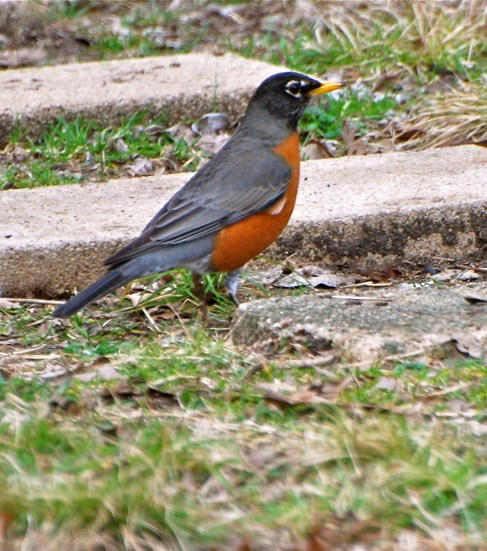
The introductory line is from Blake’s “Auguries of Innocence,” a somewhat lengthy poem consisting of a series of paradoxes in which Blake juxtaposes innocence with evil and corruption. The word augury in the title means omen or token, and the robin is the poem’s first noted “augury of innocence.” The robin’s song, personality, and countenance are such that it’s obvious why the poet saw the act of putting one in a cage as not only an enraging violation but also as a profound perversion of holiness. The sweet song and colorful markings of a robin make the bird a delightful harbinger of spring’s infancy and innocence. Looking forward to its coming is one of my favorite rites in spring’s passage, and like “all heaven” I’d be incensed if the bird’s freedom were taken away and its song silenced. Below is a legend about the robin that again ties the bird to the blameless and sacred. Although the truthfulness of legends is questionable, I’m fascinated that somehow, somewhere, and in some way the robin was connected to the Messiah.
The Legend of the First Robin
One day, long ago, a little bird in Jerusalem saw a large crowd gathered around a man carrying a heavy wooden cross. On the man’s head was a crown made from a thorn branch. The thorns were long and sharp. The little bird saw that the thorns were hurting the man. It wanted to help Him, so it flew down and took the longest, sharpest thorn in its tiny beak. The bird tugged and pulled until the thorn snapped from the branch. Then a strange thing happened. A drop of blood fell onto the bird’s breast, staining it bright red. The stain never went away. And so today the robin proudly wears a red-breast, because it helped a man named Jesus.
“But ask the animals, and they will teach you, or the birds of the air, and they will tell you; or speak to the earth, and it will teach you, or let the fish of the sea inform you. Which of all these does not know that the hand of the LORD has done this? In His hand is the life of every creature and the breath of all mankind. . .” ~Job 12:7-10 ✝
 Sacred Touches