178. All the flowers of all the tomorrows are in the seeds of today and yesterday. ~Chinese Proverb

In the garden the door is always open into the holy –
growth, birth, death.
Every flower holds the whole mystery in its short cycle,
and in the garden we are never far away from death,
fertilizing, good, creative death.
~May Sarton

Image

Every year the unseen becomes visible as new life explodes from quiet, dark, sustaining wombs.  Beneath the soil roots grow and above the surface tiny leaves yield proof of life.  Enlivening rains come, and the leaves grow.  Daylight hours lengthen, and they grow more.  Amid the leaves emerge buds, and they grow.  Buds burst into flowers, the flowers fade, and their petals fall.  Fruits, seed heads, or pods appear, and they ripen.  Fruits are harvested, seeds are spilled onto the soil, and buds are set inside woody canes or branches.  Then comes the time of rest, the discontinuance of the same, the different new genesis.  The beginnings, the middles, the ends–never an ending without a beginning–never a beginning without an ending, so goes the cyclic constancy of a garden.

The land produced vegetation; plants bearing seed according to its kinds and trees bearing fruit with seed in it according to their kinds.  And God saw that it was good.  ~Genesis 1:12  ✝

176. For the mind disturbed, the still beauty of dawn is nature’s finest balm. ~Edwin Way Teale

Slow buds the pink dawn like a rose
from out night’s gray and cloudy sheath;
softly and still it grows and grows,
petal by petal, leaf by leaf.
~Susan Coolidge

Image

Tired of tossing and turning, I got up out of bed and went in to rock in my favorite chair.  Not wanting to miss the “slow budding” of dawn’s light, however, I first raised the bamboo shade in front of the glass, patio-doors.  After a short wait a faint pinkish glow appeared low on the horizon in the eastward sky, and as the sun inched up and up and up, a ray of golden light poured through an opening centered in the heart of a tall tree framed against it just above a neighboring housetop.  The branches of the tree then took on a hallowed appearance so much so that a bird atop the roof and two squirrels sitting very still in nearby branches looked like parishioners in pews awaiting the high priest.  Later, as the sun climbed high enough for night’s curtain to be lifted completely off earth’s stage, it was apparent that all who’d seen this amazing “salutation of the dawn” were summoned to make ready for the new day.  The first to respond was a flock of birds darting willy nilly across the pastel blue sky in search of food, but beneath them as more and more drops of light appeared like jewels aloft in the bamboo I knew that despite a restless night the time for me to rise had come as well.

If I rise on the wings of dawn, if I settle on the far side of the sea, even there Your hand will guide me, Your right hand will hold me fast.  ~Psalm 139:9-10  ✝

10. For in the true nature of things, if we rightly consider, every green tree is far more glorious than if it were made of gold and silver. ~Martin Luther

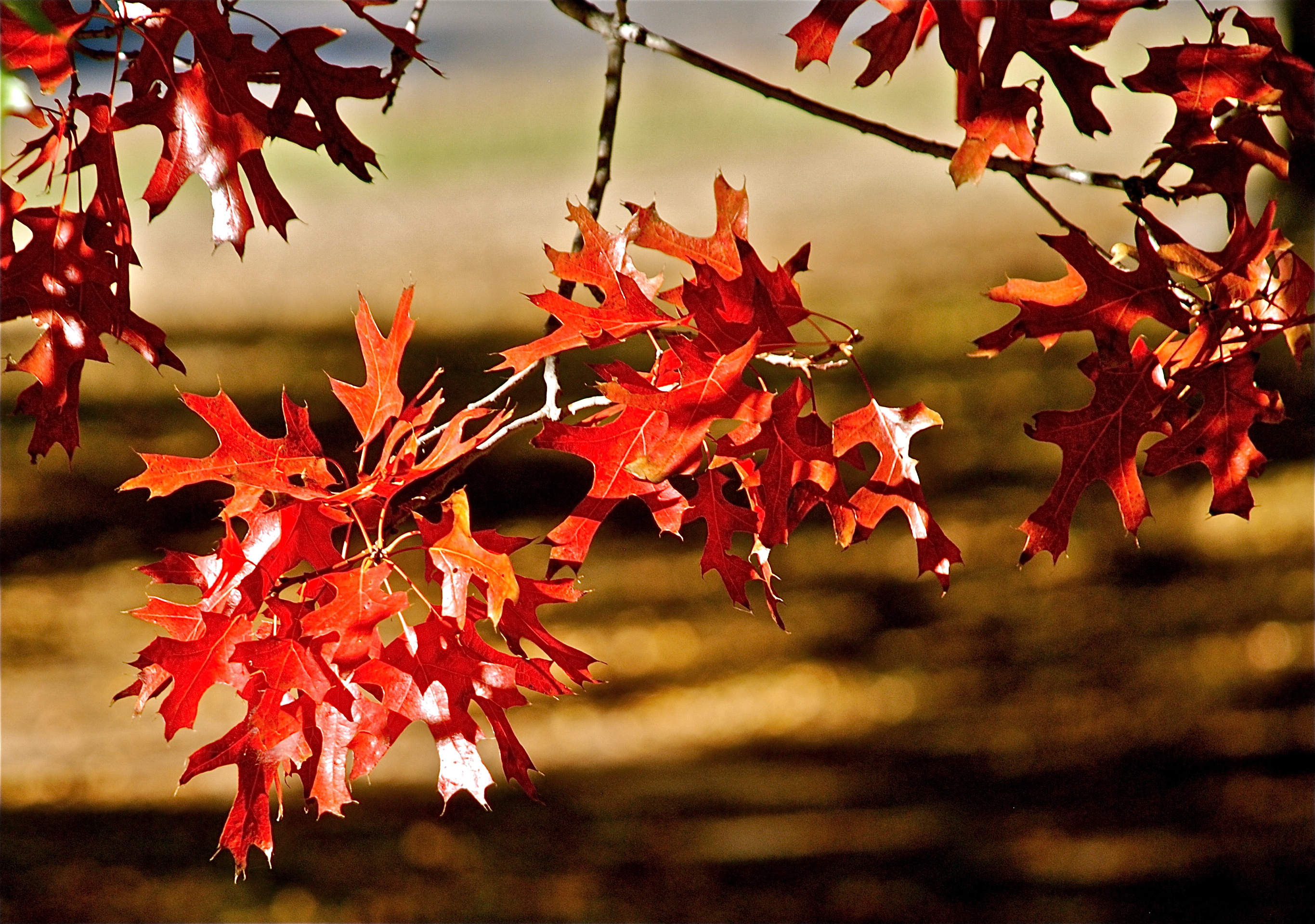
For man, autumn is a time of harvest, of gathering together.
For nature, it is a time of sowing,of scattering abroad.
~Edwin Way Teale

Image

Like Teale I knew that autumn’s winds were scatterers and sowers, but until I did some research, I didn’t realize how much the autumnal shedding of leaves accomplishes.  For the sake of the sod, the fallen leaves cover the ground like a protective blanket.  It’s also easier for leafless trees to conserve much needed moisture in their branches and trunks, and since cold, dry winter winds strip moisture from trees through their leaves, losing their leaves is self-protective mechanism.  It would also be very costly energy wise for trees to keep their little leafy food factories up and running with less light and heat.   Because the transport of water from the ground into the trunk and leaves would be a damaging drain on a trees’ limited resources, the loss of leaves puts trees into a state of dormancy thereby reducing the amount of energy they need to live.  When leaves “come to rest upon the ground,” their work is far from over.  As they lie there, they become food for soil organisms which are vital to the overall health of ecosystems.  In addition the decomposing leaves restock the soil with nutrients and make up a part of the spongy humus that absorbs and holds rainfall.  And finally with the arrival of spring and warmer temps, bacteria, fungi, and insects come into play because the fallen leaves are chewed and rotted which in turn releases nutrients for plant growth.

“For the wisdom that fashioned the universe and can be read in earth’s dark depths and in heaven’s infinity of lights thanks be to you, O God.”  ~John Philip Newell