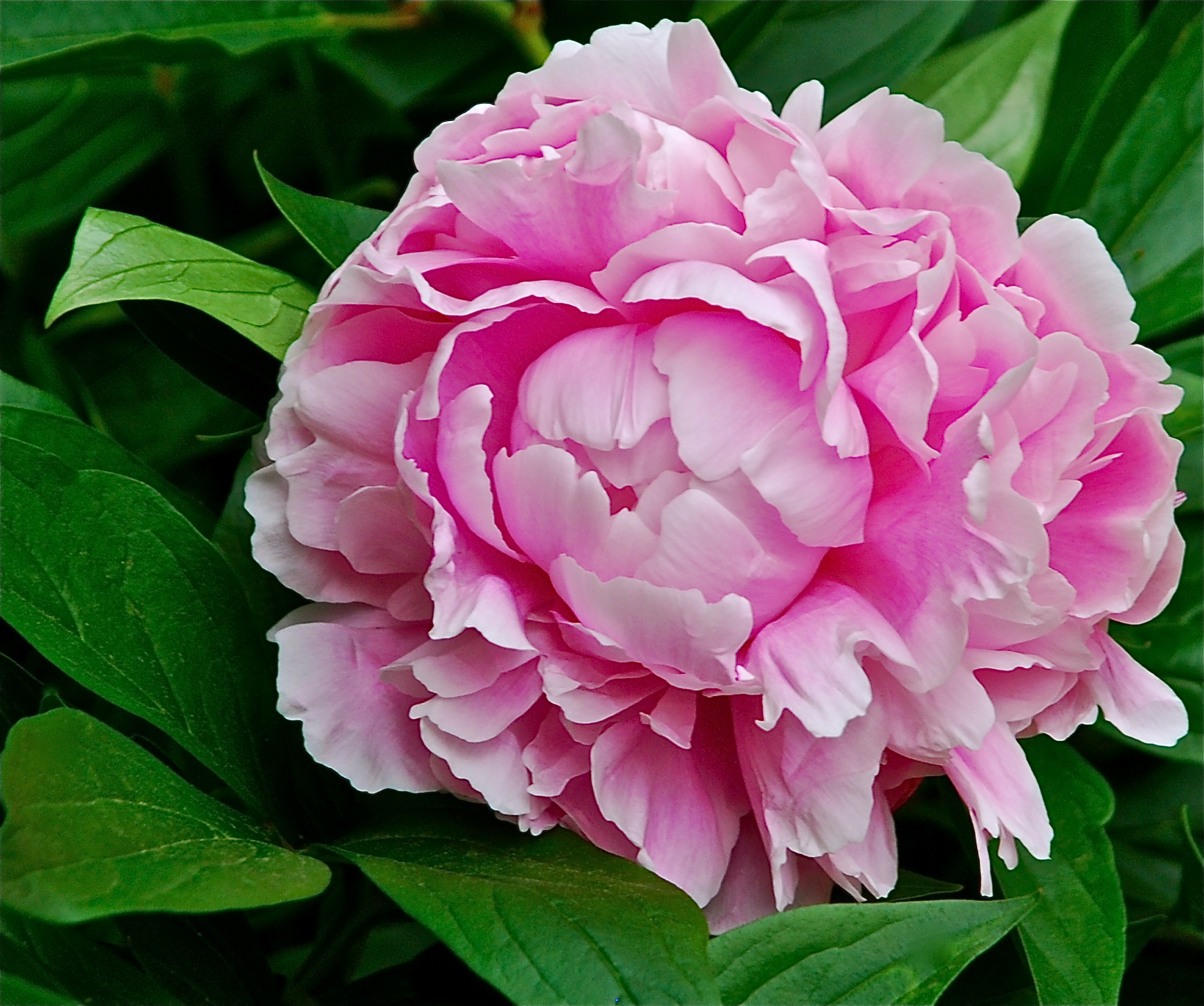
214. Angels descending, bring from above, echoes of mercy, whispers of love. ~Fanny J. Crosby

Ever felt an angel’s breath
in the gentle breeze?
A teardrop in the falling rain?
Hear a whisper among the rustle of leaves?
Or been kissed by a lone snowflake?
Nature is an angel’s favorite hiding place.
~Carrie Latet
Image

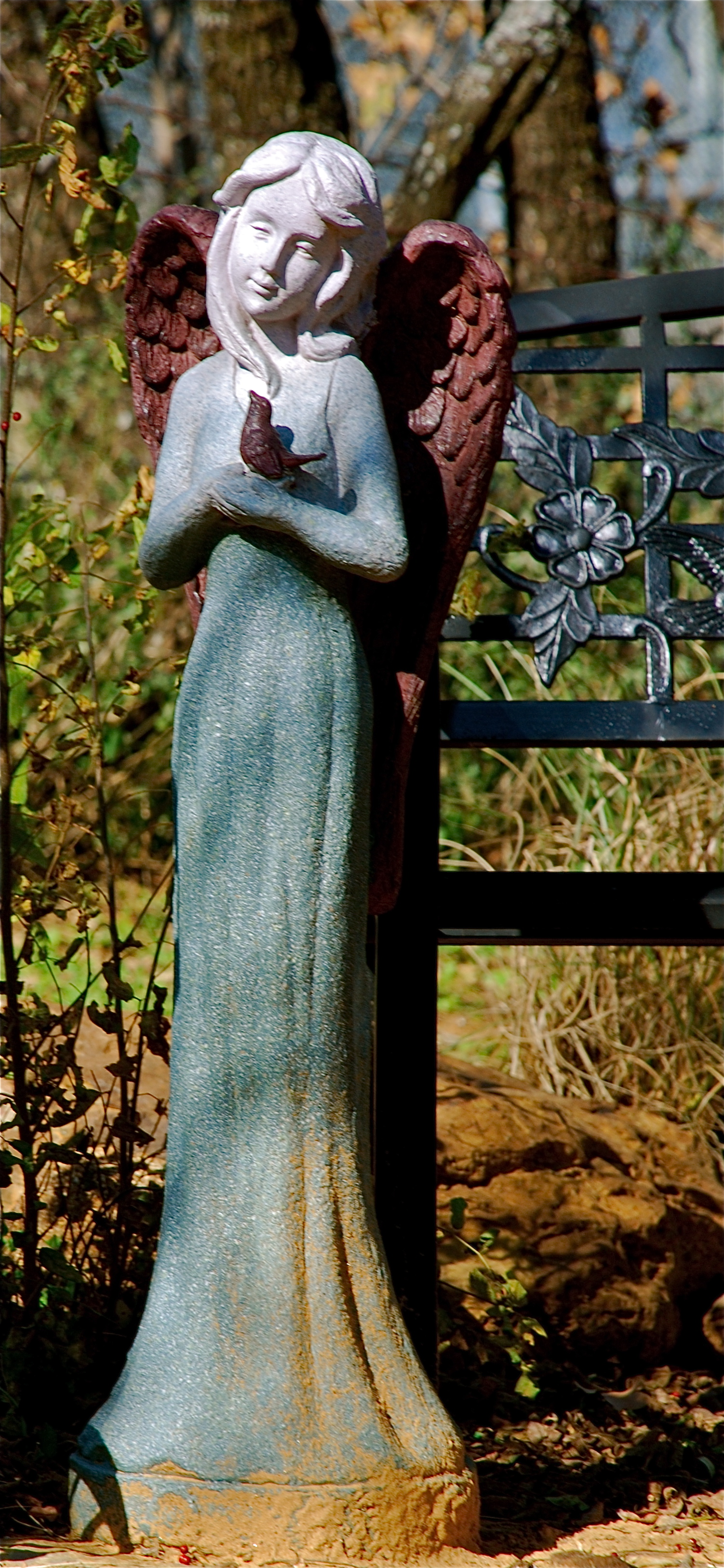
Standing amid the remains of a dying year and clothed in a dress splattered with mud this garden angel retains every bit of her vibrant elegance.  Even in the high winds of last week’s arctic storm she held her ground, waiting and watching, as quietly as the trees and dormant roses around her.  And the angel will keep on watching over this garden while my friend, inside the house, continues to busy herself attempting to heal hurting, human hearts; for you see, my friend, like an angel, is a also guardian.  She guards the secrets of her clients who entrust the painful realities of their pasts to her keeping.  Both she and her garden angel then are reminders of the Lord’s love and watchfulness over Creation and His children.  The fruits of the Holy Spirit with which my friend is gifted are what she draws upon to sustain her clients while she speaks words of wholeness in their wounded spirits.  Why is speaking the tool of her trade?  The Lord spoke the world and all that live in it into being; therefore, the spoken word in all of us who are created in His image has great power, power for good and for evil.  When any of us choose to speak loving, affirming words they fall on mortal ears like the sweet breath of an angel whispering incantations of healing benedictions.  So it is that my friend’s loving words of understanding and compassion and wisdom can be to the soul of her clients what water, in this dry and arid land, is to her garden.

Then God said, “Let us make mankind in our image, in our likeness, so that they may rule over the fish in the sea and the birds in the sky, over the livestock and all the wild animals, and over all the creatures that move along the ground.  ~Genesis 1:26  ✝

198. Autumn is the dim shadow that clusters about the sweet precious things that God created in the realm of nature. ~Northern Advocate

That soft autumnal time…
The year’s last, loveliest smile,
Thou comest to fill with hope the human heart,
And strengthen it to bear the storms a while,
Till winter days depart…

Far in a shelter’d nook
I’ve met, in these calm days, a smiling flower,
A lonely aster, trembling by a brook…
~John Howard Bryant

Image

In autumn the Maker’s pigments turn from the soft pastels of springtime to emboldened, jewel tones.  Glad witnesses are we to the green leaves on shining sumac, flowering dogwoods, Bradford pears, sweet gums, Shumard oaks, and crape myrtles changing to mixtures of burgundy, crimson, orange, and gold.  Other treats are setting buds for next year’s blossoms among the fiery red, ripening fruits of the dogwoods, and the deeper shades of blues and pinks that adorn the thickened petals of hydrangeas.  And if that is not enough to make the year smile, there are the willow leaves, among the other falling foliage, that rain down golden glory in one wave after the other like confetti from a ticker-tape parade.  In the gusting winds they litter the streets, and as cars pass by the multicolored leafage gives a festive look to curbs and lawns.  But again, that’s not all.  Roses bloom in deeper hues than before, the red fruits on the Prairifire crabapples shine forth, and sweet purple asters with their bright yellow eyes provide a closing feast for hordes of humming bees.  So smile on, lovely Autumn, and fill my heart with the hope I need to be strengthened against winter’s gathering storms.

Faithfulness spring’s forth from the earth, and righteousness looks down from heaven.  The Lord will indeed give what is good, and our land will yield its harvest.   ~Psalm 85:11-12  ✝

181. How could such sweet and wholesome hours be reckoned but with herbs and flowers. ~Andrew Marvel

Natural object themselves
even when they make no claim to beauty,
excite the feelings, and occupy the imagination.
Nature pleases, attracts, delights,
merely because it’s nature.
~Karl Wilhelm Humboldt

Image

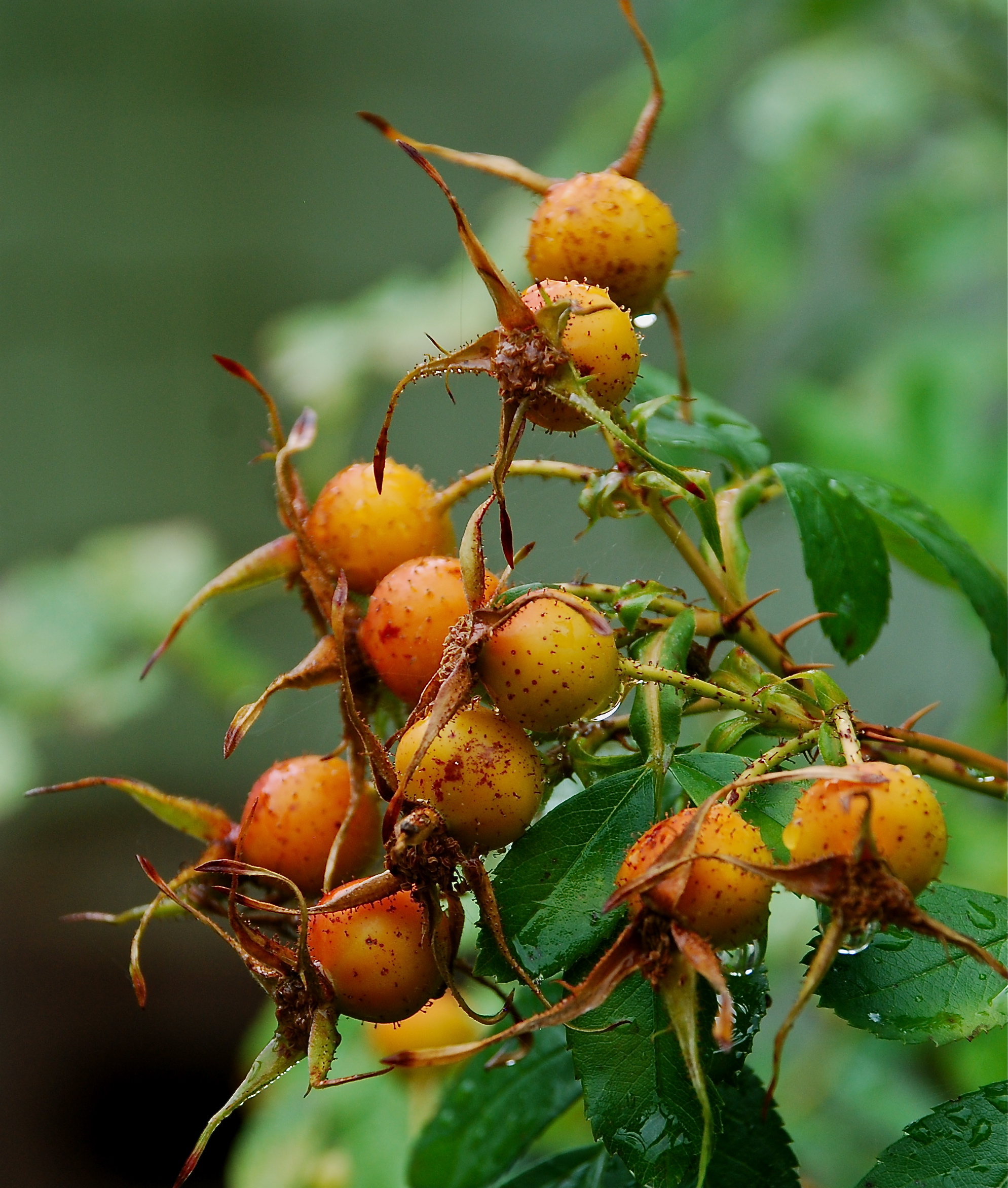
The most common attractions of the rose are the prettily colored flowers and the sweet to spicy fragrances.  On some roses there are also brightly colored hips that not only decorate bare canes in winter but also provide feasts for overwintering birds.  These hips are the pomaceous fruits of the rose, and they vary in size and shape and color.  Some of the first rosary beads were fashioned out of dried rose hips, and they have been used as well to make jellies, jam, marmalade, teas, soup, and medicinal compounds.  They also played an important role during World War II because they are very rich in Vitamin C.  It seems the people of Great Britain were encouraged to gather wild-grown rose hips to make a syrup for their children since German submarines were sinking commercial ships making it very difficult to import citrus fruits from the tropics.

Looking with expectancy for things that excite, I venture out into my gardens almost daily, weather permitting.  To that end I am seldom disappointed even on drippy days like this one.  Today’s find were some gold-orange-reddiish rose hips, and though they make no claim to great beauty, I was thrilled to see them once again.  After photographing them and beginning this post I began pondering what a difference for the better it might make if I greeted every new day’s living with the same attitude.  What an impact might it have on those around me if I met them filled with joy and expected the best from the encounter.  Once again I see how God’s Eden is not only a great sustainer but also an excellent teacher.

The seed will grow well, the vine will yield its fruit, the ground will produce crops, and the heavens will drop their dew.  ~Zechariah 8:12  ✝

178. All the flowers of all the tomorrows are in the seeds of today and yesterday. ~Chinese Proverb

In the garden the door is always open into the holy –
growth, birth, death.
Every flower holds the whole mystery in its short cycle,
and in the garden we are never far away from death,
fertilizing, good, creative death.
~May Sarton

Image

Every year the unseen becomes visible as new life explodes from quiet, dark, sustaining wombs.  Beneath the soil roots grow and above the surface tiny leaves yield proof of life.  Enlivening rains come, and the leaves grow.  Daylight hours lengthen, and they grow more.  Amid the leaves emerge buds, and they grow.  Buds burst into flowers, the flowers fade, and their petals fall.  Fruits, seed heads, or pods appear, and they ripen.  Fruits are harvested, seeds are spilled onto the soil, and buds are set inside woody canes or branches.  Then comes the time of rest, the discontinuance of the same, the different new genesis.  The beginnings, the middles, the ends–never an ending without a beginning–never a beginning without an ending, so goes the cyclic constancy of a garden.

The land produced vegetation; plants bearing seed according to its kinds and trees bearing fruit with seed in it according to their kinds.  And God saw that it was good.  ~Genesis 1:12  ✝

172. Over everything connected with autumn there lingers some golden spell–some unseen influence that penetrates the soul with its mysterious power. ~Northern Advocate

O Autumn, laden with fruit, and stain’d
With the blood of the grape, pass not, but sit
Beneath my shady roof; there thou may’st rest,
And tune they jolly voice to my fresh pipe,
And all the daughters of the year shall dance!
Sing now the lusty song of fruits and flowers.
~William Blake, English poet

Image

*Photo courtesy Mike Bizeau

Lusty indeed is the dance of the year’s 4th child!  Escalating as she goes, she regales herself in glorious colors, and whilst strutting her hour upon earth’s stage, she reigns in majesty.  As she prepares the land for its Sabbath, her chariot enters the eastern sky at dawn with pink and purple banners flying high or she comes veiled in gray from a fog or torrents of rain.  Then after day is done she exits on the western horizon in mellow twilight, or in a blaze of red and gold, or swallowed up in the wetness of massive clouds.  When not thundering “mournful melodies” for all to hear, she’s belting out songs of joyfulness until she perishes in deep December softly playing “the harps of leafless trees.”

There is pleasure in the pathless woods,
There is rapture in the lonely shore,
There is society where none intrudes,
By the deep sea, and music in its roar;
I love not man less, but Nature more,
~Lord Byron, English poet

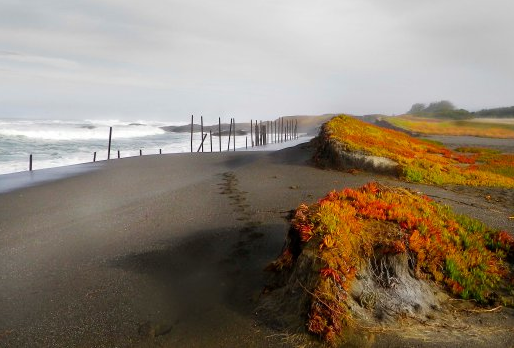
It wasn’t until Mike Bizeau posted this photo of fall-colored succulents along a beach north of Mendocino, California, that I realized lusty autumn not only sings in forests and gardens but also in places on the “lonely shore.”  What a splendid artist is the holy Yahweh!

Sing to Him, sing praise to Him; tell all of His wonderful acts.  ~1 Chronicles 16:9  ✝

166. Another fall, another turned page: there was something of jubilee in that annual autumnal beginning…. ~Wallace Stegner

The foliage had been losing its freshness through the month of August,
and here and there a yellow leaf showed itself like a first gray hair…
September dressed herself in showy dahlias and
splendid marigolds and starry zinnias.
October, the extravagant sister, ordered an immense amount of
the most gorgeous forest tapestry to make glorious her grand spectacle.
~Edited and adapted excerpt from Oliver Wendell Holmes

Image

The first leafy sign of autumn appeared on the Dogwood today, and it triggered a flood of “color” musings in my mind.  Chestnut and chocolate!  What’s not to love about a season that clears off summer’s calamities, piles delectable hues back on nature’s palette, and calls for a pot of hot chocolate?  Lemon and lime!  Grasses, flowers, fruits, berries, and even a beastie or two weave fabulous garlands in the sacred temple bound by earth and sky.  Maroon and mahogany!  Chilling winds induce chemical changes in leaves that conjure up magic shows on woody altars in earth’s forests.  Mauve and mulberry!  The leaves on maples, oaks, dogwoods, pears, persimmons, and other trees give birth to colorful, parchment-like jewels that will one day snap off, swirl in little eddies, and play like children upon the ground.  Orange and ochre!  Pumpkins made to squat on porches or bales of hay tickle the fancy of mortal tongues anxiously awaiting fall feasts and winter banquets.  Red and russet!  Roses, asters, and Maximilian sunflowers invoke a breath of spring not stifled by summer’s heat to keep the year’s last child in colorful array.  Sable and sapphire!  Skies often shrouded by gauzy, gray clouds are swept clear by northerly winds as cold fronts advance.  On such days a spectacular brilliance can be seen on the brows of morn followed by daylight hours drenched in deep, dreamy shades of blue.  Sterling and pewter!  Plumed grasses shift and sigh in authorship of haunting, autumnal hymns.  Ah, how lovely are the many colors of autumn and the Holy One who made them!

As long as earth endures, seedtime and harvest (spring and autumn), cold and heat, summer and winter, day and night will never cease.  ~Genesis 8:22  ✝

144. In the right light, at the right time, everything is extraordinary. ~Aaron Rose

For me, a landscape does not exist in its own right,
since its appearance changes at every moment;
but the surrounding atmosphere brings it to life – the
light and the air which vary continually.
For me, it is only the surrounding atmosphere
which gives subjects their true value.
~Claude Monet

Image

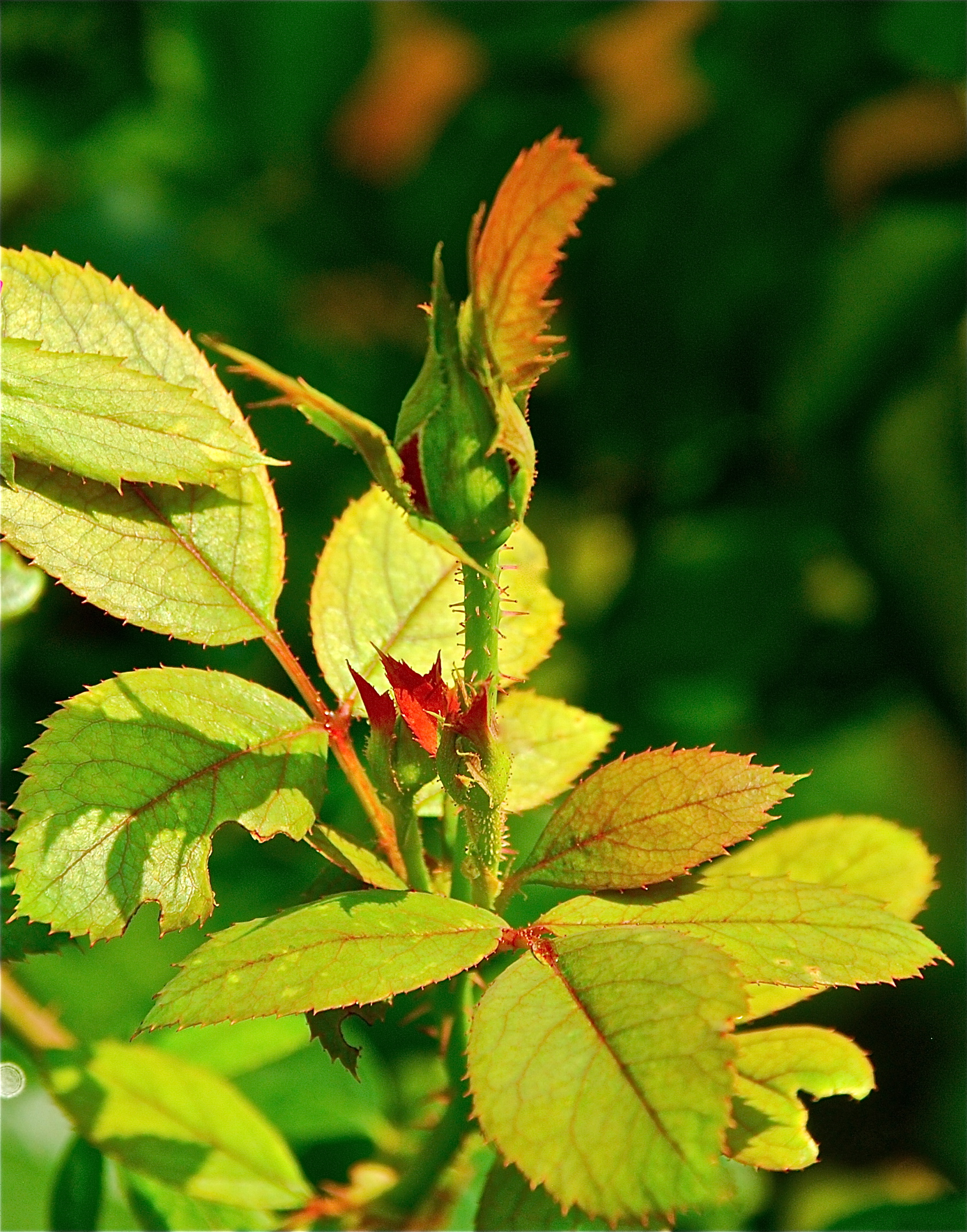
Living in a garden day after day, being a participant in all its events, witnessing the changes from season to season, and watching the way differing light falls on the landscape make gardening a thrilling experience.  The fact that colors in the garden change off and on during the course of a day fascinates me.  In morning light the hues are vivid and bright, but as daylight mellows into twilight, they melt into quieter, more subdued tones.  Light even affects the fragrance of things for it is only in the cooler moments of early morn and twilight that the strongest aromas are dispelled from herbs and flowers.  But then things are not just affected by changes in lighting.  Sometimes colors change as flowers and leaves age, when temperatures rise or fall, when changes occur in the content of the soil, or when rainfall is lacking or in abundance.  That’s why without looking at a calendar, I can tell that the rose bud in the photo is one born of recent rainfall and the passing of the autumnal equinox.  The constancy of this inconstancy defines the soul of a garden, and, like all else in nature, speaks to me of rhythmical and purposeful ordination.

Awake, north wind, and come, south wind!  Blow on my garden that its presence may spread everywhere.  Let my beloved come into his garden and taste its choice fruits.  ~Song of Songs 4:16   ✝

136. The bee is more honored than other animals, not because she labors, but because she labors for others. ~Saint John Chrysostom

His Labor is a Chant–
his idleness–a Tune–
oh, for a Bee’s experience
of Clovers, and of Noon!
~Emily Dickinson

Image

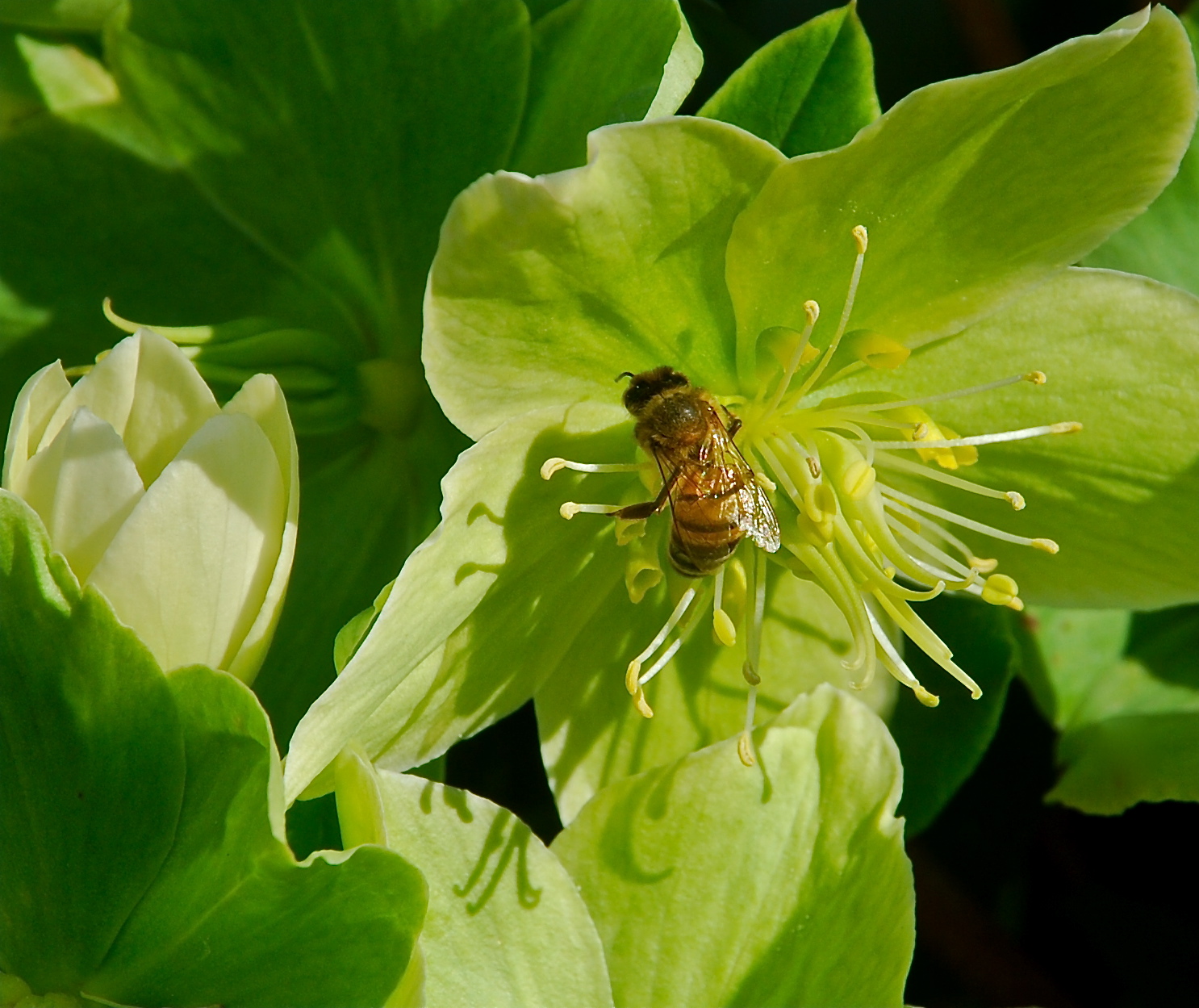
Honey bees and bumblebees, it seems, find a flower’s countenance as irresistible as I, and that “irresistibility” is of holy intent.  In the passage of Scripture that follows, we see that the Lord’s plan involved an interconnectedness of all life as well as a dependency, one on the other.  The poet, Kahlil Gibran, explains that connectedness in this way: “a flower is a fountain of life” for the bee, and to the bee and flower “the giving and receiving is a need and an ecstasy.”  But wait, how is any of this relevant in the 21st century?  In the age of incredible and still advancing technology should anyone care about flowers and bees?  Indeed all of us should care because bees are absolutely essential pollinators, and sadly there are now alarming reports which indicate that one fourth of the northern hemisphere’s honeybee population mysteriously vanished by the spring of 2007.  Then by the end of 2008, one in three hives was left lifeless.  Simply put, the honeybee is disappearing at an alarming rate across the entire globe.  The worst part is that those in the know are not sure why this is happening, but they do know that should the increasing catastrophe not be addressed and solutions to the problem not found, the complete loss of honeybees as pollinators would mean the end of agriculture as we know it.  Since much of what we wear and one third of what we eat depends on the pollinating activity of honeybees, our way of life and civilization would be threatened.  In fact one report said the situation is so dire that mankind would survive only 4 years after the complete collapse of the honeybee population.

Then God said, “I give you every seed-bearing plant on the face of the whole earth and every tree that has fruit with seed in it. They will be yours for food.  And to all the beasts of the earth and all the birds of the air and all the creatures that move on the ground—everything that has the breath of life in it—I give every green plant for food.”  And it was so.  ~Genesis 1:29-30   ✝

76. Through the dancing poppies stole a breeze most softly lulling to my soul. ~John Keats

Of all the wonderful things in the wonderful universe of God,
nothing seems to me more surprising than the planting of a seed
in the blank earth and the result thereof.
Take the Poppy seed, for instance: it lies in your palm,
the merest atom of matter, hardly visible, a speck, a pin’s point in bulk,
but within it is imprisoned a spirit of beauty ineffable,
which will break its bonds and emerge from the dark ground
and blossom in a splendor so dazzling as to baffle all powers of description.
~Celia Thaxter

Image

I love poppies, not just the flowers but also the lovely, fat pods that contain the future of the species.  The plants that put on silky, paper-thin blossoms can grow to be 3 or 4 feet tall here if the “hardly visible” seeds are sown in the fall.  So it is that in late October I toss out seeds from the ones I harvested from last’s years pods, and then all winter long I wait for the beauties which “baffle description” to make their appearance in my garden.  As winter moves along, I keep myself reassured by going out to check on them after especially frigid days or after occasional snowfalls to make sure the burgeoning “babies” have not succumbed to the elements.  And each time I go out, I almost squeal with delight when I discover that most of them, if not all, are still slowly but surely growing bigger and stronger.  Then sometime in the early spring the day comes when the waiting is over and standing before me are the first fruits of my labors and watchfulness.  Like dainty chalices, the cup-like flowers open up and drink in the day’s light while penning God’s autograph on the “scenes” of yet another springtime.  Day by day after each individual flower’s petals fall to the ground, the intriguing seed pods take their place, and as temperatures climb, they begin to ripen.  Some of these I eventually let fall to the ground to self sow; the remainder I gather and keep safe and dry until autumn comes and it is again time for me to partner with Creation and scatter abroad the “merest atoms” of such beautiful matter.

For as the soil makes the sprout come up and a garden causes seeds to grow, so the Sovereign Lord will make righteousness and praise spring up before all nations.  ~Isaiah 61:11

60. That God once loved a garden we learn in Holy writ. And seeing gardens in the Spring I well can credit it. ~Winifred Mary Letts

With the birth of the creatures there is
the emergence of seeing, hearing,
smelling, tasting, and touching.
The light of the sun and the whiteness
of the moon can now be seen.
The wind blowing through the leaves
of the trees and the crashing
of ocean waves can be heard.
The early morning fragrance of
the earth can be smelled.
Its fruits can be tasted and
its textures touched.
~Excerpted lines by J. Philip Newell

Image

Springtime is so much “a showing forth of the mystery of God” that if one wants to know more of the Creator, all he/she needs do is pull up a chair in a garden and watch the year’s first season unfold.  Seeking the goodness of God and what He made by being still therein and listening to the Holy Spirit as well as Creation’s rhythms is a way of bringing the Heavenly Father closer.  In that nearness one is then able to look through eyes that recognize the depth of His and Creation’s  goodness.

And the LORD said, “I will cause all my goodness to pass in front of you, and I will proclaim my name, the LORD, in your presence. I will have mercy on whom I will have mercy, and I will have compassion on whom I will have compassion.  ~Exodus 33:19   ✝