176. For the mind disturbed, the still beauty of dawn is nature’s finest balm. ~Edwin Way Teale

Slow buds the pink dawn like a rose
from out night’s gray and cloudy sheath;
softly and still it grows and grows,
petal by petal, leaf by leaf.
~Susan Coolidge

Image

Tired of tossing and turning, I got up out of bed and went in to rock in my favorite chair.  Not wanting to miss the “slow budding” of dawn’s light, however, I first raised the bamboo shade in front of the glass, patio-doors.  After a short wait a faint pinkish glow appeared low on the horizon in the eastward sky, and as the sun inched up and up and up, a ray of golden light poured through an opening centered in the heart of a tall tree framed against it just above a neighboring housetop.  The branches of the tree then took on a hallowed appearance so much so that a bird atop the roof and two squirrels sitting very still in nearby branches looked like parishioners in pews awaiting the high priest.  Later, as the sun climbed high enough for night’s curtain to be lifted completely off earth’s stage, it was apparent that all who’d seen this amazing “salutation of the dawn” were summoned to make ready for the new day.  The first to respond was a flock of birds darting willy nilly across the pastel blue sky in search of food, but beneath them as more and more drops of light appeared like jewels aloft in the bamboo I knew that despite a restless night the time for me to rise had come as well.

If I rise on the wings of dawn, if I settle on the far side of the sea, even there Your hand will guide me, Your right hand will hold me fast.  ~Psalm 139:9-10  ✝
174. The greatness of a nation and its moral progress can be judged by the way its animals are treated. ~Mahatma Ghandi

If all the beasts were gone,
men would die from a great loneliness of spirit,
for whatever happens to the beasts
also happens to the man.
All things are connected.
Whatever befalls the Earth befalls the sons of Earth.
~Chief Seattle of the Suquamish Tribe

Image

The creatures of earth, sea and sky came forth “out of the waters of God’s life.”   And their arrival was yet another manifestation of the visible from the invisible–another disclosure of the mystery of God.  In addition, “with the birth of the creatures there is the emergence of seeing, hearing, smelling, tasting, and touching.  The light of the sun and the whiteness of the moon can now be seen.  The wind blowing through the leaves of trees and the crashing of ocean waves can be heard.  The early morning fragrance of the earth can be smelled.  Its fruit can be tasted, and its textures touched,” writes J. Philip Newell.  It has even been said that if one wants to know the Creator, one of the ways to gain insight is to know His creatures, and I think that’s especially true when it comes to examining the sensory aspect of their coming.  For does not the ability to see, that the creatures brought, teach mankind to see with the eyes of the heart?  In the silences of humanity’s reality does not the ability to hear teach men to listen for the “echo of the spheres” and the still, small voice of God?  Do not the abilities to smell, taste, and touch help mortals meet their Savior, Jesus, through the holy sacrament of the Eucharist (Communion)?

And to all the beasts of the earth and all the birds in the sky and all the creatures that move along the ground–everything that has the breath of life in it–I give every green plant for food.”  And it was so.  ~Genesis 1:30

172. Over everything connected with autumn there lingers some golden spell–some unseen influence that penetrates the soul with its mysterious power. ~Northern Advocate

O Autumn, laden with fruit, and stain’d
With the blood of the grape, pass not, but sit
Beneath my shady roof; there thou may’st rest,
And tune they jolly voice to my fresh pipe,
And all the daughters of the year shall dance!
Sing now the lusty song of fruits and flowers.
~William Blake, English poet

Image

*Photo courtesy Mike Bizeau

Lusty indeed is the dance of the year’s 4th child!  Escalating as she goes, she regales herself in glorious colors, and whilst strutting her hour upon earth’s stage, she reigns in majesty.  As she prepares the land for its Sabbath, her chariot enters the eastern sky at dawn with pink and purple banners flying high or she comes veiled in gray from a fog or torrents of rain.  Then after day is done she exits on the western horizon in mellow twilight, or in a blaze of red and gold, or swallowed up in the wetness of massive clouds.  When not thundering “mournful melodies” for all to hear, she’s belting out songs of joyfulness until she perishes in deep December softly playing “the harps of leafless trees.”

There is pleasure in the pathless woods,
There is rapture in the lonely shore,
There is society where none intrudes,
By the deep sea, and music in its roar;
I love not man less, but Nature more,
~Lord Byron, English poet

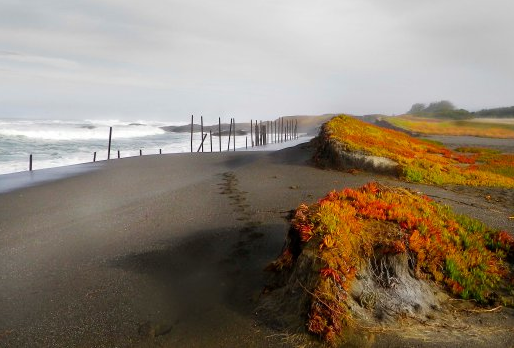
It wasn’t until Mike Bizeau posted this photo of fall-colored succulents along a beach north of Mendocino, California, that I realized lusty autumn not only sings in forests and gardens but also in places on the “lonely shore.”  What a splendid artist is the holy Yahweh!

Sing to Him, sing praise to Him; tell all of His wonderful acts.  ~1 Chronicles 16:9  ✝

161. The glory of gardening: hands in the dirt, head in the sun, heart with nature. ~Alfred Austin

So deeply is the gardener’s instinct implanted in my soul
that I really love the tools with which I work –
the iron fork, the spade, the hoe, the rake, the trowel,
and the watering pots are pleasant objects in my eyes.
~Celia Thaxter

Image

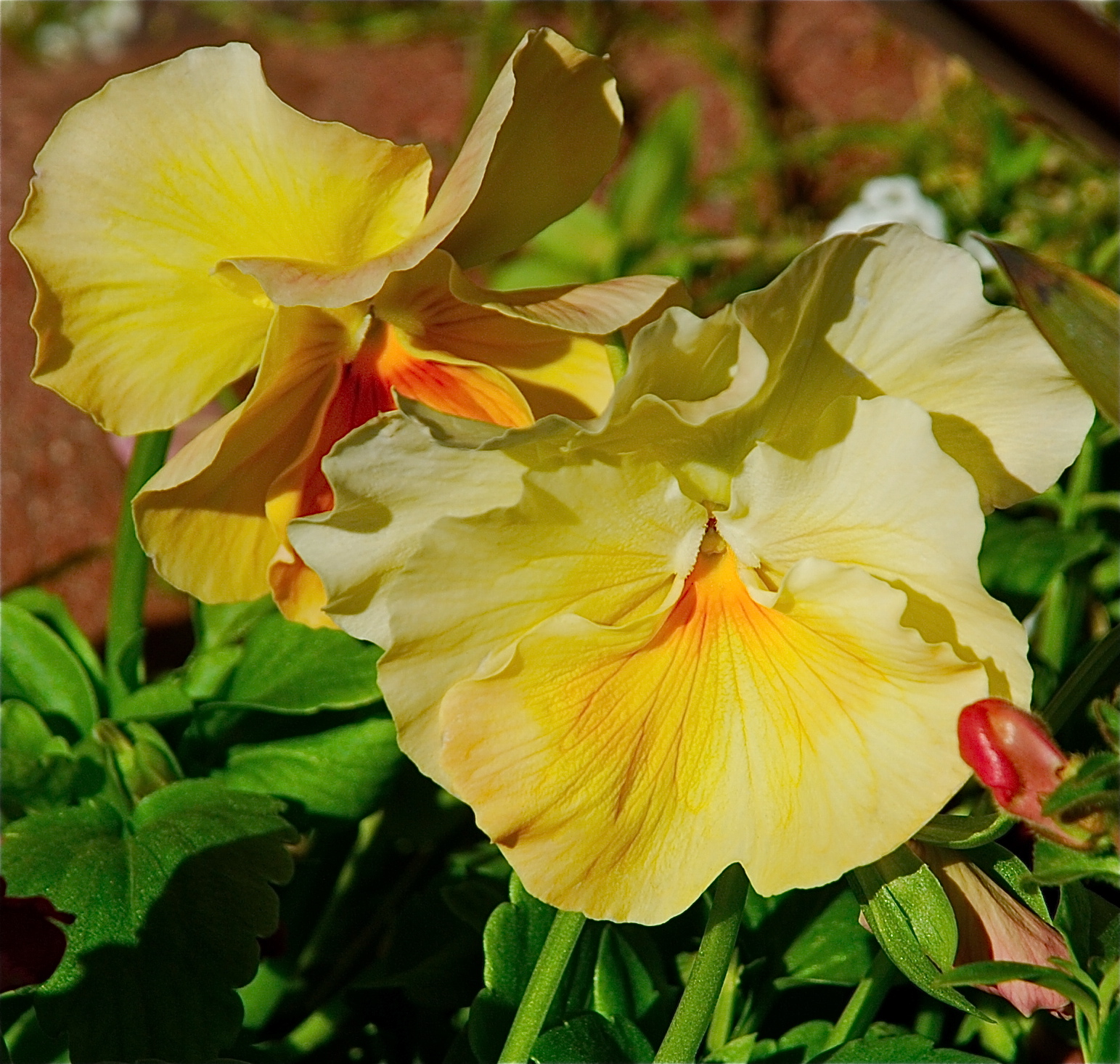
The sidewalks were long and narrow that ran between the stucco houses, and high was the exterior wall of the two-story duplex two doors down from us on the seaward end of the block.  At the base of that duplex’s stucco wall was a shallow flower bed filled with pansies and strawberries, and about halfway down the wall was a door that separated the flower bed into two sections.  Behind the door was a storage area, a closet of sorts, and because the closet was under the front stairwell of the two story structure, it was one of those odd-shaped little niches with a downward sloping ceiling on one end.  In the closet’s mysterious, deeper recesses were all kinds of fascinating tools.  When the door to the closet was ajar, it meant Uncle was inside sitting on his stool, working on a yard or household project Auntie had commissioned.  The “doghouse” as he called it, was a rich and irresistible den of curiosities for a child, and in it with Uncle as tutor-in-residence I not only learned a great deal but also fell in love with a myriad of things.  The closet with its earthy smells and assorted contraptions was a magical place, and the gardening tools were as provocative a sight for young eyes as the images of the storybook gardens they conjured up.  Decades later when a friend commented that I live close to nature, I thought of that closet again and realized the lasting impression that it and Uncle had had on my life.  Then and there in a place that smelled of soil and sea I came to love and respect the earth for its charming and sometimes “shy presences”–the visible ones, the audible ones, the tangible ones, even the ones that dwell in dim obscurity.  Uncle’s closet and his tales gave birth to “stirrings” in me that ultimately led me to believe that all Creation is a holy gift to be cherished and that its Maker is to be adored and praised.

The LORD is my strength and my song; He has become my salvation.  He is my God, and I will praise Him and I will exalt Him.  ~Exodus 15:2   ✝

Image

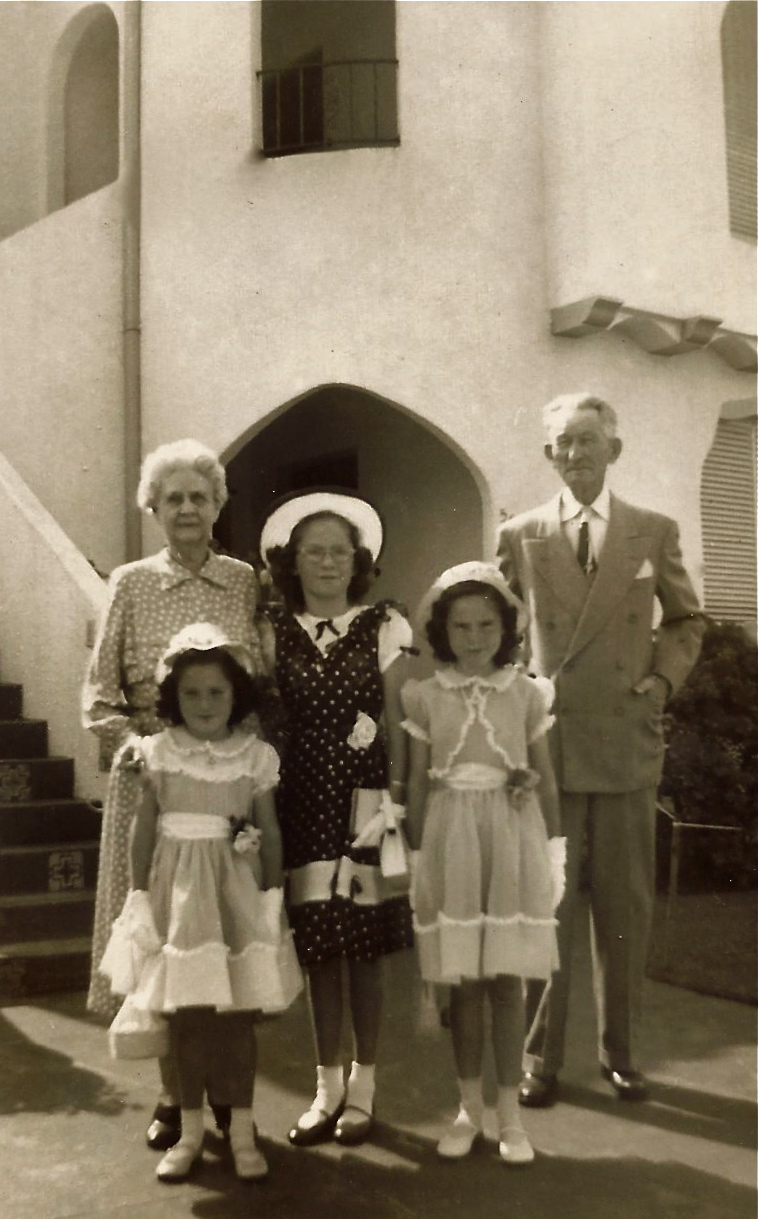
This is the duplex I’ve written about above, and in front of it are Auntie and Uncle as well as me and my two sisters, circa 1952.  We were dressed up for Easter Sunday in clothes made, starched, and ironed by our mother’s loving hands.  Since our grandparents lived in Texas and Illinois,  Aunt Stella and Uncle Walter were for all intents and purposes our “surrogate” grandparents.  (Uncle was actually the brother of my maternal grandfather.)

147. If you wish to know the Creator, come to know His creatures. ~Columbanus, 6th century Irish monk

A flash of harmless lightning,
A mist of rainbow dyes,
The burnished sunbeams brightening
From flower to flower he flies.
~John Banister Tabb, Roman Catholic priest,
poet and professor of English

Image

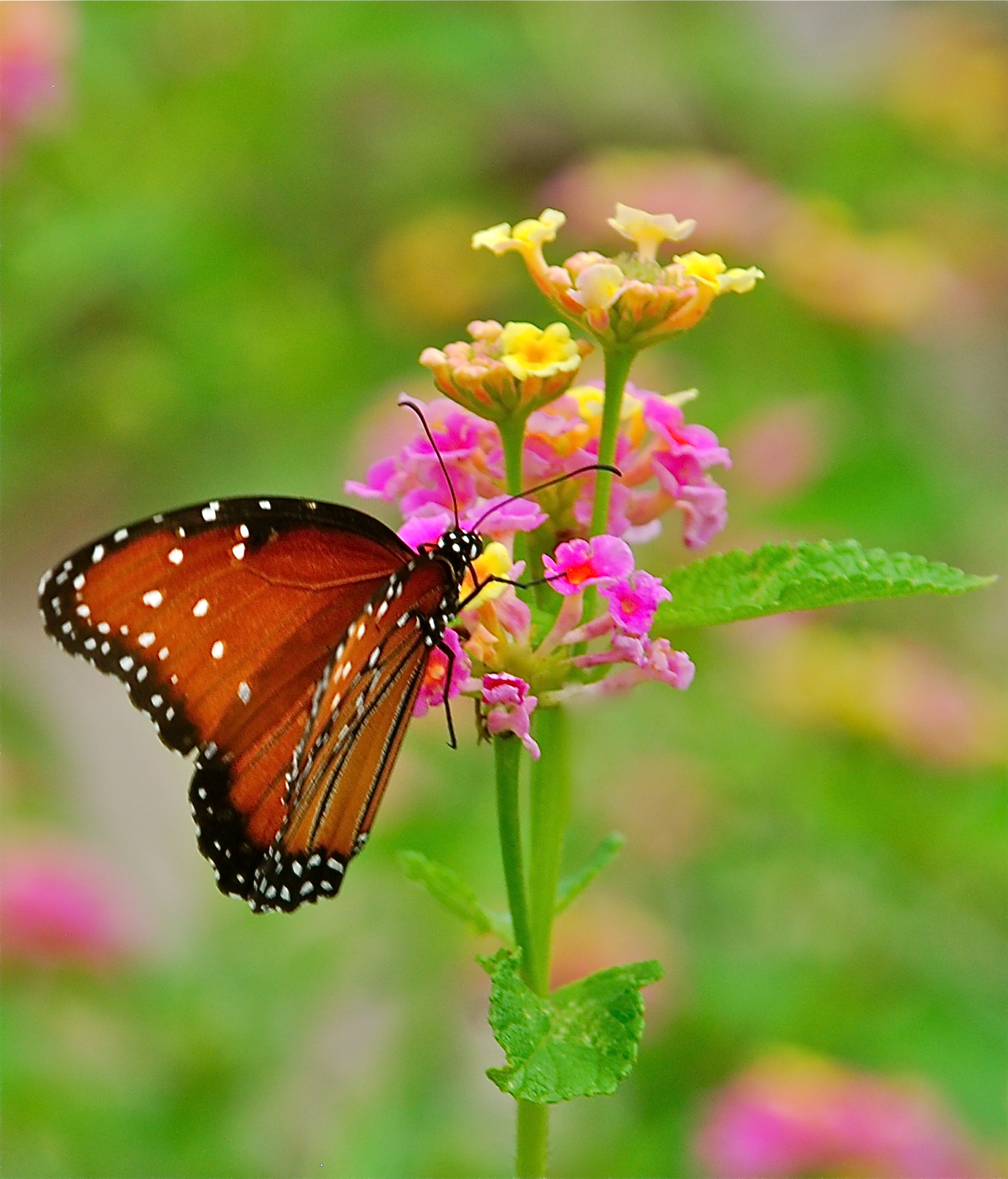
Tabb’s description is of a hummingbird, but it could be said as well of bees, butterflies, and dragonflies, hordes of which I’ve seen of late.   Gulf fritillaries and an assortment of swallowtails have been flitting around the garden for weeks.  Then today I spotted the first monarchs which means their migration from Canada to overwintering grounds in Mexico has begun.  I’m guessing the reappearance of the dragonflies is because recent rains have filled their breeding grounds again with enough water for their nymphs.  The bees are back in greater numbers because the cooler temperatures are encouraging more and more blooms, and as for the hummers, two or three at a time have been coming to our feeder since early August.

John Philip Newell says, “the inclusion of creatures in the garden of God in Genesis is pointing not simply to the outward dimension of the creaturely realm.  It is also showing something of the way of God’s seeing or sensing. . .”  That’s why I I love my garden.  It’s not just about the flowers.  Spending time therein lets me be near all God created and keeps me wanting to know more of the Lord and that which is important to Him.

“But ask the animals, and they will teach you, or the birds of the sky, and they will tell you; or speak to the earth, and it will teach you, or let the fish of the sea inform you. . .”  ~Job 12:7-8  ✝

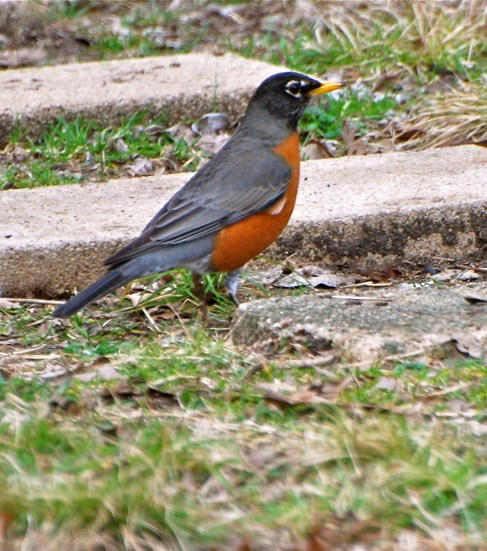
46. A Robin Redbreast in a cage puts all Heaven in a rage. ~William Blake, English poet, painter and printmaker

When father takes his spade to dig
then Robin comes along;
And sits upon a little twig
And sings a little song.
~Laurence Alma-Tadema

Image

The introductory line is from Blake’s “Auguries of Innocence,” a somewhat lengthy poem consisting of a series of paradoxes in which Blake juxtaposes innocence with evil and corruption. The word augury in the title means omen or token, and the robin is the poem’s first noted “augury of innocence.”  The robin’s song, personality, and countenance are such that it’s obvious why the poet saw the act of putting one in a cage as not only an enraging violation but also as a profound perversion of holiness.  The sweet song and colorful markings of a robin make the bird a delightful harbinger of spring’s infancy and innocence.  Looking forward to its coming is one of my favorite rites in spring’s passage, and like “all heaven” I’d be incensed if the bird’s freedom were taken away and its song silenced.  Below is a legend about the robin that again ties the bird to the blameless and sacred.  Although the truthfulness of legends is questionable, I’m fascinated that somehow, somewhere, and in some way the robin was connected to the Messiah.

The Legend of the First Robin

One day, long ago, a little bird in Jerusalem saw a large crowd gathered around a man carrying a heavy wooden cross.  On the man’s head was a crown made from a thorn branch.  The thorns were long and sharp.  The little bird saw that the thorns were hurting the man.  It wanted to help Him, so it flew down and took the longest, sharpest thorn in its tiny beak.  The bird tugged and pulled until the thorn snapped from the branch.  Then a strange thing happened.  A drop of blood fell onto the bird’s breast, staining it bright red.  The stain never went away.  And so today the robin proudly wears a red-breast, because it helped a man named Jesus.  

“But ask the animals, and they will teach you, or the birds of the air, and they will tell you; or speak to the earth, and it will teach you, or let the fish of the sea inform you.  Which of all these does not know that the hand of the LORD has done this?  In His hand is the life of every creature and the breath of all mankind. . .”  ~Job 12:7-10   ✝