267. God waits to win back His own flowers as gifts from man’s hands. ~Rabindranath Tagore

Flowers don’t worry about how they are going to bloom.
They just open up and turn toward the light
and that makes them beautiful.
~Jim Carrey

Image

Small children pick flowers for their mamas, men bring flowers to women they love, flowers are thrown on a stage after a stellar performance, a bride carries flowers down the aisle at her wedding, returning warriors were once showered with flower petals, a coffin may be surrounded by flowers at a funeral, and on and on go the roles that flowers play in our lives.  We adore them and deem them worthy tokens of admiration, love, respect, and honor.

I’ve tended the soil and planted flowers for my own enjoyment and because I feel close to God in my garden, but until I read what Tagore said, I’d never thought about it as being a way to give gifts to God.  I’ve known that how we live and what we do with our lives is to be an offering to the Lord and done for His glory, and now the thought of presenting Him with my posies as gifts adds an even greater level of joy to my labors in the garden.  Although the time has not yet come for a miraculous flower like the one in the photo to bloom, I offer up this one from last year’s bounty as a thank offering to the Holy One for the coming of another spring and for His continual presence in my life and for all the ways He blesses me.  I chose this Star Magnolia because it lights up whatever darkness surrounds it in the same way the stars light the heavens and Jesus lights the darkness around us.

And let the peace of Christ rule in your hearts, to which indeed you were called in one body.  And be thankful.  ~Colossians 3:15  ✝

**Over the past 10 years, a plethora of research has shown that flowers increase the levels of positive energy and moods, reduce the likelihood of stress-related depression, and help people feel secure, relaxed, optimistic, and happy.

225. Stripes that are red like the blood shed for me. ~Author Unknown

There’s a song in the air!
There’s a star in the sky!
~Joseph G. Holland

Image

The strongest connection one might make between the origins of the candy cane and any intentional Christian association is to guess that possibly some unknown person, at some indefinite time, took a long-existing form of sweet (i.e., straight white sticks of sugar candy) that was already associated with Christmas and produced bent versions of it to represent a shepherd’s crook and/or make it easier to hang on Christmas trees, but even that general association is nothing more than mere supposition with no supporting evidence behind it.  This is charming folklore, but one should not lose sight of the fact that such stories of the candy cane’s origins are, like Santa Claus, myths and not “true stories.”

There is one verifiable (albeit indirect) religious connection associated with the modern candy cane, however.

In 1919 Bob McCormack began making candy canes for local use and sales in Albany, Georgia, and by the middle of the century his company (originally the Famous Candy Company, then the Mills-McCormack Candy Company, and later Bob’s Candies) had become one of the world’s leading candy cane producers. But candy cane manufacturing initially required a fair bit of labor that limited production quantities (the canes had to be bent manually as they came off the assembly line in order to create their ‘J’ shape,) and it was McCormack’s brother-in-law, a Catholic priest named Gregory Harding Keller, who came up with the solution: Father Keller invented the Keller Machine that automated the process of shaping straight candy sticks into candy canes.   ~Barbara Mikkelson

The woman said to him, “I know Messiah is coming” (who is called Christ).  “When he comes, he will proclaim all things to us.”  ~John 4:25  ✝

14. In every man’s heart there is a secret nerve that answers to the vibrations of beauty. ~Christopher Morley

A man should hear a little music,
read a little poetry, and
see a fine picture every day of his life,
in order that worldly cares
may not obliterate the sense of the
beautiful implanted in the human soul.
~Johann Wolfgang Goethe

Image

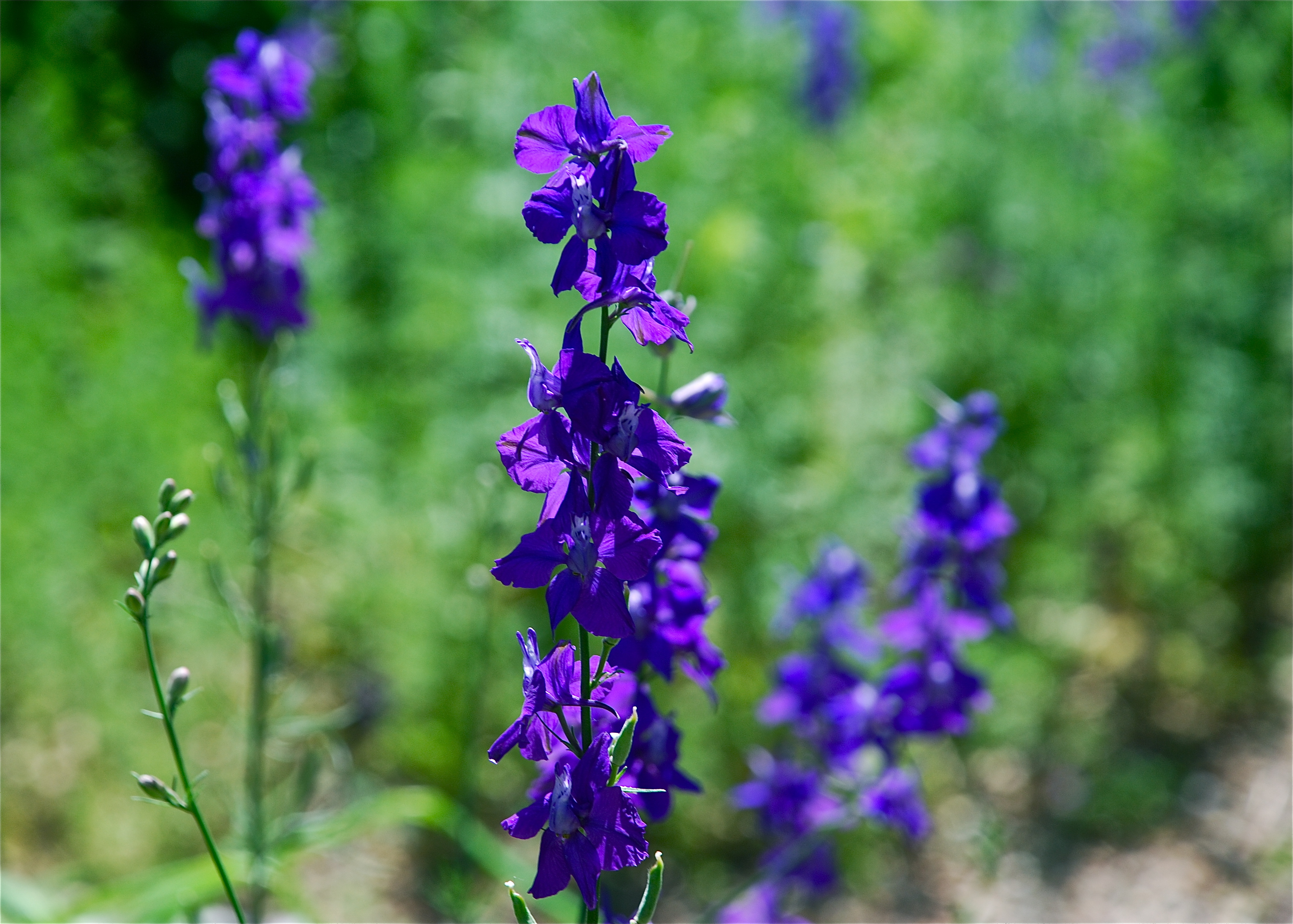
In her novel, THE COLOR PURPLE, Alice Walker says she thinks God gets angry if a person walks by the color purple and doesn’t notice it.  At one point in her story the main character, Celie is told to look at the purple flowers and to embrace their beauty in spite of all the pain and suffering in her world.  She is urged to see the good in them because it was God who placed them on earth.  As she comes to this realization for herself, she begins to understands the magnitude of God’s grace, and like the purple flowers, blossoms as she gains a respect for God and life.

It’s obvious that God puts a premium on beauty, not only for His own sake but also for ours.  Since we are made in His image, our souls cannot help but be implanted by a “sense of the beautiful” as Goethe suggests.  As a highway sign points us in the right direction, in the same way loveliness points to God’s heavenly realm and His goodness.   If we can find beauty, then we can find God. Beauty is meant to feed us spiritually, and the Lord uses what’s beautiful to speak to our hearts for His divine purposes.  For example notice all the richness and beauty involved in the scriptural telling of the birth of the Christ child.  It starts with a beautiful star that leads the way to a manger.  For Celie her beautiful flowers led her to God’s grace, and the Christ child brings all who follow the star and Him the same gift of redeeming grace.

11. The moment one gives close attention to anything,
even a blade of grass, it becomes a mysterious, awesome,
indescribably magnificent world in itself. ~Henry Miller

Each blade of grass has its spot on earth whence it draws its life,
its strength; and so man is rooted to the land
from which he draws his faith together with his life.
~Joseph Conrad

DSC_0026

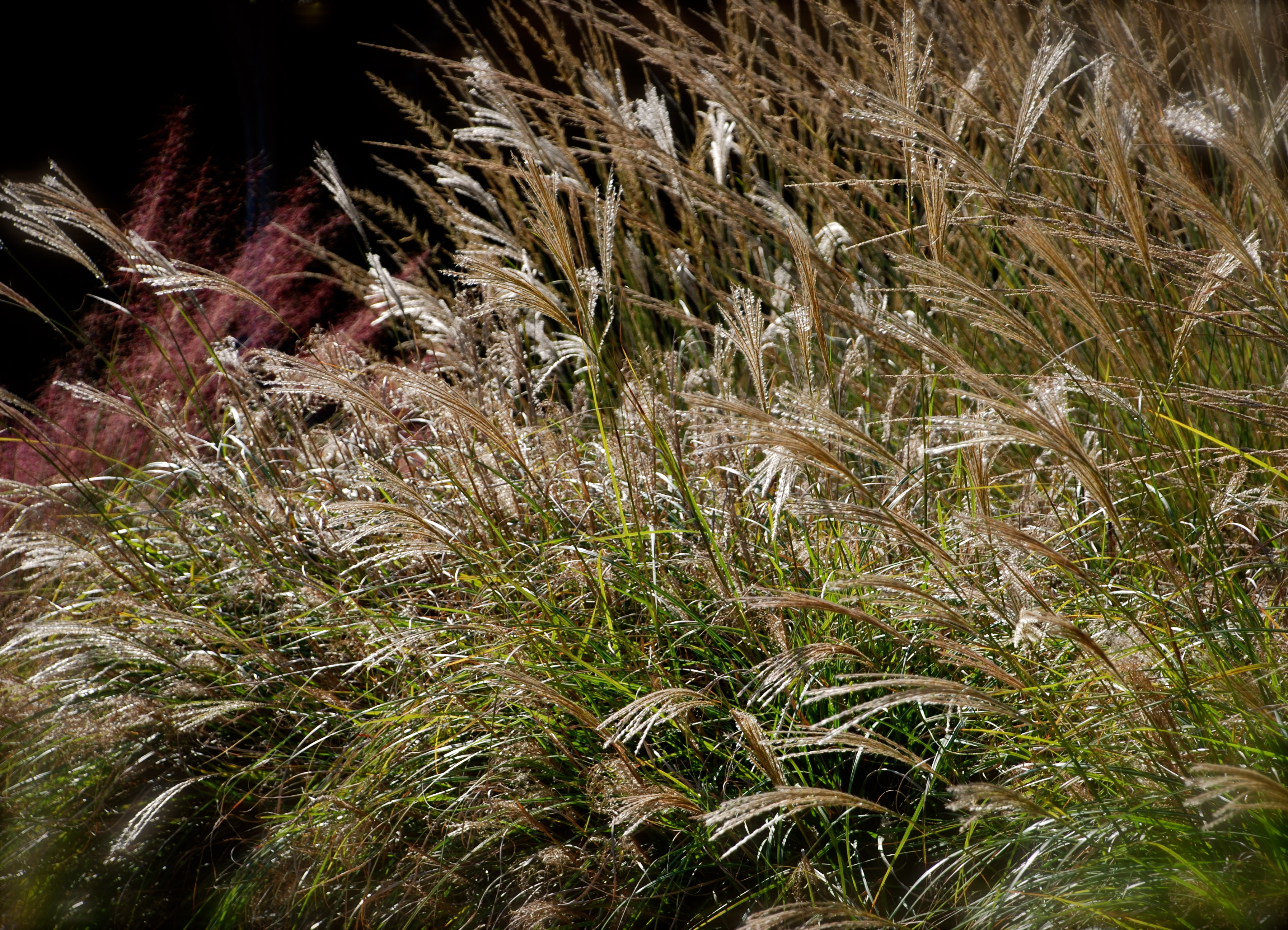
Against the backdrop of autumn’s falling leaves ornamental grasses shift and sigh adding an ethereal element to the landscape.  With airy flower panicles, fluffy seed plumes, and striking seed heads ornamental grasses provide charming “fringe accents” in yards and gardens. Even after the onslaughts of freezing temperatures, grasses continue to grace the landscape with beauty.  They add subtle colors, assorted textures, and the dimensions of motion and sound.  Throughout winter’s “vale of grief,” they capture and play with whatever light is available and in so doing speak of life and give us something “that glimmers in the sleep of things.” The “music” of their swishing and swaying reminds us that what’s happening isn’t an ending but merely a transition for the next beginning.

In a poetic conversation with the Lord, Edna St. Vincent Millay said, “God, I can push the grass apart and lay my finger on Thy heart.”  A Quaker and itinerant preacher named Elias Hicks wrote that “the fullness of the godhead dwelt in every blade of grass.”  And Thomas Carlyle, a Scottish writer, asked, “To us also, through every star, through every blade of grass, is not God made visible if we will open our minds and our eyes.”  These writers, like me, realize that man was meant to be “rooted to the land and therefore to God.”  But, the “umbilical cord” that connects all humanity to Creation and God seems, for many, to have been severed.

The Lord, however, refuses to remain separated or removed from that which He has made.  In an effort to reconnect people to the land and to provide healthier food, many neighborhoods are finding places to build community gardens.  More and more people are getting involved in caring for the land in these communal plots.  Also many schools across the nation are incorporating habitat gardens into the learning experiences of their students, and we are seeing a rise in “hobby farms” where retired professionals have started a second career as a hobby farmer or others who are still working are spending their spare time on their own small farm.

You care for the land and water it; You enrich it abundantly.  The streams of God are filled with water to provide the people with grain, for so You have ordained it.   You drench its furrows and level its ridges; You soften it with showers and bless its crops. You crown the year with Your bounty, and Your carts overflow with abundance.  The grasslands of the wilderness overflow; the hills are clothed with gladness.  The meadows are covered with flocks and the valleys are mantled with grain; they shout for joy and sing.  ~Psalm 65:9-13   ✝