290. Wisdom is ofttimes nearer when we stoop than when we soar. ~William Wordsworth

We watched a very disturbing movie on television last night, and it left me grappling again with how one person can possibly make a difference in a world fraught with so much depravity and strife.  Then the Lord helped me remember this lovely story, and His peace settled in my spirit.  I believe the girl in this parable was dancing with joy to the day as she blessed helpless others and accomplished one little miracle at a time.   One day at a time, one step at a time, one blessing at time is enough to make a huge difference if we “stoop” to serve up love in the lives of those God places on the paths of our individual journeys.  “We can do no great things – only small things with great love.”  ~Mother Teresa

Image

A Parable

Once upon a time, there was a wise man who used to go to the ocean to do his writing.  He had a habit of walking on the beach before he began his work.

One day, as he was walking along the shore, he looked down the beach and saw a human figure moving like a dancer. He smiled to himself at the thought of someone who would dance to the day, and so, he walked faster to catch up.  As he got closer, he noticed that the figure was that of a young woman, and that what she was doing was not dancing at all.

The young woman was reaching down to the shore, picking up small objects, and throwing them into the ocean.  He came closer still and called out, “Good morning.  May I ask what it is that you are doing?”  The young woman paused, looked up, and replied, “Throwing starfish into the ocean.”  “I must ask, then, why are you throwing starfish into the ocean?”

To this, the young woman replied, “The sun is up and the tide is going out. If I don’t throw them in, they’ll die.”  Upon hearing this, the wise man commented, “But, young lady, do you not realize that there are miles and miles of beach and there are starfish all along every mile?  You can’t possibly make a difference!”

At this, the young woman bent down, picked up yet another starfish, and threw it into the ocean.  As it met the water, she said, “I made a difference to that one!”

~Part of a 16 page essay by Loren Eiseley

Happy are those who find wisdom, and those who get understanding.  ~Proverbs 3:13   ✝

289. Wisdom consists of the anticipation of consequences. ~Norman Cousins

Image

Two Wolves – Cherokee Parable

An old Cherokee chief was teaching his grandson about life.
“A fight is going on inside me,” he said to the boy.
“It is a terrible fight and it is between two wolves.
One is evil – he is anger, envy, sorrow, regret, greed, arrogance, self-pity, guilt, resentment, inferiority, lies, false pride, superiority, self-doubt, and ego.”
He continued, “The other is good – he is joy, peace, love, hope, serenity, humility, kindness, benevolence, empathy, generosity, truth, compassion, and faith.
This same fight is going on inside you – and inside every other person, too.”

The grandson thought about it for a minute and then asked his grandfather,
“Which wolf will win?”
The old chief simply replied, “The one you feed.”

~Author Unknown

…for wisdom will come into your heart, and knowledge will be pleasant to your soul; …  Proverbs 2:10   ✝

288. May brooks and trees and singing hills join in the chorus too, and every gentle wind that blows send happiness to you. ~Irish Blessing

Image

Bless to me, O God,
Each thing mine eye sees;
Bless to me, O God,
Each sound mine ear hears;
Bless to me, O God,
Each odour that goes to my nostrils;
Bless to me, O God,
Each taste that goes to my lips;
Each note that goes to my song,
Each ray that guides my way,
Each thing that I pursue,
Each lure that tempts my will,
The zeal that seeks my living soul,
The Three that seek my heart.
~Old Celtic Prayer

Happy are the people to whom such blessings fall; happy are the people whose God is the Lord.  ~Psalm 144:15   ✝

287. Hope is some extraordinary spiritual grace that God gives us… ~Vincent McNabb

Sit by the edge of the dawn / and the sun will rise for you.
Sit by the edge of the night / and the stars will shine for you.
Sit by the edge of the stream / and the nightingale will sing for you.
Sit by the edge of silence / and God will speak to you.
~from an ancient Hindu text

Image

“The semi-colon tells you that there is still some question about the preceding full sentence; something needs to be added…It is almost a greater pleasure to come across a semicolon than a period.  The period tells you that that is that; if you didn’t get all the meaning you wanted or expected, you got all the writer intended to parcel our and now you have to move along.  But with a semicolon there you get a pleasant little feeling of expectancy there is more to come; read on; it will get clearer.”  ~Lewis Thomas, American doctor and essayist

I think of nature’s seasons as junctures followed by divinely positioned, albeit invisible, semi-colons because they impart “a pleasant little feeling of expectancy.”  There are always more of them to be had, and it is that expectancy of “more” that keeps me hopeful not only in nature’s seasons but also in the seasons of my life when what I see tries to delude me into thinking things won’t ever change or this is the end.  In the passage above from the old Hindu text the use of “slashes” and “ands” could instead have been replaced with semi-colons because there is something more that comes after each of the suggested occasions to sit and wait.  In the same way, the fact that gardens keep an unfaltering “punctuation of continuance” right in front of me is one of the reasons I’m so drawn to spend time in them.  I need endless expectancy that breeds hopefulness.

And you will have confidence, because there is hope; you will be protected and take your rest in safety.  ~Job 11:18   ✝

**Even the two mauve hellebores in the photo look a bit like a semi-colon if one uses his/her imagination.

286. Where flowers bloom so does hope. ~Lady Bird Johnson

Live each season as it passes
breathe the air, drink the drink,
taste the fruit, and resign yourself
to the influences of each.
~Henry David Thoreau

Image

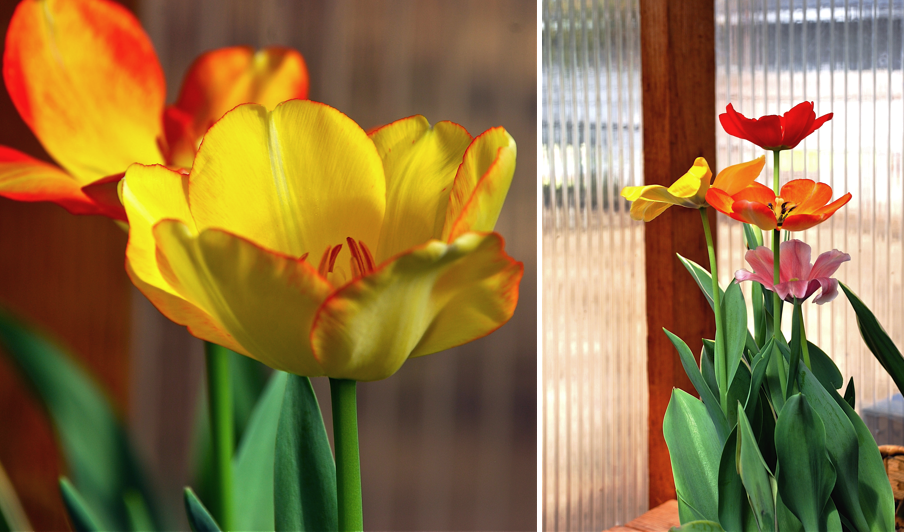
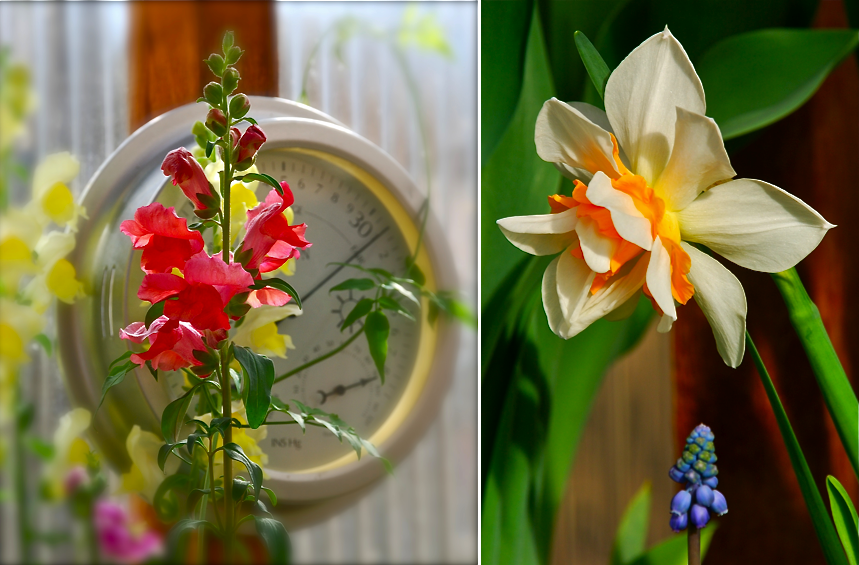
Smitten (v.) – affected suddenly and strongly with a specified feeling; affected mentally or morally with a sudden pang; impressed favorably; charmed; enamored.  I love the word smitten, I love being smitten, I look forward to being smitten, and on days like today I’m in desperate need of being smitten.  And what might the source of my “smittenness” be today?  It’s tulips and daffodils and hyacinths and crocus.  After years of planting bulbs in the ground to little or no avail, I’d resigned myself to being able to admire them until now only in books, magazines, and yards where others somehow have success with them.

Image

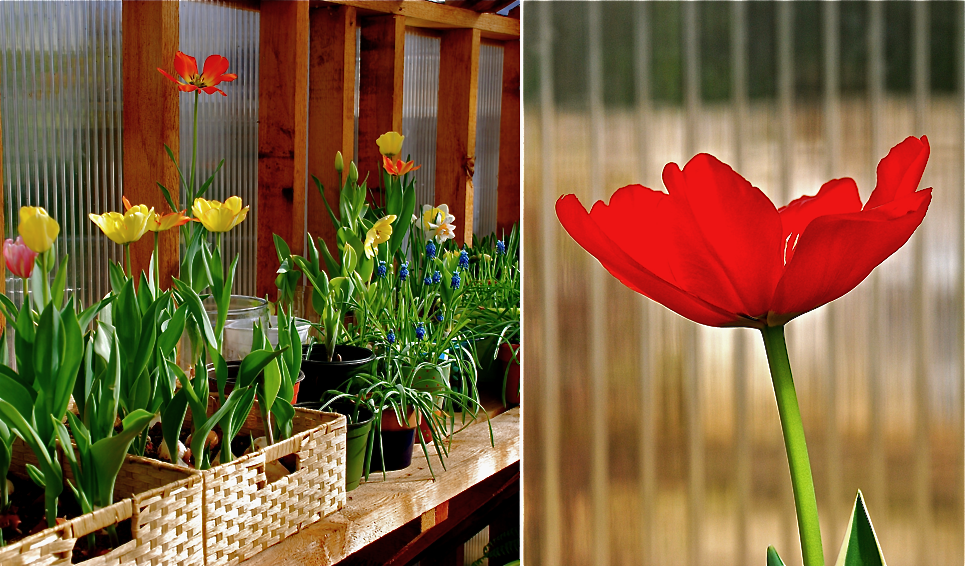
Nothing speaks of springtime louder or more clearly than flowering bulbs.  They are the epitome of spring’s opening opus, and now that my greenhouse is abloom with many of them, it feels like spring is close enough to reach out and touch.  Ah, spring, the season of increased sunlight, warmer temperatures, and the rebirth of fauna and flora, the season when the tilt of the earth relative to the sun is zero, the season which begins one month from today.

Image

For me drinking the drink, tasting the fruit, and resigning myself to the influence of each season as it passes is a way of life that inevitably brings me face to face with Yahweh and Son, the Holy One with whom I am beyond smitten.  Like Tennyson, I’m convinced that if one can understand what a flower is “root and all, and all in all, one should know what God and man is.”

O taste and see that the Lord is good; happy are those who take refuge in Him.  ~Psalm 34:8   ✝

285. We men of Earth have here the stuff of Paradise – we have enough! ~Edwin Markham

Image

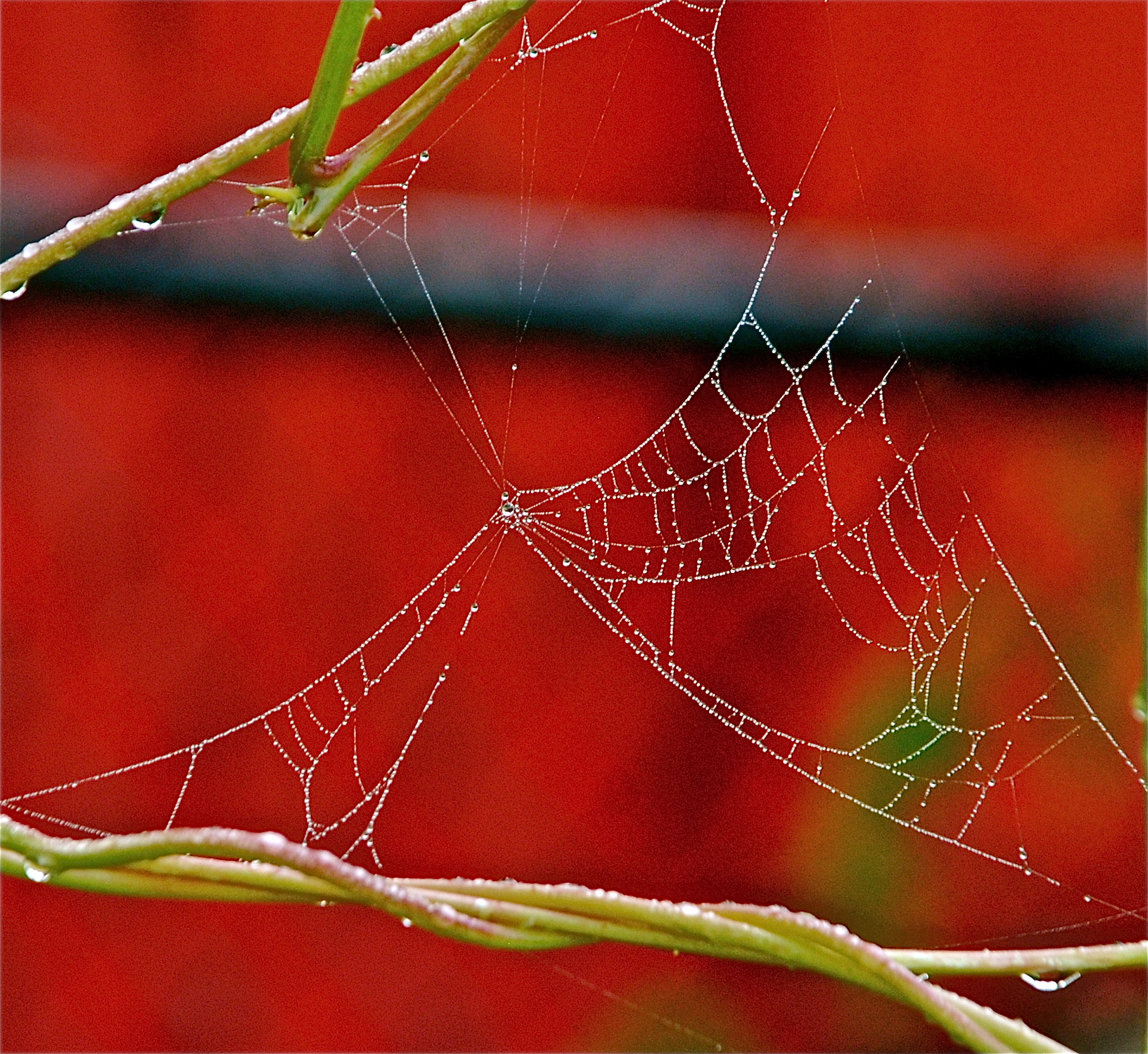
All things are connected.
Whatever befalls the earth
befalls the sons of the earth.
Man did not weave the web of life.
He is merely a strand in it.
Whatever he does to the web,
he does to himself.
~Chief Seattle

So let us not grow weary in doing what is right, for we will reap at harvest time, if we do not give up.  So then, whenever we have an opportunity, let us work for the good of all, and especially for those of the family of faith.  ~Galatians 6:9-10   ✝

284. Seek the wonder of life and love, for it lasts but a short time…believe that the Creator will guide you, for there are grand rewards within mystery. ~Black Hawk

Image

the loveliness is everywhere
even
in the ugliest
and most hostile environment
the loveliness is everywhere
at the turning of a corner
in the eyes
and on the lips
of a stranger
in the emptiest areas
where is no place for lope
and only death
invites the heart
the loveliness is there
it emerges
incomprehensible
inexplicable
it rises in its own reality
and what we must learn is
how to receive it
into ours
~Kenneth White

The Lord will guide you continually, and satisfy your needs in parched places, and make your bones strong; and you shall be like a well watered garden, like a spring of water, whose waters never fail.  ~Isaiah 58:11   ✝

283. Man’s heart grows hard away from nature. ~Standing Bear, Ponca Chief

Image

For myself, I am grateful to nature,
not so much when I see her on the side
that is open to the world,
as when I’m permitted to enter her shrine.
Then one may seek
to know of what stuff the universe is made,
who is its author or guardian,
what is the nature of God…
Life would have been a useless gift,
were I not admitted to the study of such themes.
~Seneca, 4 BC-AD 65

Take delight in the Lord, and He will give you the desires of your heart.  ~Psalm 37:4   ✝

**Edited photo via Pinterest

282. Life has its own hidden forces which you can only discover by living. ~Soren Kierkegaard

Crowfoot, chief of the Blackfoot Nation, once asked, “What is life?”  He then answered his own question with haunting and graphic wisdom.  He said, “it is the flash of the firefly in the night.  It is the breath of the buffalo in wintertime.  It is the little shadow which runs across the grass and loses itself in the sunset.”

Image

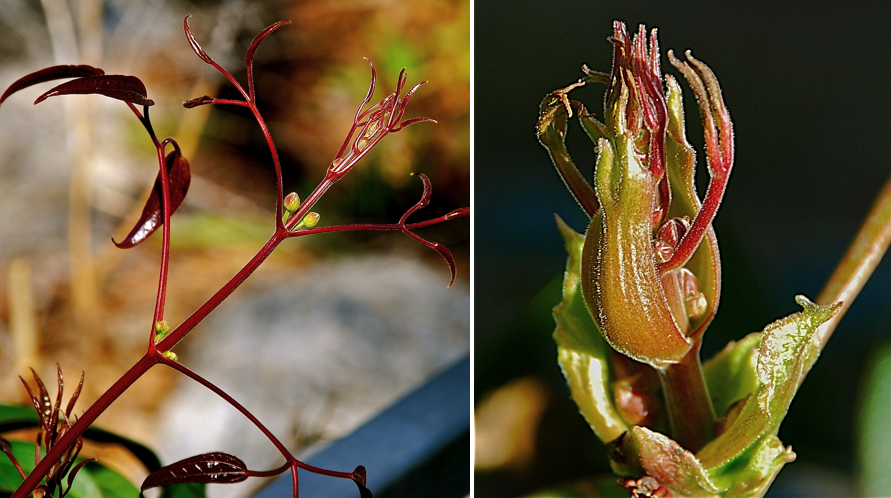
Life, that spark, that whispering breath of God over the void, grows faint in winter.  Cloistered behind the grays and browns of gloomy veils, its glow, its hum, its buzz, pales and lowers, but as we near the vernal equinox, Eden’s heartbeat becomes a little more perceptible each day.  It has been said that “God pours life into death and death into life without a drop being spilled,” and today I’ve discovered right here in my back yard that through dark, seemingly dead branches life into the lifeless has been poured again without any wasted spillage.  It is on the trailing tendrils of a “Clematis armandii” vine that life has flowed silently and secretly until it could no longer be contained.  As it burst forth into the newness you see in my photos, it is proof that the Holy One tends His Eden still.  His divine, hidden forces of life have become tangibly visible, and a new spark has ignited a tiny flame.  Soon a steady succession of similar sparks will fuel a blaze, a blaze that will spread like a wildfire lighting the world anew with evidence of God’s never-ending glory.

Who among all these does not know that the hand of the Lord has done this?  In His hand is the life of every living thing and the breath of every human being.  ~Job 12:9-10  ✝

281. There are defeats more triumphant than victories. ~Michel de Montaigne

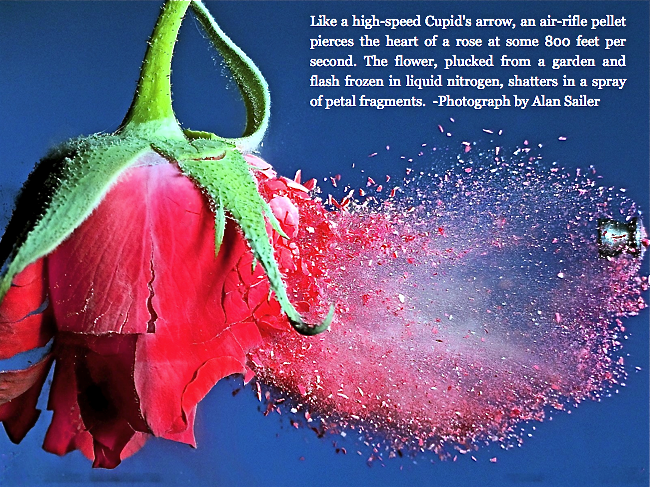
I found this image on the internet, and I’m not sure why I’m so fascinated with it, but I am.  Perhaps it’s because the rose, though now damaged, remains exquisite in color and form or because the spraying bits of freeze-dried petals create a stunning scene.  Or maybe I’m intrigued by the photo because it somehow reassures me that human brokenness touched by God’s grace can produce valuable and worthwhile fruit.  Whatever the case may be, all this pondering about the fragmented rose triggered the memory of the profound story below the photo.

Image

A water bearer in India had two large pots, each hung on each end of a pole which he carried across his neck.  One of the pots had a crack in it, and while the other pot was perfect and always delivered a full portion of water at the end of the long walk from the stream to the master’s house, the cracked pot arrived only half full.  For a full two years this went on daily, with the bearer delivering only one and a half pots full of water in his master’s house.  Of course, the perfect pot was proud of its accomplishments.  But the poor cracked pot was ashamed of its own imperfections, and miserable that it was able to accomplish only half of what it had been made to do. After two years of what it perceived to be a bitter failure, it spoke to the water bearer one day by the stream.  “I am ashamed of myself, and I want to apologize to you.”  “Why?” asked the bearer.  “What are you ashamed of?”  I have been able, for these past two years, to deliver only half my load because this crack in my side causes water to leak out all the way back to your master’s house.  Because of my flaws, you have to do all of this work and you don’t get full value for your efforts,” the pot said. The water bearer felt sorry for the old cracked pot and in his compassion he said, “As we return to the master’s house I want you to notice the beautiful flowers along the path.” Indeed, as they went up the hill, the old cracked pot took notice of the sun warming the beautiful wild flowers on the side of the path, and this cheered it some.  But at the end of the trail, it still felt bad because it had leaked out half its load, and so again it apologized to the bearer for its failure. The bearer said to the pot, “Did you notice that there were flowers only on your side of the path but not on the other pot’s side?  That’s because I have always known about your flaw, and I took advantage of it.  I planted flower seeds on your side of the path, and every day while we walk back from the stream, you’ve watered them.  For two years I have been able to pick these beautiful flowers to decorate my master’s table.  Without you being just the way you are, he would not have this beauty to grace his house.”  ~Author Unknown

Every human “pot” becomes “cracked” in some way, but that does not render the flawed man or woman ugly or useless.  The Creation story in Genesis tells us that each day God looked back at what He had made and saw that it was good.  So, although we humans are imperfect, we started from a place of goodness that is still in us.

Do not remember the sins of my youth and my rebellious ways; according to your love remember me, for you, LORD, are good.  ~Psalm 25:7  ✝