176. For the mind disturbed, the still beauty of dawn is nature’s finest balm. ~Edwin Way Teale

Slow buds the pink dawn like a rose
from out night’s gray and cloudy sheath;
softly and still it grows and grows,
petal by petal, leaf by leaf.
~Susan Coolidge

Image

Tired of tossing and turning, I got up out of bed and went in to rock in my favorite chair.  Not wanting to miss the “slow budding” of dawn’s light, however, I first raised the bamboo shade in front of the glass, patio-doors.  After a short wait a faint pinkish glow appeared low on the horizon in the eastward sky, and as the sun inched up and up and up, a ray of golden light poured through an opening centered in the heart of a tall tree framed against it just above a neighboring housetop.  The branches of the tree then took on a hallowed appearance so much so that a bird atop the roof and two squirrels sitting very still in nearby branches looked like parishioners in pews awaiting the high priest.  Later, as the sun climbed high enough for night’s curtain to be lifted completely off earth’s stage, it was apparent that all who’d seen this amazing “salutation of the dawn” were summoned to make ready for the new day.  The first to respond was a flock of birds darting willy nilly across the pastel blue sky in search of food, but beneath them as more and more drops of light appeared like jewels aloft in the bamboo I knew that despite a restless night the time for me to rise had come as well.

If I rise on the wings of dawn, if I settle on the far side of the sea, even there Your hand will guide me, Your right hand will hold me fast.  ~Psalm 139:9-10  ✝
154. “Just living is not enough,” said the butterfly, “one must have sunshine, freedom, and a little flower.” ~Hans Christian Andersen

Bees sip honey from flowers
and hum their thanks when they leave.
The gaudy butterfly is sure that
the flowers owe thanks to him.
~Rabindranath Tagore

Image

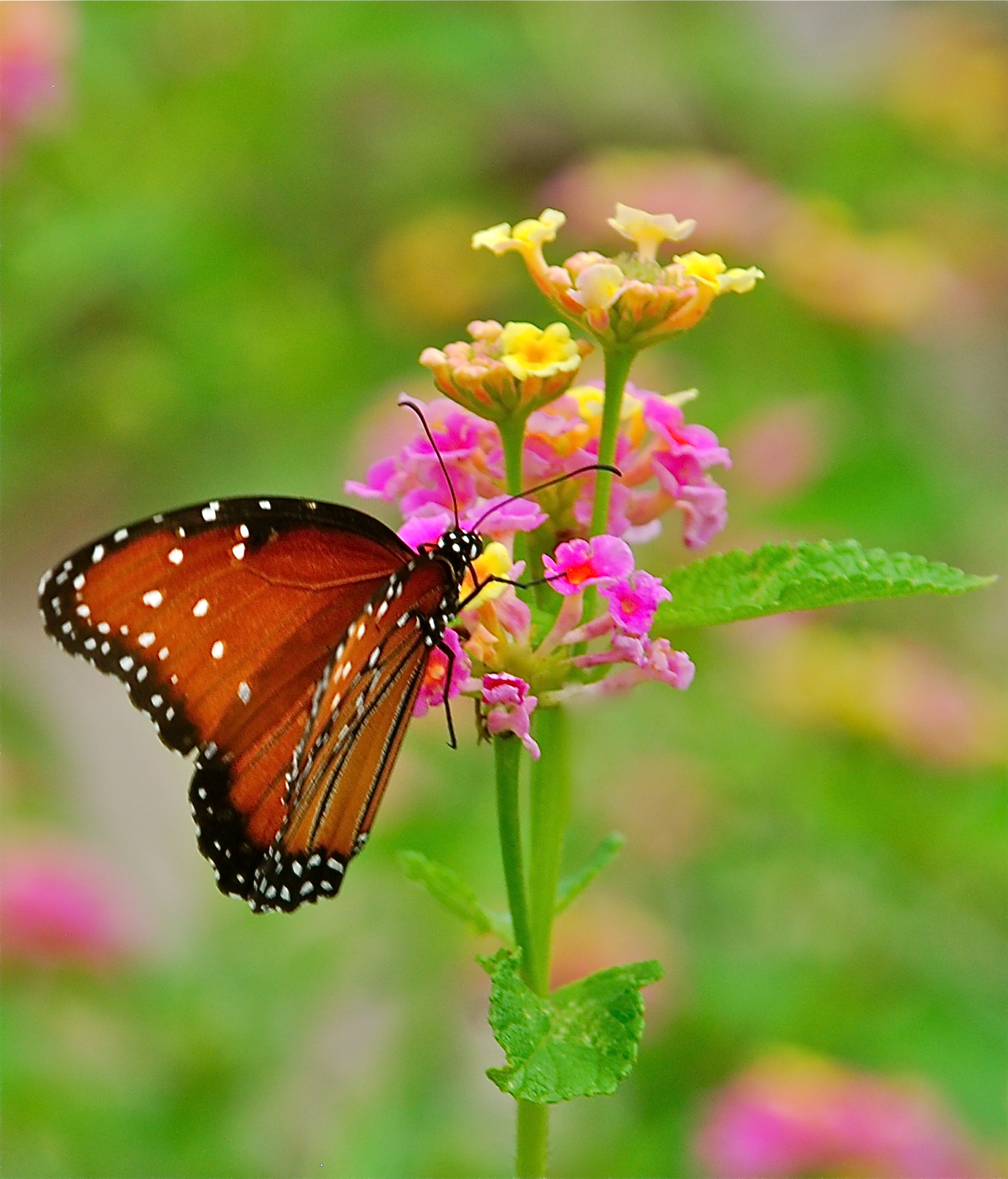
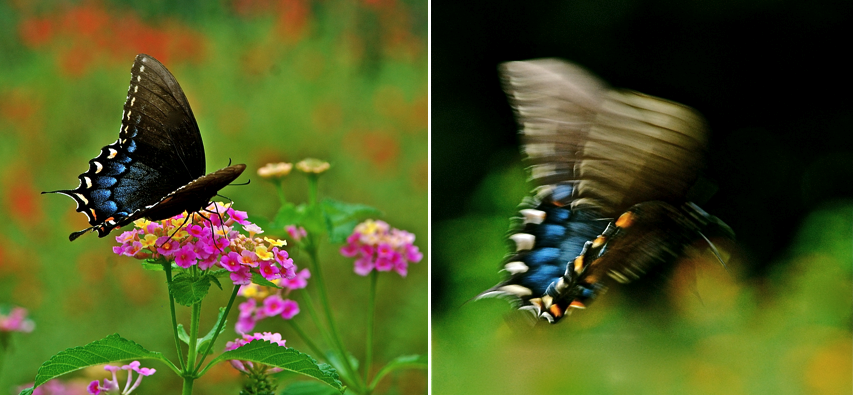
Could there be a more mesmerizing or glamorous creature than the butterfly?  No matter where I am or what I’m doing, the winged beauties stop me in my tracks.  Envious of their dance and fascinated by the way they feed, I watch in awe as they gracefully float from one flower to another.  On this particular trip to our local Botanic gardens, I was thrilled to get a pretty good shot of a swallowtail in flight.  As you can see, butterflies are beautiful even when their likenesses are blurred.  Butterflies, often described as self-propelled or flying flowers, have long been venerated all over the world.  We see a variety of artistic depictions of them in many cultures, including the 3500-year-old ones on Egyptian hieroglyphs.  They are also the darlings that inspired the images of “butterfly fairies” both in art and as fictional characters in stories.  They have been used as well as symbols of God’s favor, good luck, the human soul, love, and rebirth.  Simply put, they are to the world of insects what the rose is in the world of flowers–incomparably beautiful.

How sweet are Your words (Lord) to my taste, sweeter than honey in my mouth.  ~Psalm 119:103  ✝

147. If you wish to know the Creator, come to know His creatures. ~Columbanus, 6th century Irish monk

A flash of harmless lightning,
A mist of rainbow dyes,
The burnished sunbeams brightening
From flower to flower he flies.
~John Banister Tabb, Roman Catholic priest,
poet and professor of English

Image

Tabb’s description is of a hummingbird, but it could be said as well of bees, butterflies, and dragonflies, hordes of which I’ve seen of late.   Gulf fritillaries and an assortment of swallowtails have been flitting around the garden for weeks.  Then today I spotted the first monarchs which means their migration from Canada to overwintering grounds in Mexico has begun.  I’m guessing the reappearance of the dragonflies is because recent rains have filled their breeding grounds again with enough water for their nymphs.  The bees are back in greater numbers because the cooler temperatures are encouraging more and more blooms, and as for the hummers, two or three at a time have been coming to our feeder since early August.

John Philip Newell says, “the inclusion of creatures in the garden of God in Genesis is pointing not simply to the outward dimension of the creaturely realm.  It is also showing something of the way of God’s seeing or sensing. . .”  That’s why I I love my garden.  It’s not just about the flowers.  Spending time therein lets me be near all God created and keeps me wanting to know more of the Lord and that which is important to Him.

“But ask the animals, and they will teach you, or the birds of the sky, and they will tell you; or speak to the earth, and it will teach you, or let the fish of the sea inform you. . .”  ~Job 12:7-8  ✝

136. The bee is more honored than other animals, not because she labors, but because she labors for others. ~Saint John Chrysostom

His Labor is a Chant–
his idleness–a Tune–
oh, for a Bee’s experience
of Clovers, and of Noon!
~Emily Dickinson

Image

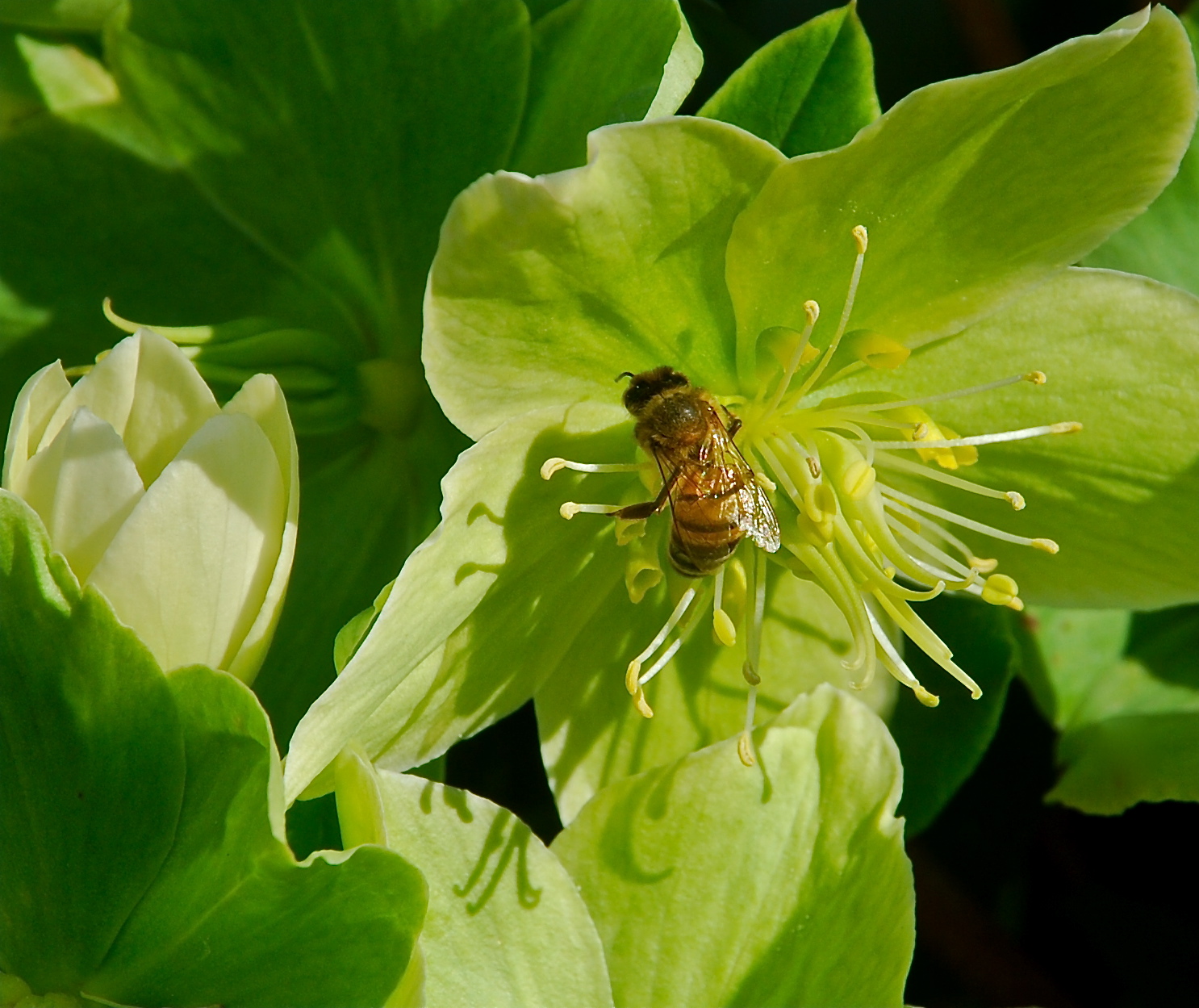
Honey bees and bumblebees, it seems, find a flower’s countenance as irresistible as I, and that “irresistibility” is of holy intent.  In the passage of Scripture that follows, we see that the Lord’s plan involved an interconnectedness of all life as well as a dependency, one on the other.  The poet, Kahlil Gibran, explains that connectedness in this way: “a flower is a fountain of life” for the bee, and to the bee and flower “the giving and receiving is a need and an ecstasy.”  But wait, how is any of this relevant in the 21st century?  In the age of incredible and still advancing technology should anyone care about flowers and bees?  Indeed all of us should care because bees are absolutely essential pollinators, and sadly there are now alarming reports which indicate that one fourth of the northern hemisphere’s honeybee population mysteriously vanished by the spring of 2007.  Then by the end of 2008, one in three hives was left lifeless.  Simply put, the honeybee is disappearing at an alarming rate across the entire globe.  The worst part is that those in the know are not sure why this is happening, but they do know that should the increasing catastrophe not be addressed and solutions to the problem not found, the complete loss of honeybees as pollinators would mean the end of agriculture as we know it.  Since much of what we wear and one third of what we eat depends on the pollinating activity of honeybees, our way of life and civilization would be threatened.  In fact one report said the situation is so dire that mankind would survive only 4 years after the complete collapse of the honeybee population.

Then God said, “I give you every seed-bearing plant on the face of the whole earth and every tree that has fruit with seed in it. They will be yours for food.  And to all the beasts of the earth and all the birds of the air and all the creatures that move on the ground—everything that has the breath of life in it—I give every green plant for food.”  And it was so.  ~Genesis 1:29-30   ✝

124. Every flower about a house certifies to the refinement of somebody. Every vine climbing and blossoming tells of love and joy. ~Robert G. Ingersoll

What a desolate place would be
a world without a flower!
It would be a face without a smile,
a feast without a welcome.
~A .J. Balfour

Image

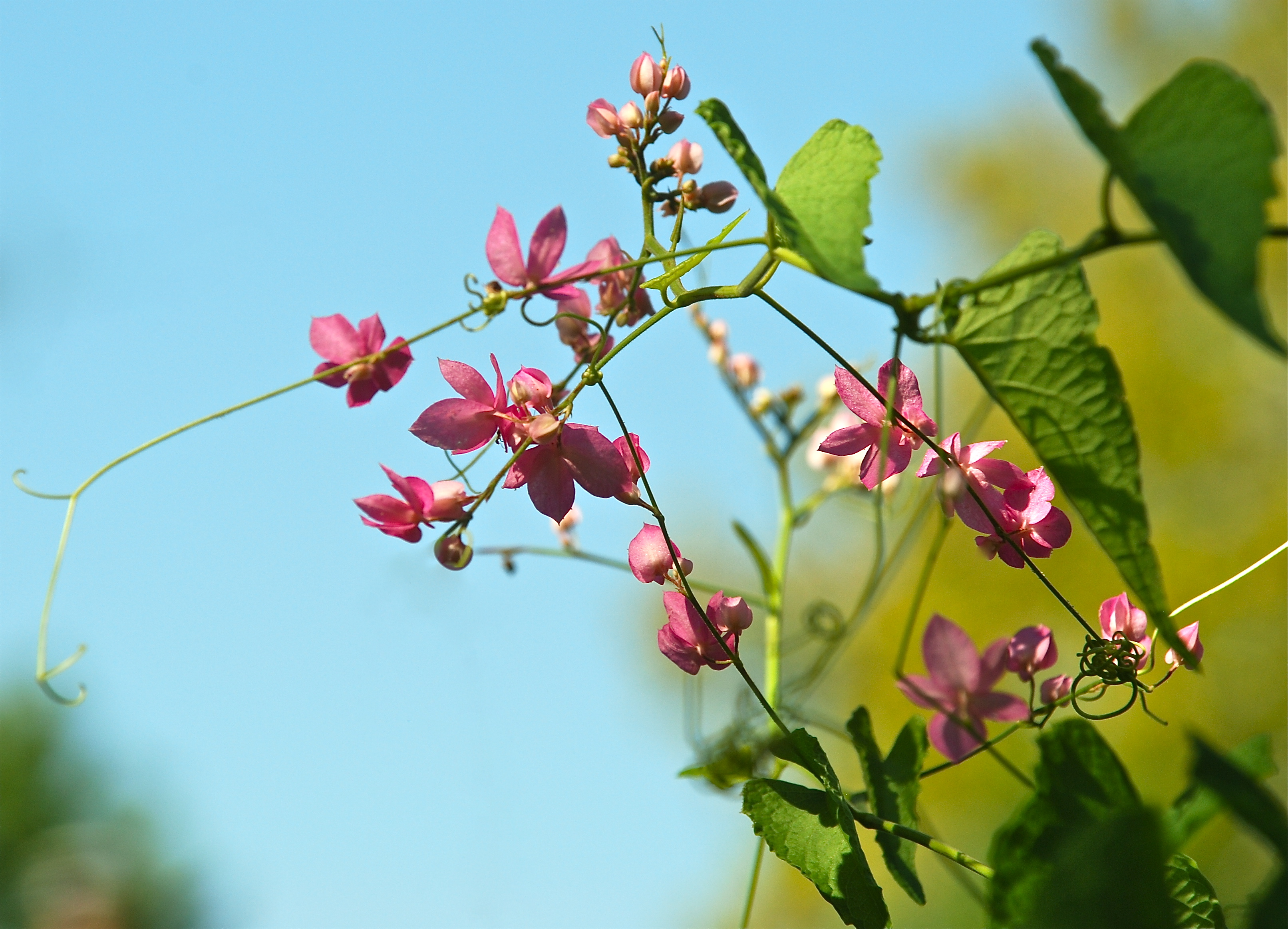
With its delicate tendrils the striking, lacy pink coral vine rapidly climbs up, over, and on anything it can find.  Because it is a vigorous vine upon which masses of flowers are situated, it needs support to produce the masses of green heart-shaped leaves and large branching flower stalks.  Once it reaches high enough and the dainty pink blooms appear, the sweet of it delights the bees.  And of course like all flowering vines it feeds my soul.

Return to us, God Almighty!  Look down and see!  Watch over this vine. . .  ~Psalm 80:14  ✝

40. Spring shows what God can do with a drab and dirty world. ~Virgil Kraft

Awake, thou wintry earth –
fling off thy sadness!
Fair vernal flowers, laugh forth –
your ancient gladness!
~Thomas Blackburn

Image

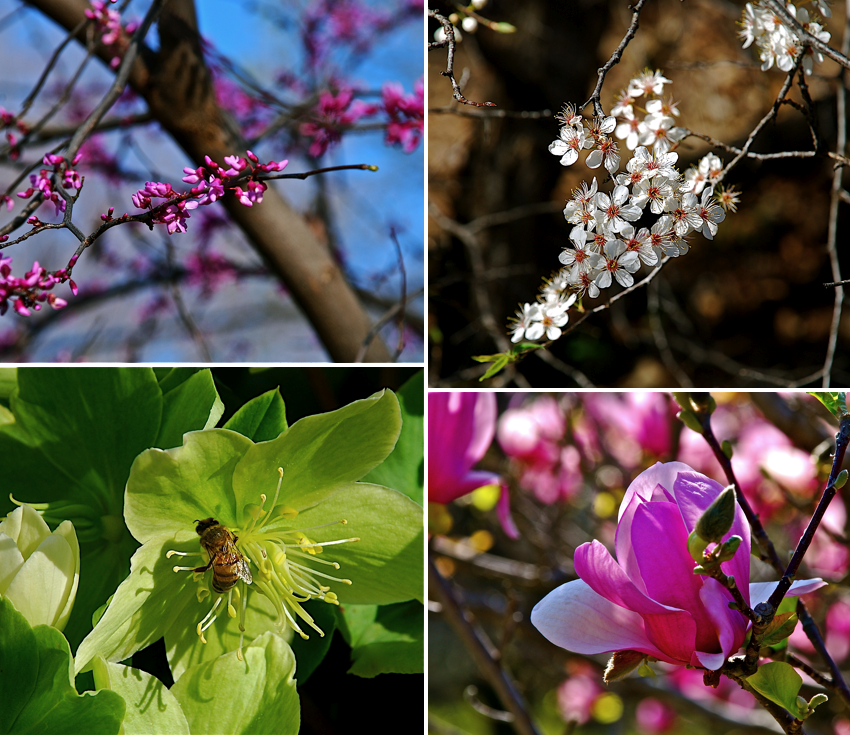
Leaf by leaf, bud by bud, and blossom by blossom the spring of the year advances.   On warmish days, earth casts off its wintry gloom, and breezes broadcast sweetly-scented aromas.  The first butterflies then dare to soar and the hungry bees hum amid the glad laughter issuing forth from flowering bulbs and trees.  As a result the year’s initial poetry of rebirth is penned by the pollinating, aerial whirring of dainty wings.  In the meantime as I hurry about trying to taking photos of the blossoming narratives and their paramours, I often find myself asking the same question Walt Whitman once did.  “Why are there trees I never walk under but large and melodious thoughts descend upon me?”  The answer I’ve decided is that the arms of trees reach towards the heavens to gather sacred messages meant to draw mankind near to “the living Word of God in nature” as well as what is read in Scripture.

In our area the first verses of  “tree” poetry come from Saucer Magnolias.  Their big, goblet-shaped flowers pen exquisite couplets in pink and white.  Soon to follow are the brilliant white blossoms of Star Magnolias.  Though not quite enough lines to form a fourteen-lined sonnet, their twelve exquisite, “petal-poesy” lines form rhyming schemes as lovely as any Shakespearean sonnet.  Next and in perfect rhyming sequences come the double samaras.  Samaras, the scarlet, dual winged fruits of the Red Maple, look like long, slender fairy wings as they dance choric rhymes writ by the winds.  Then come the Eastern Redbuds and Bradford Pears that compose stunning free-verse stanzas in purple and white, each resplendent branch, a psalm written in praise of its Maker.  For a pollinator now there’s no quandary about where sweet nectaries are to be found for stanza after stanza they and I are lead in springtime to earth’s most festive and delicious banquets.

He has taken me to the banquet hall, and His banner over me is love.  ~Song of Songs 2:4