
Tag Archives: Blessings
40. Spring shows what God can do with a drab and dirty world. ~Virgil Kraft
Awake, thou wintry earth –
fling off thy sadness!
Fair vernal flowers, laugh forth –
your ancient gladness!
~Thomas Blackburn
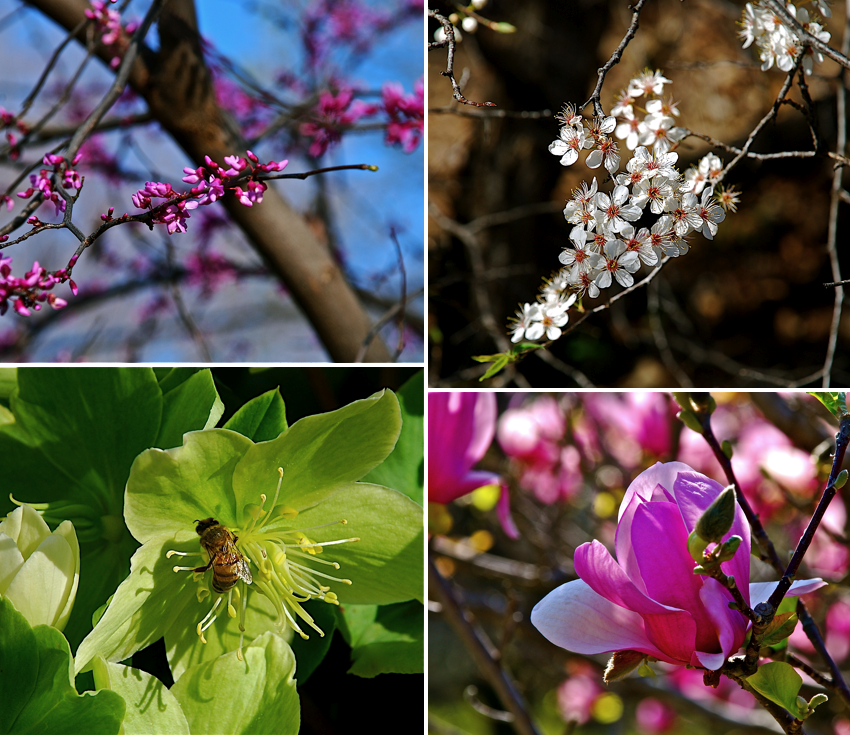
Leaf by leaf, bud by bud, and blossom by blossom the spring of the year advances. On warmish days, earth casts off its wintry gloom, and breezes broadcast sweetly-scented aromas. The first butterflies then dare to soar and the hungry bees hum amid the glad laughter issuing forth from flowering bulbs and trees. As a result the year’s initial poetry of rebirth is penned by the pollinating, aerial whirring of dainty wings. In the meantime as I hurry about trying to taking photos of the blossoming narratives and their paramours, I often find myself asking the same question Walt Whitman once did. “Why are there trees I never walk under but large and melodious thoughts descend upon me?” The answer I’ve decided is that the arms of trees reach towards the heavens to gather sacred messages meant to draw mankind near to “the living Word of God in nature” as well as what is read in Scripture.
In our area the first verses of “tree” poetry come from Saucer Magnolias. Their big, goblet-shaped flowers pen exquisite couplets in pink and white. Soon to follow are the brilliant white blossoms of Star Magnolias. Though not quite enough lines to form a fourteen-lined sonnet, their twelve exquisite, “petal-poesy” lines form rhyming schemes as lovely as any Shakespearean sonnet. Next and in perfect rhyming sequences come the double samaras. Samaras, the scarlet, dual winged fruits of the Red Maple, look like long, slender fairy wings as they dance choric rhymes writ by the winds. Then come the Eastern Redbuds and Bradford Pears that compose stunning free-verse stanzas in purple and white, each resplendent branch, a psalm written in praise of its Maker. For a pollinator now there’s no quandary about where sweet nectaries are to be found for stanza after stanza they and I are lead in springtime to earth’s most festive and delicious banquets.
He has taken me to the banquet hall, and His banner over me is love. ~Song of Songs 2:4
19. Let us love winter, for it is the spring of genius. ~Pietro Aretino
We need a renaissance of wonder.
We need to renew, in our hearts and in our souls,
the deathless dream, the eternal poetry, the perennial sense
that life is miracle and magic.
~E. Merrill Root
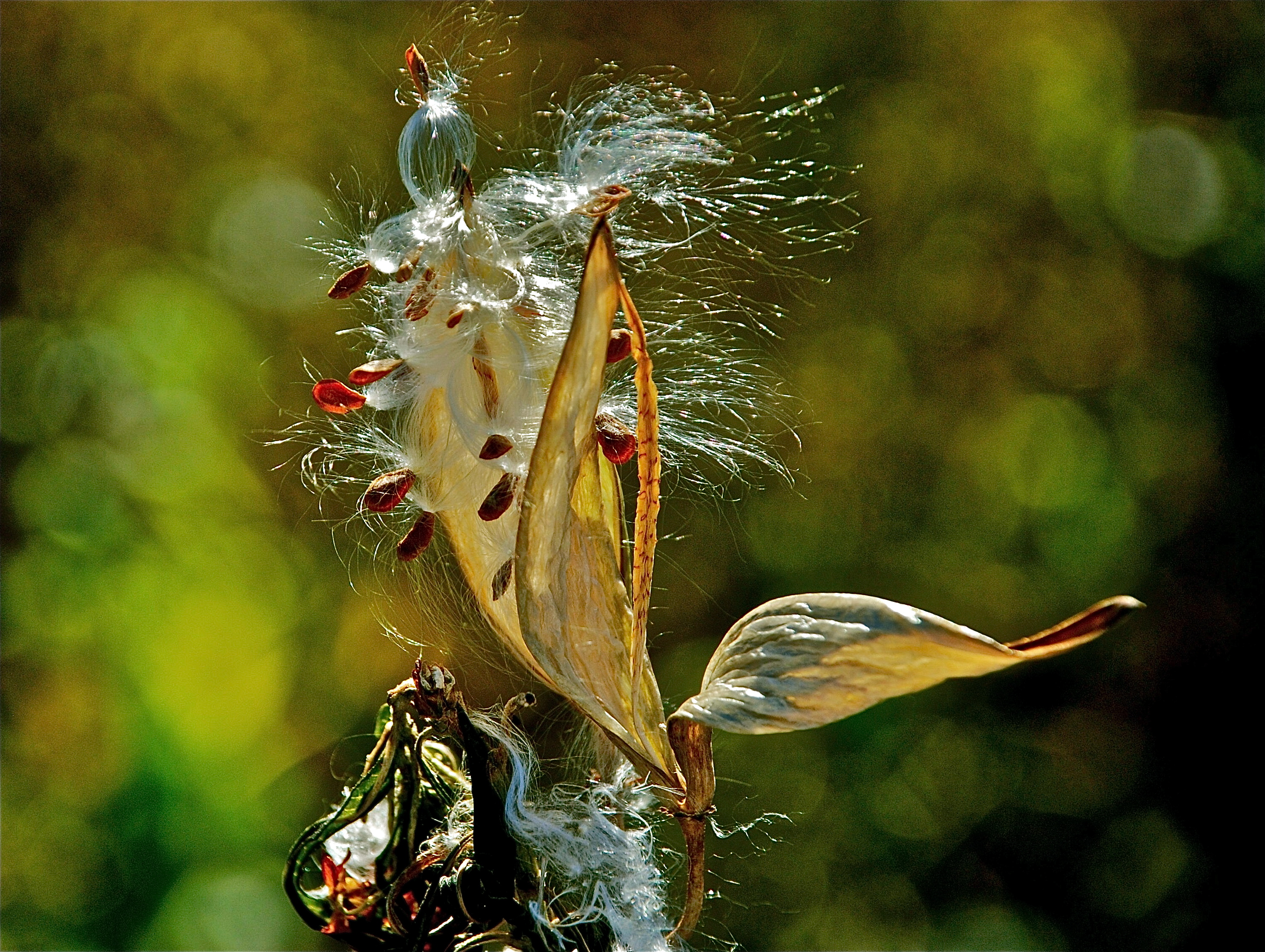
Since it is year’s end, we have entered the season of somber gardens, short days, low temperatures, and more-gray-than-blue skies. The reckless abandon of the growing seasons has yielded to deepening winter’s, unadventurous restraint. But, while looking out a window brings into view only the barrenness of winter, an actual venture out into its domain can expose wondrous sights like the seed pod in the photograph. What a treat to see wondrous silken filaments that look like angel hair releasing seeds that are proof of a continuously running thread in Creation’s tapestry. Such finds are tangible fragments of God’s imagination buried deep in the mystery of nature, and the aura of holiness that surrounds them often leaves onlookers amazed and awestruck. These miraculous strands are the same kind of threads that govern the ceaseless ebbing and flowing of oceanic waves, the waxing and waning of the moon, the rising and setting of the sun, the birth and death of life forms, and the endless repetition of the seasons.
The most beautiful thing we can experience is the mysterious.
It is the source of all true art and all science.
He to whom this emotion is a stranger, who can no longer pause to wonder
and stand rapt in awe, is as good as dead: his eyes are closed.
~Albert Einstein
Rediscovering awe helps us appreciate the vast wonders of what the Creator’s mind imagined, what His words spoke, and what His hands created. It bring us closer to God and restores our childlike joy and zeal for life. The unfathomable mysteries of life are sacred benedictions; their blessings encourage us to stay in the Lord’s keeping and continue searching for His intent for our lives.
Who among the gods is like you, LORD? Who is like you—majestic in holiness, awesome in glory, working wonders? ~Exodus 15:11 ✝
**”if an object or expression can bring about, within us, a sense of serene melancholy and a spiritual longing, then that object could be said to be wabi-sabi.” “Wabi-sabi nurtures all that is authentic by acknowledging three simple realities: nothing lasts, nothing is finished, and nothing is perfect.” The photo of the seed pod is a excellent example of Wabi Sabi.
 Sacred Touches