549. The man who is happy is fulfilling the purpose of existence. ~Fyodor Dostoyevsky

If Heaven made him —
earth can find some use for him.
~Chinese Proverb

Screen shot 2014-11-15 at 2.33.40 PM

I watched light split the darkness on this chilly November morn, and as the sun rose higher on the horizon, I saw it initially tickle the tops of trees. Then leaf by leaf by leaf it began to lower. In the topmost branches, the squirrels, benefactors of the sun’s first fruits, sat poised in readiness for the day. Below the birds, yet reluctant to lift off, and I were on stand by waiting for the light’s kiss to brush its warmth against us as well. While I sat before the unfolding drama, it occurred to me that such as this, these primal vignettes of earth’s awakening, had played out in the same prevailing silence and expectancy since the dawn of time. It’s as if the light, and only the light, adds the vibrancy and buoyancy of sound and tempo to the day–as if there is a purpose in dim, quiet beginnings, as if first there is a need to obey holy rhythms, a foremost call to offer thanksgiving, a wisdom in opening songs of praise. Verily what I witnessed was the pregnant pause between what was, what is, and what’s yet to be, and standing in those gaps waiting to be greeted was, as always, the Giver of light, of breath, of life. At last when the light touched the ground, birds gave voice to the day’s opus and the dance of life began again! Thus I knew it was time not only to rise but also to celebrate miracles and keep them from becoming ordinary, time to prevent the mundane from stealing joy and a sense of awe and wonder. For it is ordained that we, all of us, have been anointed, have been given skill sets, and somehow, in some way have a purpose to fulfill. And if we are to accomplish that, we must cherish the light, take it with us, open life’s doors, and live in amazement.

And we know that in all things God works for the good of those who love Him, who have been called according to His purpose. ~Romans 8:28  ✝

**Image via Pinterest
528. Behold congenial autumn comes, the Sabbath of the year. ~John Logan

There’s music in the sighing of a reed;
There’s music in the gushing of a rill;
There’s music in all things, if men had ears:
Their earth is but an echo of the spheres.
~Lord Byron

Screen shot 2014-10-25 at 1.51.46 PM

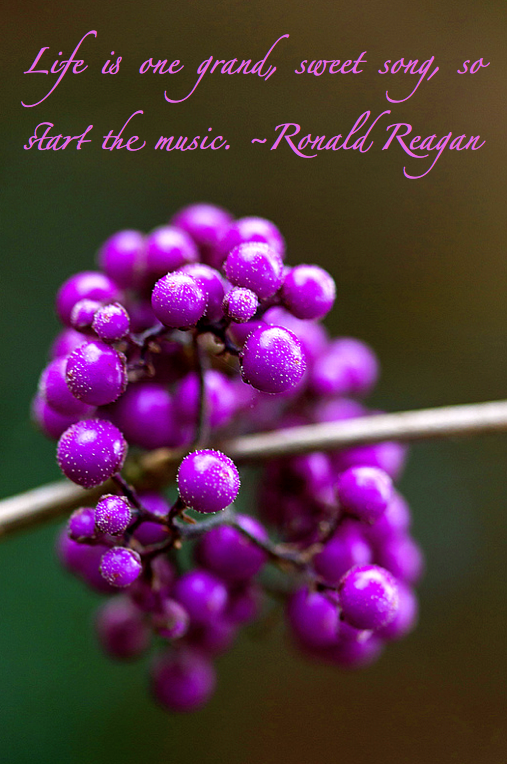
Year after year I fall in love again with autumn, and this one is no different than all the others. Even though few leaves have changed colors, there are tangible signs of Keats “season of mists and mellow fruitfulness.” Samples of such manifest themselves daily in the form of ripening seeds, nuts, hips, berries, fruits, and acorns. As well several crisp mornings have filled autumn’s cup with its quintessential sanctity, and some shrouded in foggy mists have revealed squirrels scurrying about with greater urgency while birds, soon to pull out on migratory treks, feast on seeds and berries like the ones in the photo. These are American beautyberries, and they first appeared months ago in shades of pretty, pale greens, but as autumn drew near they deepened into their stunning shade of magenta and began issuing forth tunes in this, the next series of earth’s delightful melodies.

Passages in Scripture indicate that music originated with God and accompanied Creation, and there are those who yet hear the continuing echoes of Yahweh’s “Divine symphony” as made evident in the lines I quoted from Lord Byron. The American evangelist, Beth Moore, says that a song is “the fluent language of the soul,” and I couldn’t agree more because it is my soul that “hears” the myriads of earth’s melodic voices. I think perhaps the hymns of nature are more discernible in spring and autumn after they’ve been weighed down by winter’s oppression or nearly snuffed out by the intensity of summer’s fires, but earth’s music never fails to play on. And whenever the “echo of the spheres” and “the music in all things” of which Baron Byron spoke is heard, it is a privilege to “listen” to the “songs of the morning stars and the angels shout for joy” (Job 38:7). And how blessed are we, the peoples of the earth, that God “takes delight” in us, that “He quiets” us “with His love,” and that “He rejoices” over us “with singing.”

“The Lord your God is with you, the Mighty Warrior who saves. He will take great delight in you; in his love he will no longer rebuke you, but will rejoice over you with singing.”   ~Zephaniah 3:17   ✝

469. The ripest peach is highest on the tree. ~James Whitcomb Riley

This is the blessing for a ripe peach:
This is luck made round. Frost can nip
the blossom, kill the bee. It can drop,
a hard green useless nut. Brown fungus,
the burrowing worm that coils in rot can
blemish it and wind crush it on the ground.
Yet this peach fills my mouth with juicy sun.
~A verse from a poem by Marge Piercy

Screen shot 2014-08-27 at 2.33.53 PM

Abracadrabra! Hinkety, pinkety! Jiggity, jog! Poof! Oh wouldn’t it be lovely if with such a simple incantation we could go back in time to a place where one of our life’s greatest treasures lie! For me it would be a place filled with the sights and sounds of the sea, the fragrances of beautiful flowers, the tastes of luscious fruits, and the magic of innocence. That place would always be my childhood home in southern California where sanctity fell from on high and oozed up from the ground, and the air was charged and ripe with God’s goodness.

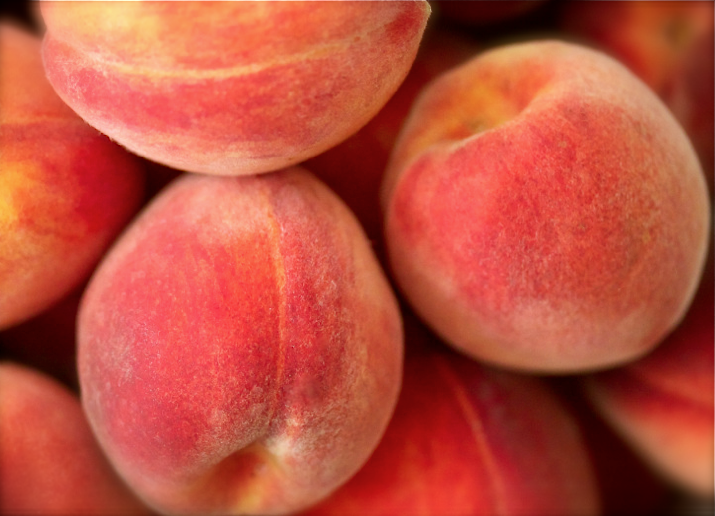
It was when I read this verse today that the poet’s words actually took me back for the briefest of moments to that time and place. For you see in our backyard we had a large peach tree, and I remember so well reaching up, grabbing one, though it might not have been the highest, and eating it with joyful abandon, letting the “juicy sun” drip right down from my mouth. And then there were my mama’s peach pies!!! My oh my oh my but they were the best I have ever eaten!

The land produced vegetation: plants bearing seed according to their kinds and trees bearing fruit with seed in it according to their kinds. And God saw that it was good. ~Genesis 1:12   ✝

“Holy, holy, holy is the Lord God Almighty. With all Creation I sing: Praise to the King of Kings. You are my everything, and I will adore you!” (From Revelation Song by Phillips, Craig, and Dean)

461. When the eye sees a color it is immediately excited… ~Johann Wolfgang von Goethe

“Maybe we should develop a Crayola bomb as our next secret weapon. A happiness weapon. A beauty bomb. And every time a crisis developed, we would launch one. It would explode high in the air — explode softly — and send thousands, millions, of little parachutes into the air. Floating down to earth — boxes of Crayolas. And we wouldn’t go cheap, either — not just little boxes of eight, but the boxes of 64… And people would smile and get a little funny look on their faces and cover the world with imagination.” ~Robert Fulghum

DSC_0053During the growing seasons in my yard, yellow sets up camp on sunflower’s faces, orange spills from the daylily’s cup, red rests on many a rosy petal, blue climbs salvia spikes and perches on morning glory vines while purple dangles from the wisteria vine and crawls along the top of the lavender’s wands. Then there’s the medley of light to dark pink that runs along coneflower petals while gold fills the Rudbeckia petals, the magenta that bubbles on the panicles of the Crape Myrtles, the hot pink that mounts the spires of loosestrife and trumpets forth from the upright tubes of Monarda, and the softer and varied shades of light pinks that adorn other roses as well as the coral vine. What I don’t have nor never will have here in my yard are what you see in the photo, the beautiful wine-red fruits of the prickly pear cactus. I am just not a cactus fan, but I think the ripened fruits of Opuntia are stunning, and in the Texas landscape the prickly pear cactus can be found almost anywhere.

Claude Monet once said that color was his “day-long obsession, joy and torment” and that he perhaps owed “having become a painter to flowers.” Similarly it is my love affair with color and flowers that led have me to become a photographer and blogger. And to think it all began with boxes of crayolas. Why? When I was a child, we lived in southern, coastal California where I fell in love with the flowers I encountered at every turn, and since we traveled every summer either by car or train, Mother wanted to make sure my sisters and I had things to keep us from getting bored and antsy. So each of us got, among other engaging things, a brand new box of crayolas and coloring books for our journeys. I looked forward all year long to those new boxes of crayolas and the pleasurable hours of coloring, but I was not then nor am I now able to draw images very well from scratch. So later in life I replaced my box of crayons for a camera and bought a house with a large yard so I could have lots of growing spaces for flowers. And now it is the pretty flowers and their luscious colors that move me daily to make “offerings” of praise and gratitude to the Lord.

Praise Him (God) for his mighty deeds; praise Him according to his excellent greatness. ~Psalm 150:2   ✝

Thank you, Lord Jesus, that you save, you heal, you restore, and you reveal Your Father’s heart to us! May I dwell in Your holy presence and praise Your name for all that you have given and done.

390. And the fruits will outdo what the flowers have promised. -François Malherbe, French poet

The sun with all those planets
revolving around it and dependent on it,
can still ripen a bunch of grapes
as if it has nothing else in the universe to do.
~Galileo

Image

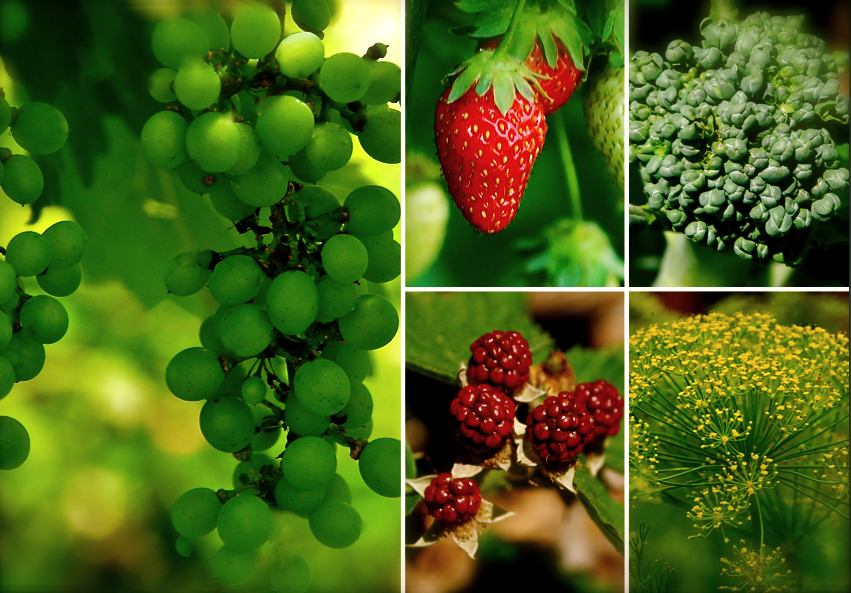
Yummy! Yummy! Yummy! What deliciousness can be found in a garden! The flowers that precede the fruits and vegetables, as Malherbe suggests, are definitely not impressive. Not only are they unimpressive but they are also smallish and challenge the ordinary camera lens’ ability to get a good focus on them. On the other hand, the mature fruits photograph quite well because they are more substantial and anything but ordinary. Like Galileo, I stand amazed at the process, but then I am perennially in awe of all that Creation does and is.

Recently in a National Geographic snippet that aired on the internet, the narrator remarked that present-day humanity is the recipient of a 400,000,000 year old legacy bequeathed by the earth. Imagine that! For 400 million years, the sun has risen and set, fruits have ripened, and the earth has turned issuing one season after the other. And all that the earth is and does for those who depend on it for life and sustenance is the loving gift of Him who created Heaven and Earth.

For since the creation of the world God’s invisible qualities–His eternal power and divine nature–have been clearly seen, being understood from what has been made, so that men are without excuse. ~Romans 1:20 ✝

Thank you, Lord Jesus, that you save, you heal, you restore, and you reveal Your Father’s heart to us! You have captured me with grace and I’m caught in Your infinite embrace! Like Saint Hildegard Lord, may I too be a feather on your holy breath and spread, like seeds, the gospel abroad.

350. But I always think the best way to know God is to love many things. ~Vincent Van Gogh

All things bright and beautiful,
All creatures great and small,
All things wise and wonderful,
The Lord God made them all.

Image

Each little flower that opens,
Each little bird that sings,
He made their glowing colours,
He made their tiny wings.

Image

The rich man in his castle,
The poor man at his gate,
God made them, high or lowly,
And ordered their estate.

Image

The purple-headed mountain,
The river running by,
The sunset, and the morning,
That brightens up the sky;

Image

The cold wind in the winter,
The pleasant summer sun,
The ripe fruits in the garden,
He made them every one.

Image

The tall trees in the greenwood,
The meadows where we play,
The rushes by the water,
We gather every day;–

Image

He gave us eyes to see them,
And lips that we might tell,
How great is God Almighty,
Who has made all things well.
~Cecil Frances Alexander

Image

Your righteousness, God, reaches to the heavens, you who have done great things. Who is like you, God? ~Psalm 71:19 ✝

Thank you, Lord Jesus, that you save, you heal, you restore, and you reveal Your Father’s heart to us! You have captured me with grace and I’m caught in Your infinite embrace!

301. Fingers now scented with sage and rosemary, a kneeling gardener is lost in savory memories. ~Dr. Sun Wolf

Image

I know a garden with a loveliness
Deeper than eye can see or indrawn breath
Can measure rightly. Ancient centuries press
Against its walls till time is gone and death
Is lost in fragrance of the lavender
That grows serenely by a lichened stile.
Basil, rosemary, marjoram are there,
And savory, whose blossoms lift a smile
Beside a dripping pool. There silver sage
And lads-love, that all our mothers knew
And pressed for us in many a yellow-page.
Woodruff is there, mint, caraway, and rue.
Old flowers are lovely, lovelier still are these
Sweet scented herbs near box and cedar trees.
~Catherine Coblentz

Awake, O north wind, and come, O south wind!  Blow upon my garden that is fragrances may be wafted abroad.  Let my beloved come to his garden, and eat its choicest fruits.   ~Song of Solomon 4:16   ✝

 **photos via Pinterest

273. The man who has planted a garden feels that he has done something for the good of the whole world. ~Vita Sackville-West

The most noteworthy thing about gardeners
is that they are optimistic, always enterprising, and never satisfied.
They always look forward to doing something better
than they have ever done before.
~Vita Sackville-West

Image

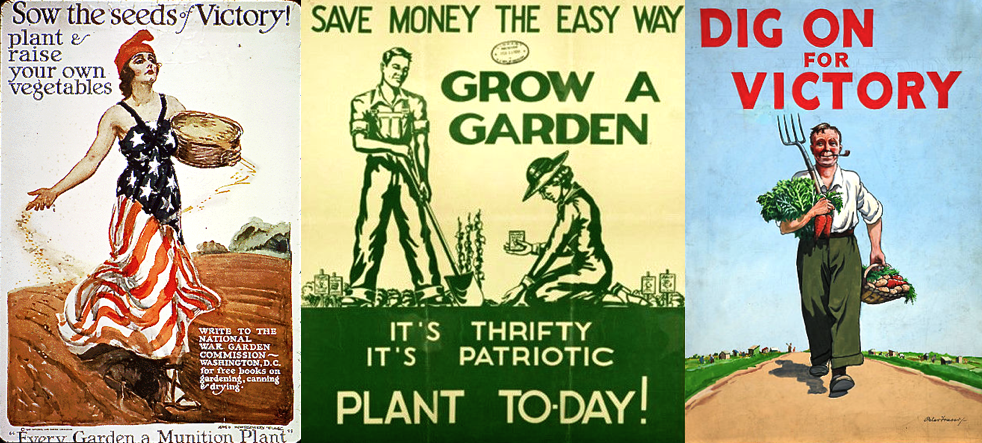
During World War I and World War II, victory gardens were planted at private residences and public parks in the United States, the United Kingdom, Canada, and Germany.  Vegetables, fruits, and herbs were grown to reduce the pressure on the public food supply brought on by the war efforts.  Not only did these gardens indirectly aid in the war efforts, but they were also considered civil “morale boosters.”  By planting them, gardeners felt empowered by their contribution of labor and rewarded by the produce they grew.  As a result victory gardens became a part of daily life on the home front.

Amos Bronson Alcott said, “Who loves a garden still his Eden keeps, perennial pleasures plants, and wholesome harvests reaps.”  Can you imagine what it must have been like to stand in Eden? And to listen for the Lord as He walked in the cool of the day?  There are times when I’m in my garden that I get a sense of the incredible thrill that must have been.  The perennial pleasures of my garden plant a rightness in my days and a comfortable feeling of harmony in my spirit.  And the wholesome harvests I reap are not just the fruits, the flowers, and the beauty all around me but also the peace it brings and the times when the deep sanctity of it touches my soul where the Lord is planting and digging for harvests of His own.

There is nothing better for mortals than to eat and drink, and find enjoyment in their toil.  This also, I saw, is from the hand of God; for apart from him who can eat or who can have enjoyment.  ~Ecclesiastes 2:24-25  ✝

219. That each day I may walk unceasingly on the banks of my water, that my soul may repose on the branches of the trees which I planted, that I may refresh myself under the shadow of my sycamore. ~Egyptian Tomb Inscription, circa 1400 BCE

Because they are primeval, because they outlive us,
because they are fixed, trees seem to emanate a sense of permanence.
And though rooted in earth, they seem to touch the sky.
For these reasons it is natural to feel we might learn wisdom from them,
to haunt about them with the idea that if we could only read
their silent riddle rightly we should learn some secret vital
to our real, our lasting and spiritual existence.
~Kim Taplin

Image

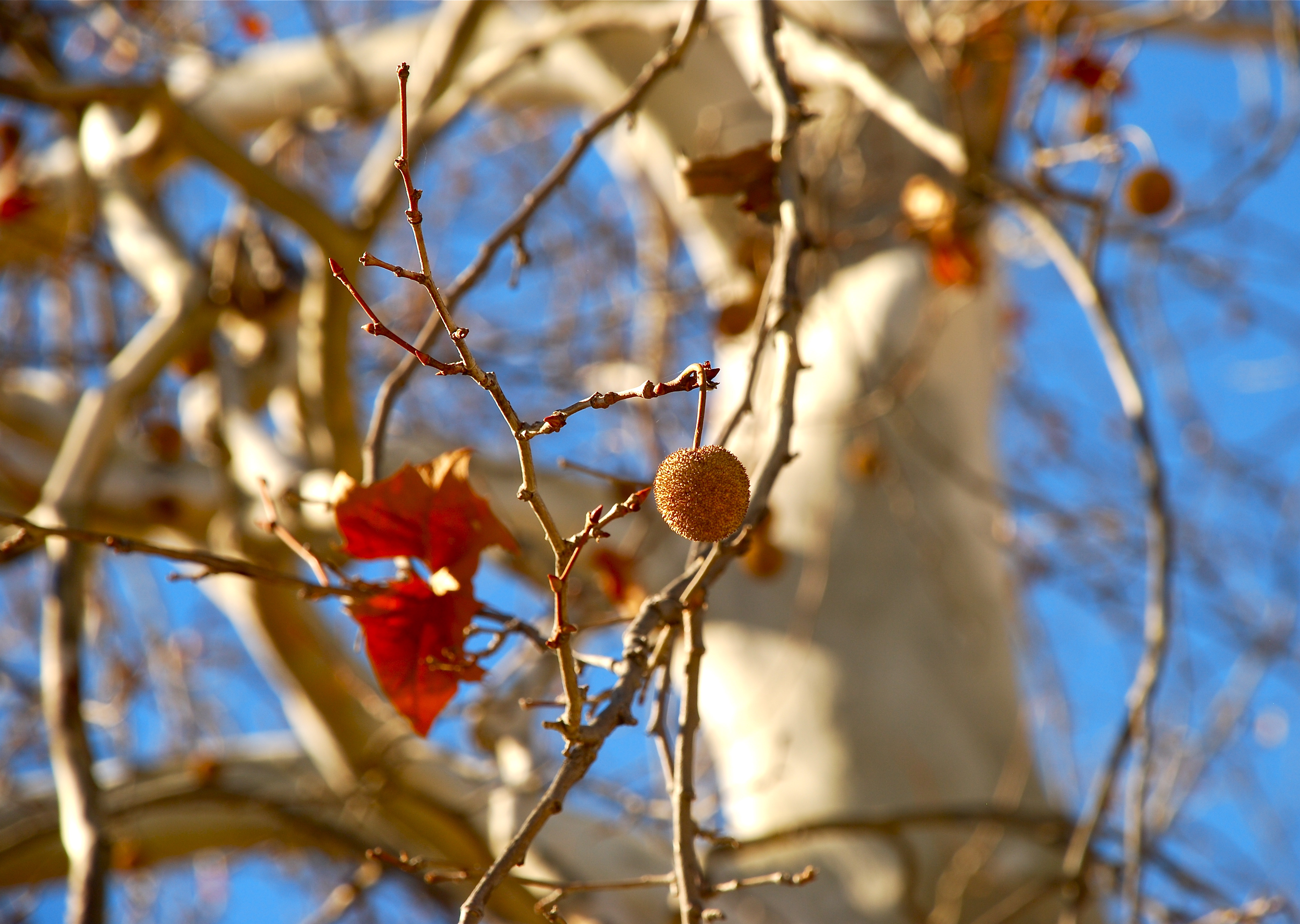
Before the sun fell over the edge of the world yesterday, it painted its recently traversed path with reddish-pink and mauve streaks.  In between the streaks were smaller golden rays that eventually blended into the pinker bands of light.  As these streaks shot up to the sky’s pinnacle, they oozed deliciousness through the open spaces in one of my favorite trees.  It’s a sycamore tree directly across the street from our house, and it’s so old that most of its bark has fallen away.  When it has, as it has now, lost most of its floppy brown leaves the tree’s strange fruits are more visible as area its long, slender alabaster arms, arms that seem to reach up and caress the heavens’ spacious blue lagoons.  Another thing I love about this particular tree is that in winter’s chilling winds its clattering branches seem to whisper prophecies of another spring’s birthing beneath the soil in silent chambers waiting for the prompting of the sun’s warmth on lengthening days and spring rains.

I’m the first one to admit that sometimes I’m hard pressed on difficult days to find reasons to be joyful, but I’m learning to look expectantly as well as long enough to find some measure of God’s glory in the day at hand.  When dealing with a run of painful days as I am now, it becomes not only more challenging but also more necessary.  The Holy Spirit within is the protector of one’s spiritual flame as well as a guide, and so if one turns inward to look for an appointment of grace, he/she will find what’s needed to press upward and onward.  On this day that spark of relief and mercy was found in the beauty of a tree.

This is the day that the Lord has made; let us rejoice and be glad in it.  ~Psalm 118:24  ✝

215. A few minutes ago every tree was excited, bowing to the roaring storm, waving, swirling, tossing their branches in glorious enthusiasm like worship… ~John Muir

…But though to the outer ear these trees are now silent,
their songs never cease.
Every hidden cell is throbbing with music and life,
every fiber thrilling like harp strings…
~John Muir, American naturalist and author

Image

In this particular writing Muir eventually goes on to say that it’s “no wonder the hills and groves were God’s first temples.”  When one thinks about earth’s courts in such a way, he/she realizes that trees, whose roots are three times the size of the tree itself, monopolize large chunks of the planet’s hallowed ground, and so it’s not surprising that throughout the ages trees have been endowed with profound and sacred meanings.  For example, by observing the growth and death of trees, the flexible nature of their branches, the annual reoccurrence of their foliage, many have regarded trees as powerful symbols of growth, decay, and resurrection.  In addition to their aesthetic appeal, trees prevent soil erosion; they provide weather-sheltered ecosystems in and under their leaves; they play a vital role in the production of oxygen and the reduction of carbon dioxide; they moderate ground temperatures; and some even produce sumptuous orchard fruits.  Trees also speak to mortal men of the largeness and power of their Creator, and their lofty heights as well as the views afforded from them are envied by those who dare not climb their towering trunks.

The Lord God made all kinds of trees grow out of the ground–trees that were pleasing to the eye and good for food.  ~Genesis 2:9a  ✝