171. Nature is to be found in her entirety nowhere more than in her smallest creatures. ~Pliny the Elder (Roman Scholar)

She sat down in a weed patch, her elbows on her knees ,
and kept her eyes on the small mysterious world of the ground.
In the shade and sun of grass blade forests,
small living things had their metropolis.
~Nancy Price, Website writer and poet

Image

This writer is describing a kingdom that exists in probably every square foot of ground in any garden, and it is not a singular kingdom.  In and around blossoming things there’s yet another mysterious metropolis.  In it airborne living things yearn to “possess the sweet of every flower that blooms,” and so in that above-ground realm there really is a very simple equation: if there are no flowers there are no pollinators; if there are no pollinators there are no flowers.  One simply doesn’t exist without the other, at least for very long.  The hum or buzz of the pollinating agent and the flower’s blooming go hand in hand.   Together they dance the dance of life and commit their acts of love.  And so it is that different life forms as well as scripture “remind us that there are other voices, other rhythms, other strivings, and other fulfillments…”  How I’d love to hover over the petals of a rose, peer deep into its center, and then dive in to taste its “sweets” like the wasp on this bi-colored Scentimental rose.

God’s voice thunders in marvelous ways; he does great things beyond our understanding.  ~Job 37:5   ✝
168. A garden without its statue is like a sentence without its verb. ~Joseph W. Beach

Man becomes aware of the sacred because it manifests itself, shows itself,
as something wholly different from the profane.
In each case we are confronted by the same mysterious act–
the manifestation of something of a wholly different order,
a reality that does not belong to our world,
in objects that are an integral part of our natural “profane” world.
~Mircea Eliade, Romanian historian, writer, and professor

Image

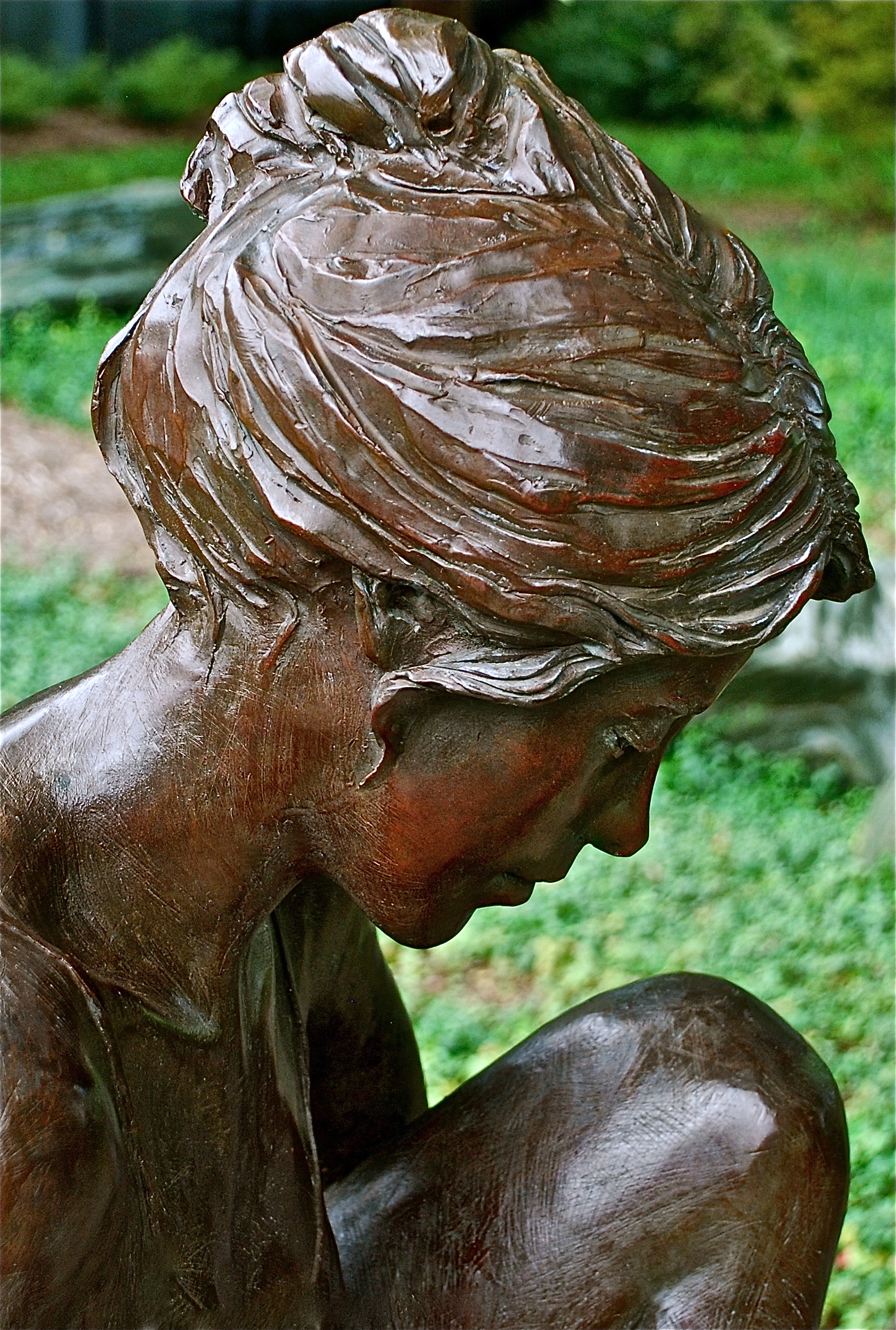
Although I dearly wish it were, the statue in the photo is not in my garden.  She is one of several scattered around our city’s Botanical Gardens.  The captivating sculpture in her quiet reverie and reverence is not unlike a “be” verb in that she expresses a state of being, and I think she does it ever so engagingly.  In fact, when I look at her, especially her bowed head, I get the feeling I’m observing someone deep in contemplative prayer.  Given that, I’m always a little reluctant at first to move in too close for fear of disturbing her petitions.  William Faulkner said that “the aim of every artist is to arrest motion, which is life, by artificial means and hold it fixed so that a hundred years later, when a stranger looks at it, it moves again since it is life.”  How successful then was the artist who crafted this bronze “lady of the garden!”  I’ve always sensed life and movement in her, and as an admiring observer, I am moved inwardly in her presence.  Her movement is not flamboyant; instead it is more of a faint in and our movement of breath.  Another thing that fascinates me about the statue is that there is a warmth in her presence even on bitterly cold, wintry days.  It’s a kind of glowing warmth that speaks of life, holy and not in the least profane.

Sing to Him, sing praise to Him; tell of all His wonderful acts.  Glory in His holy name; let the hearts of those who seek the Lord rejoice.  Look to the Lord and His strength; seek His face always.  ~1 Chronicles 16:9-11  ✝

156. I have always been delighted at the prospect of a new day, a fresh try, one more start, with perhaps a bit of magic waiting somewhere behind the morning. ~J. B. Priestley

I do believe in an everyday sort of magic–
the inexplicable connectedness we sometimes experience
with places, people, works of art and the like;
the eerie appropriateness of moments of synchronicity;
the whispered voice, the hidden presence,
when we think we’re alone.
~Charles de Lint

Image

Rose Fyleman (1877-1957) was an English writer and poet of exceptional talent who was best known for her works on the “fairy folk” for children.  She also translated many rare children’s books from French and German into their first English translations.  She eventually became the editor of one of the first children’s magazines called The Merry Go Round.  Rose was born in Nottingham, England, and there is speculation that it could have been the magical setting of Nottingham which led her to believe in fairies.  Whatever the reason, she blessed generations of readers with her lovely fairy poems.

It was one of Rose’s poem, Fairies at the Bottom of the Garden, which prompted my post last night about toadstools.  I loved her poetry as a child and I love it still.  I am passionate about gardening and its lore, and when I see creatures like the one in my photo I see how easy it would be to invent stories about “fairies.”  Besides what he said above, Charles de Lint, explained childhood this way:  “It is easy to believe in magic when you’re young.  Anything you couldn’t explain was magic then.  It didn’t matter if it was science or a fairy tale.  Electricity and elves were both infinitely mysterious and equally possible — elves probably more so.”  I believe Creation is both miracle and magic, and the more we try to explain it the more we see how miraculous and magical it is.  R. A. Salvatore said “a world without mystery is a world without faith,” and so it is because it is our faith that tells us what magic is “waiting somewhere behind the morning” and whose is the “whispered voice, the hidden presence, when we think we’re alone.”

There are fairies at the bottom of the garden!
It’s not so very, very far away;
You pass the gardener’s shed and you just keep straight ahead.
I do so hope they’ve really come to stay. . .
~for more of Fyleman’s work go to:  http://www.fairyamber.com/rfyleman.html

By faith he left Egypt, not fearing the king’s anger: he persevered because he saw Him who is invisible.  ~Hebrews 11:27

154. “Just living is not enough,” said the butterfly, “one must have sunshine, freedom, and a little flower.” ~Hans Christian Andersen

Bees sip honey from flowers
and hum their thanks when they leave.
The gaudy butterfly is sure that
the flowers owe thanks to him.
~Rabindranath Tagore

Image

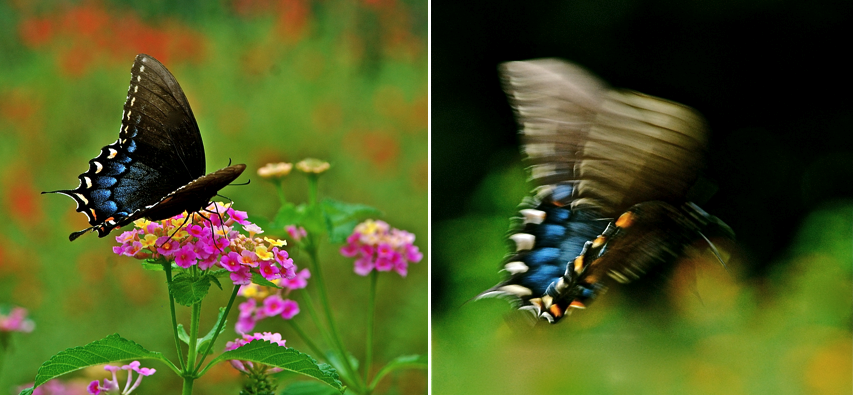
Could there be a more mesmerizing or glamorous creature than the butterfly?  No matter where I am or what I’m doing, the winged beauties stop me in my tracks.  Envious of their dance and fascinated by the way they feed, I watch in awe as they gracefully float from one flower to another.  On this particular trip to our local Botanic gardens, I was thrilled to get a pretty good shot of a swallowtail in flight.  As you can see, butterflies are beautiful even when their likenesses are blurred.  Butterflies, often described as self-propelled or flying flowers, have long been venerated all over the world.  We see a variety of artistic depictions of them in many cultures, including the 3500-year-old ones on Egyptian hieroglyphs.  They are also the darlings that inspired the images of “butterfly fairies” both in art and as fictional characters in stories.  They have been used as well as symbols of God’s favor, good luck, the human soul, love, and rebirth.  Simply put, they are to the world of insects what the rose is in the world of flowers–incomparably beautiful.

How sweet are Your words (Lord) to my taste, sweeter than honey in my mouth.  ~Psalm 119:103  ✝

153. The soul would have no rainbow had the eyes no tears. ~John Vance Cheney

The flower offered of itself
And eloquently spoke of God
In languages of rainbows
Perfumes,
And secret silence. . .
~Phillip Pulfrey, photographer, painter, and poet

Image

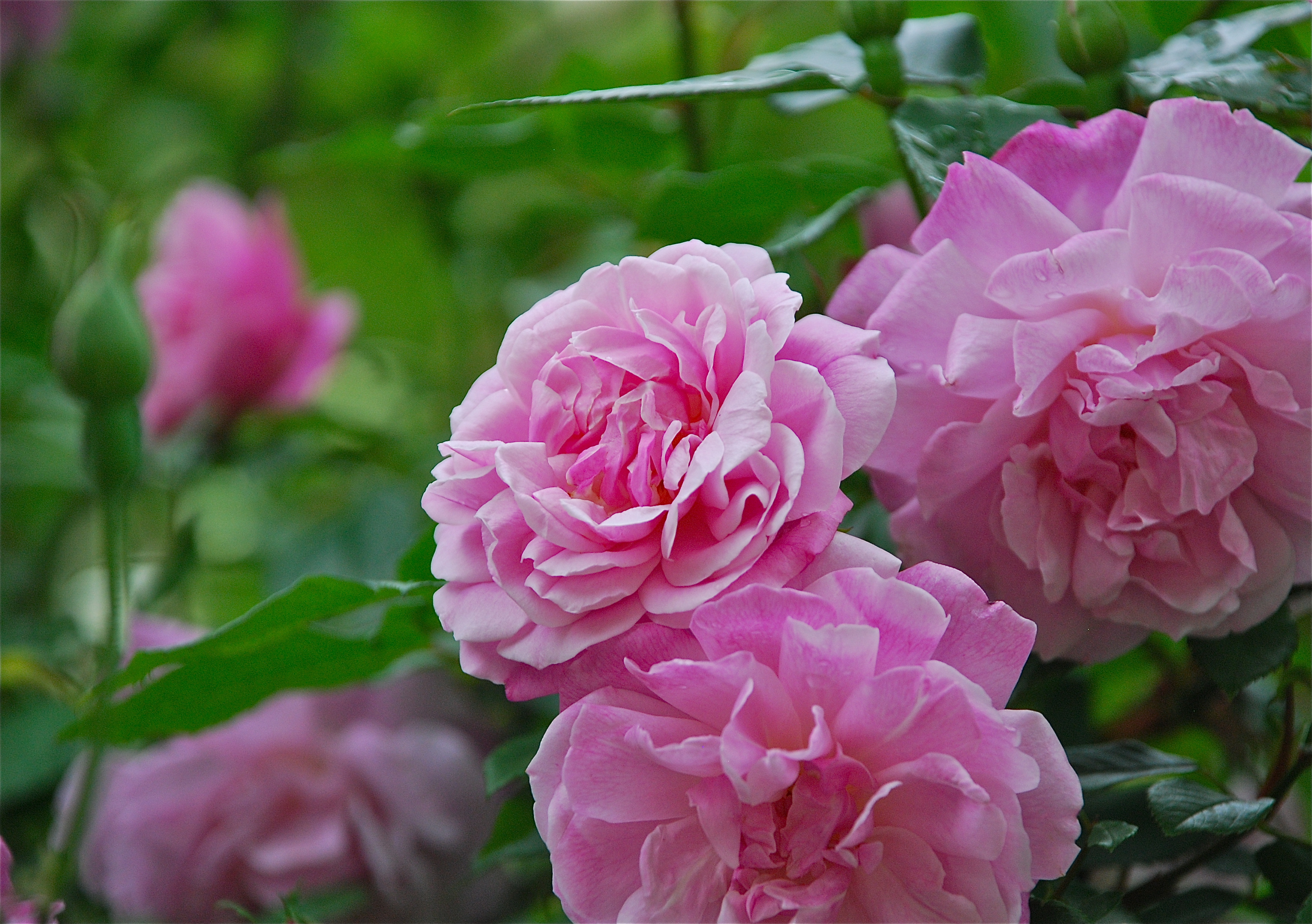
Almost comically what brought roses to Texas began with a “slow boat to China,” as it were.  The Chinese had been cultivating roses for over 5,000 years. Then during the early 19th century, ships of the East India Company brought the repeat-blooming China roses from the Orient to Europe.  Once there the Europeans bred the China roses with their once-blooming roses.  Eventually progeny of the old China roses, the once-blooming European roses, and their hybrids were brought to the Americas by the early settlers.  However as time passed, the public grew to have a greater desire for the more modern roses, and nurseries stopped offering old roses.  Thankfully in the last couple of decades there has been resurgence of interest in the old garden roses, and they are readily available to the public again.  In my garden most of the 70+ roses I’ve planted are roses of antiquity.  I’ve found that they are much hardier, and I love wondering what roads they must have traveled to get here, but the best part is that in every season my old garden roses speak to me more and more distinctly of God, His love, and His faithfulness that can be seen in His rainbows.

I have set my rainbow in the clouds, and it will be the sign of the covenant between me and the earth.  -Genesis 9:13    ✝

*In the photo is the China Rose named, among other things, “Old Blush.”  She is one of the most famous of the China roses and an important parent of literally thousands of other roses.  She is generally accepted as the first East Asian rose cultivar to reach Europe.

150. He made you a part of Creation, and you praise Him in glorious celebration. ~Katherine R. Lane

Bring to me then the plant
that points to those bright Lucidites
swirling up from the earth,
and life itself exhaling that central breath!
Bring me the sunflower crazed with the love of light.
~Eugenio Montale

Image

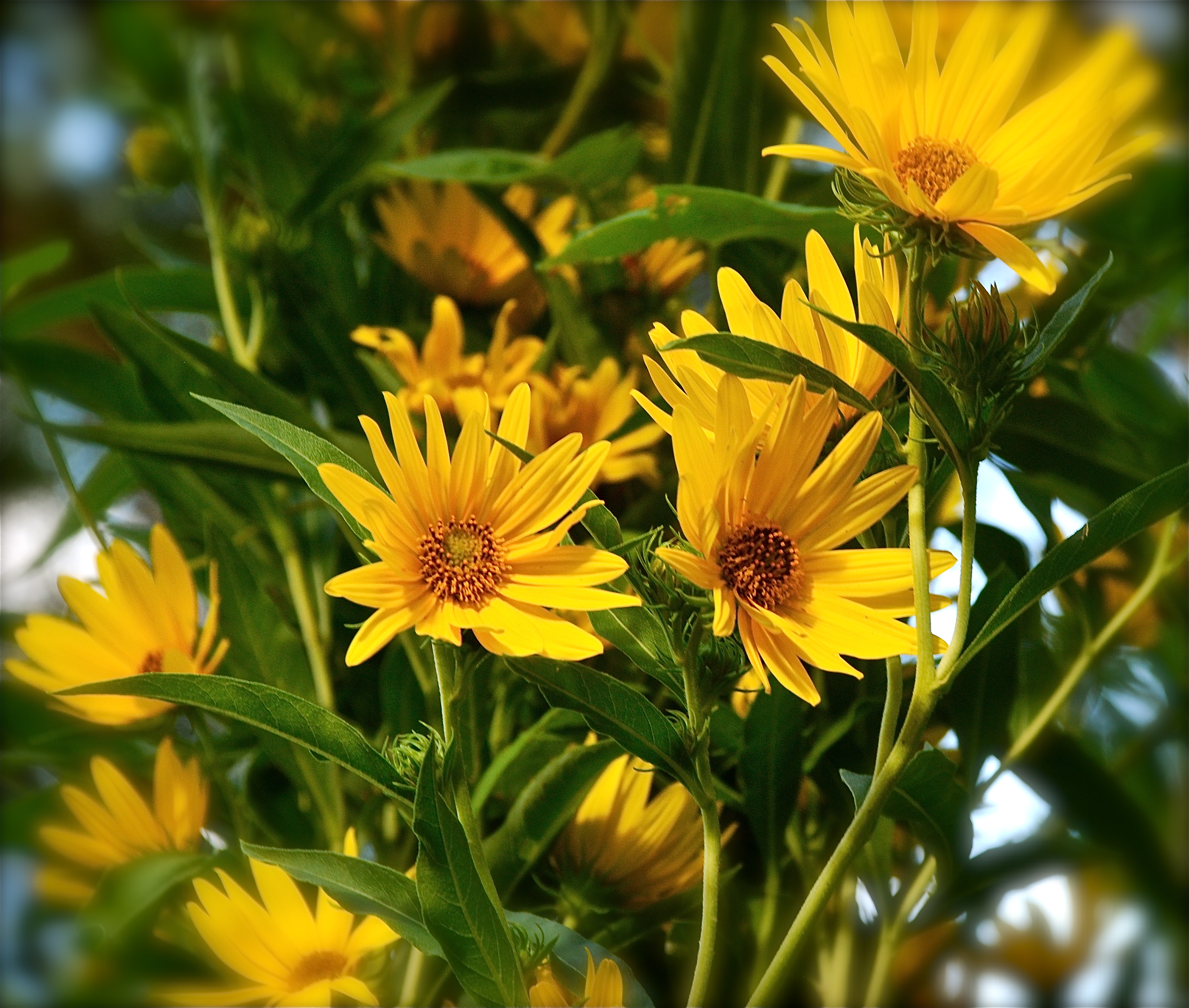
The Maximilian sunflowers in the photo are natives to Texas, but they extend north throughout the tall-grass prairies of the central plains where they were discovered in the 19th century by a German botanist named Prince Maxmilian Alexander Philip von-Wied-Neuwied, thus their rather lofty sounding name.  When I planted 2 of them several years ago, I knew that like their name, they would reach lofty heights before beginning to bloom in September, and that first summer they grew to about 7 feet.  However, by the second year these perennials herbs were reaching heights of 12-16 feet or more, and although I know people like to claim that things are always bigger in Texas, I’m not buying that.  So I did some research and come to find out the more one waters them the taller they grow.  Okay, so now what to do?  Well, before digging them up and moving them or admitting to my husband that I do, in fact, water too much, I’ve decided to give them one more year where they are and try a trick I recently read about; a plantsman in one article said if I pinch off the growing tips when the plants are 3-4 tall I will get shorter plants with more flowers.  More flowers, did he say more flowers?  Now that’s sweet music to my ears!

They are like a well-watered plant in the sunshine, spreading its shoots over the garden. . .  ~Job 8:16  ✝

149. It would be worthwhile having a cultivated garden if only to see what autumn does to it. ~Alfred Austin, British poet laureate

Lord, it is time.
The summer was very big.
Lay thy shadow on the sundials,
and on the meadows let the winds go loose.
~Ranier Maria Rilke

Image

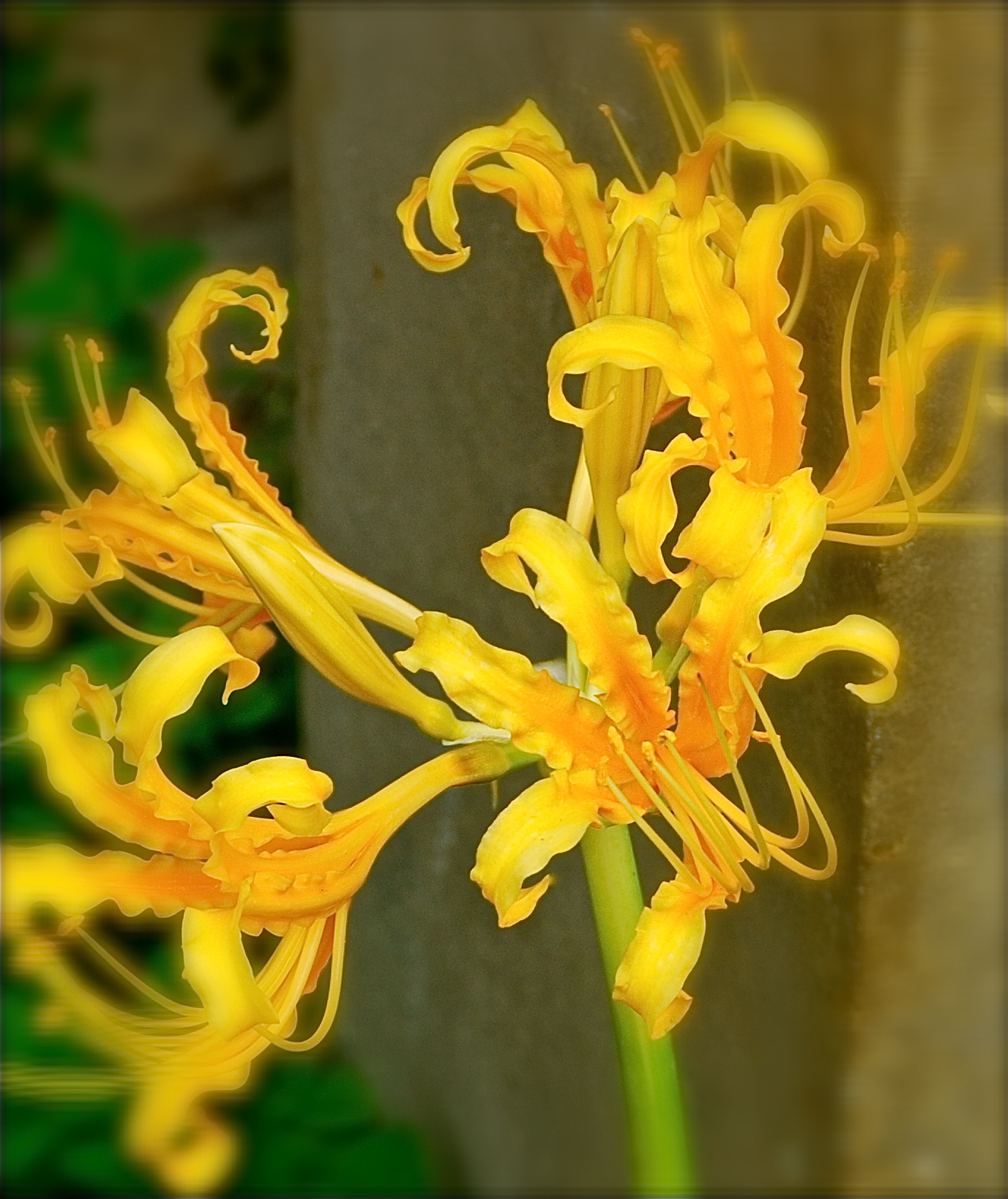
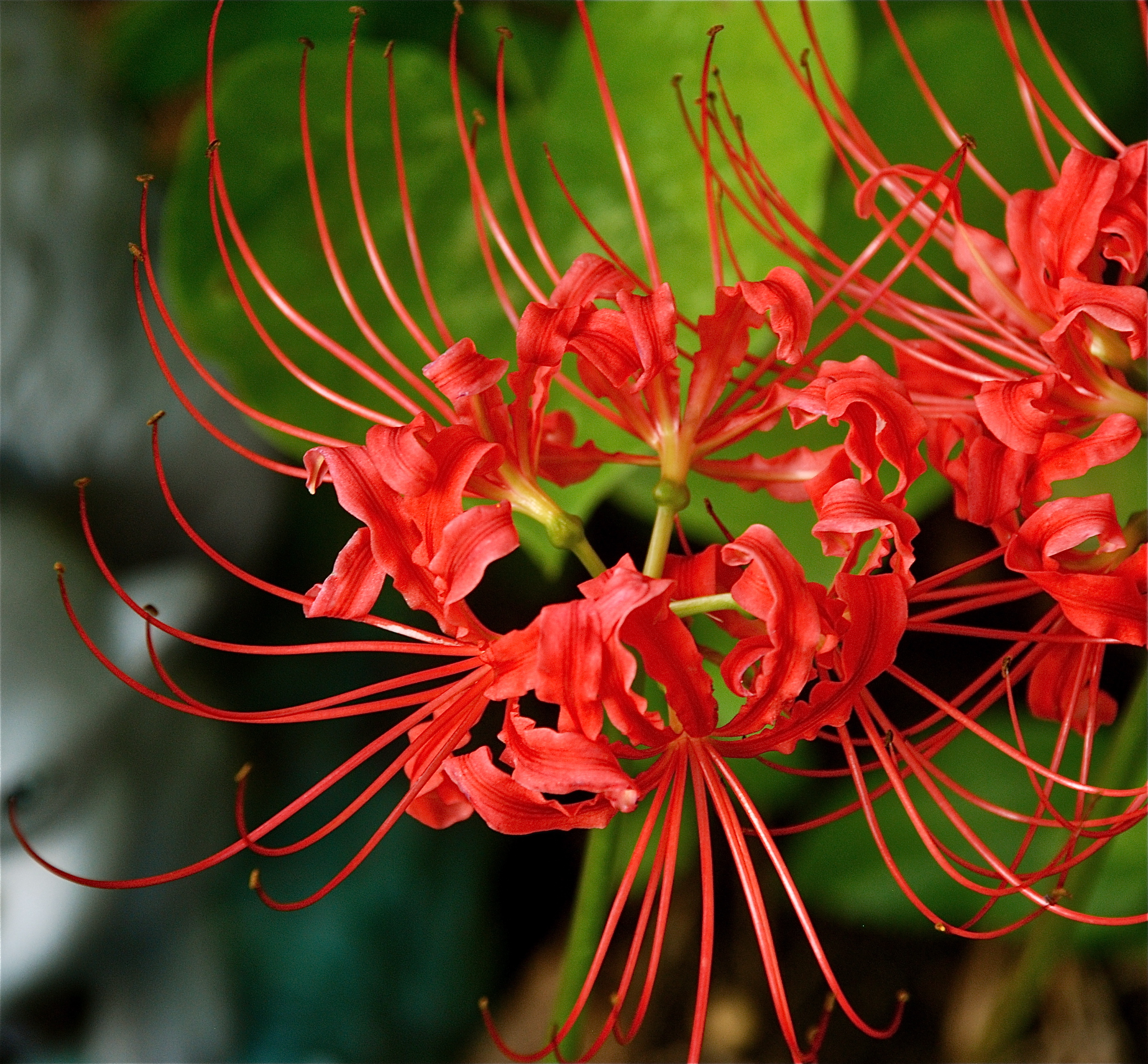
The beauty in the photo above, like the summer sun, is the color of gold.  And her petals have slightly wavy edges that seem to mimic the summer’s waves of heat that lead up to her appearance in the garden where she winks at people passing by with her long, wispy eyelash-like stamen.  In Latin the word “stamen” means “thread of the warp,” and it was Emerson who birthed the idea that “days are made on a loom whereof the warp and woof are past and future time.”  Apparently what he said ‘tis true since these threads of the warp are definitely forerunners of the future.  When they appear in the garden, hurricane season has begun and autumn is drawing near.  But who is she, this fair maiden dressed so elegantly in gold?  She and others like her are called Golden Spider Lilies, Naked Lilies, Surprise Lilies, Golden Hurricane Lilies, and/or Lycoris.  But whatever one calls them, they’re always dressed in their rich, apricot-yellow-orange finery, and their blooms which appear late in the summer after their leaves have disappeared create a lovely sweeping quality in the garden.  The official name of the species is Lycoris aurea, and it originated in China where it is known as “Hudixiao” (Suddenly The Soil Shines).  But she is not an only child; for she has an amazing sibling, Lycoris radiata, the Red Spider Lily.

Image

Now look again at the yellow one.  I deliberately blurred the outer edges of the photograph so the heart she was forming in the middle was more noticeable.

Acknowledge and take to heart this day that the Lord is God in Heaven above and on earth below.  There is no other.  ~Deuteronomy 4:39  ✝

147. If you wish to know the Creator, come to know His creatures. ~Columbanus, 6th century Irish monk

A flash of harmless lightning,
A mist of rainbow dyes,
The burnished sunbeams brightening
From flower to flower he flies.
~John Banister Tabb, Roman Catholic priest,
poet and professor of English

Image

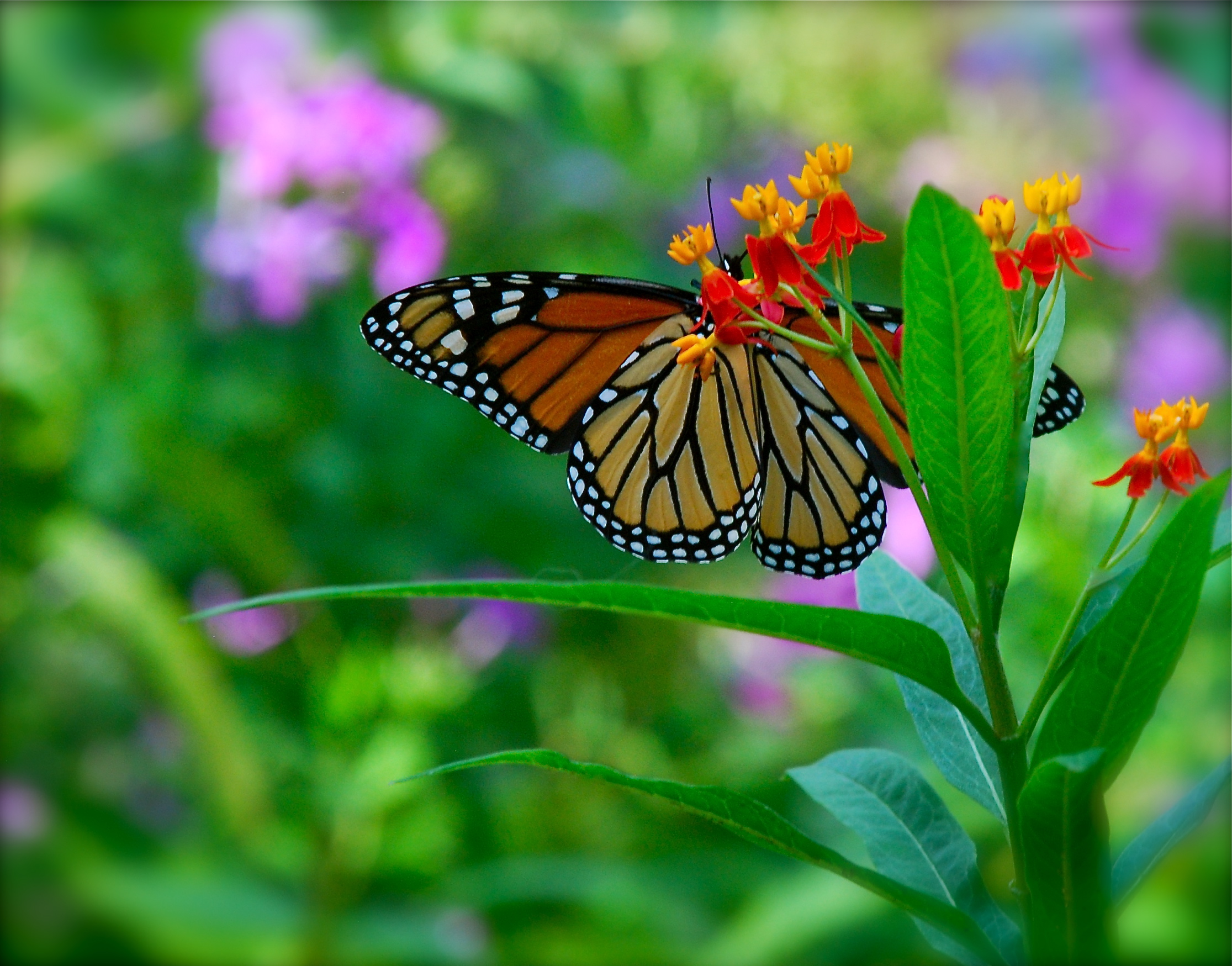
Tabb’s description is of a hummingbird, but it could be said as well of bees, butterflies, and dragonflies, hordes of which I’ve seen of late.   Gulf fritillaries and an assortment of swallowtails have been flitting around the garden for weeks.  Then today I spotted the first monarchs which means their migration from Canada to overwintering grounds in Mexico has begun.  I’m guessing the reappearance of the dragonflies is because recent rains have filled their breeding grounds again with enough water for their nymphs.  The bees are back in greater numbers because the cooler temperatures are encouraging more and more blooms, and as for the hummers, two or three at a time have been coming to our feeder since early August.

John Philip Newell says, “the inclusion of creatures in the garden of God in Genesis is pointing not simply to the outward dimension of the creaturely realm.  It is also showing something of the way of God’s seeing or sensing. . .”  That’s why I I love my garden.  It’s not just about the flowers.  Spending time therein lets me be near all God created and keeps me wanting to know more of the Lord and that which is important to Him.

“But ask the animals, and they will teach you, or the birds of the sky, and they will tell you; or speak to the earth, and it will teach you, or let the fish of the sea inform you. . .”  ~Job 12:7-8  ✝

144. In the right light, at the right time, everything is extraordinary. ~Aaron Rose

For me, a landscape does not exist in its own right,
since its appearance changes at every moment;
but the surrounding atmosphere brings it to life – the
light and the air which vary continually.
For me, it is only the surrounding atmosphere
which gives subjects their true value.
~Claude Monet

Image

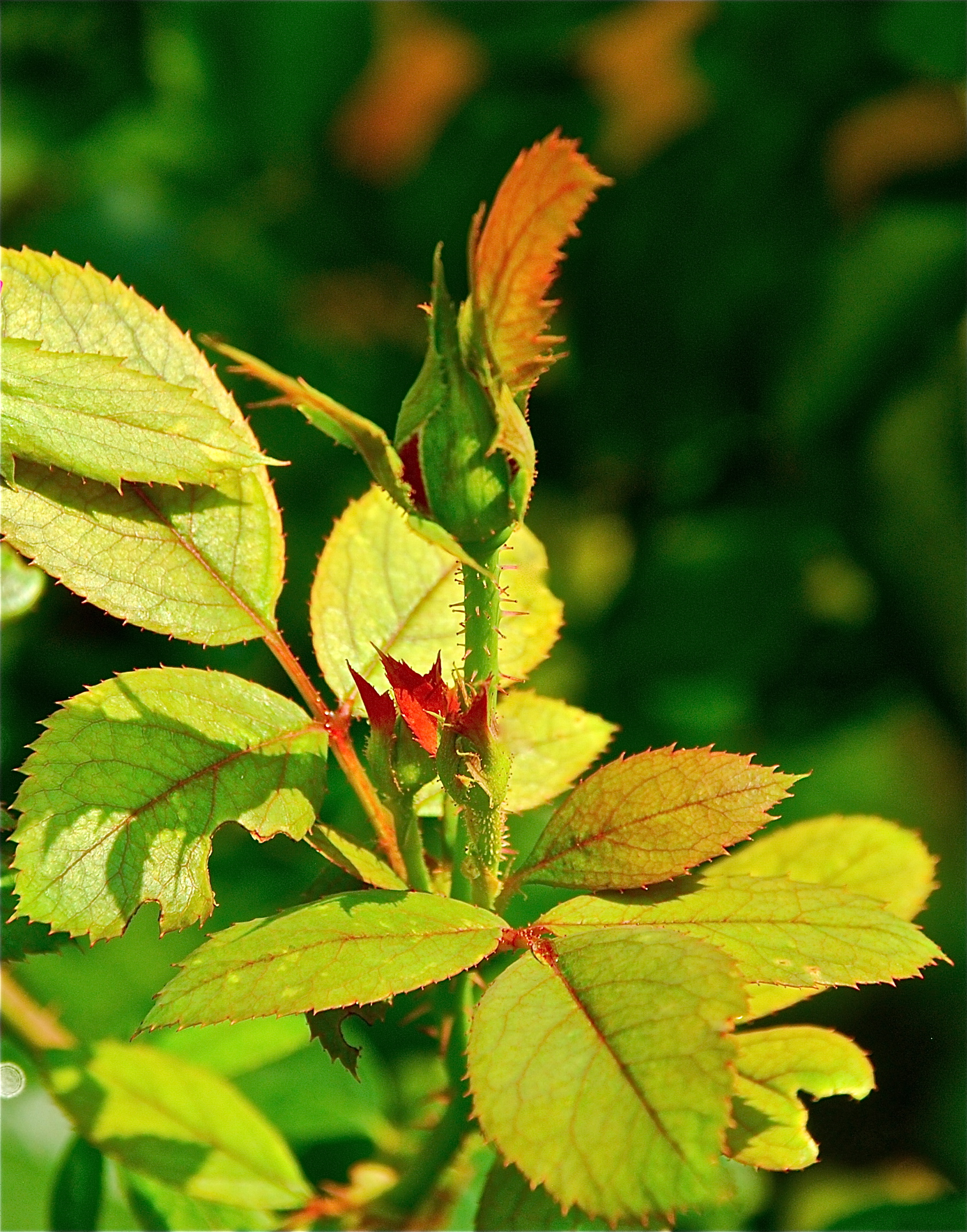
Living in a garden day after day, being a participant in all its events, witnessing the changes from season to season, and watching the way differing light falls on the landscape make gardening a thrilling experience.  The fact that colors in the garden change off and on during the course of a day fascinates me.  In morning light the hues are vivid and bright, but as daylight mellows into twilight, they melt into quieter, more subdued tones.  Light even affects the fragrance of things for it is only in the cooler moments of early morn and twilight that the strongest aromas are dispelled from herbs and flowers.  But then things are not just affected by changes in lighting.  Sometimes colors change as flowers and leaves age, when temperatures rise or fall, when changes occur in the content of the soil, or when rainfall is lacking or in abundance.  That’s why without looking at a calendar, I can tell that the rose bud in the photo is one born of recent rainfall and the passing of the autumnal equinox.  The constancy of this inconstancy defines the soul of a garden, and, like all else in nature, speaks to me of rhythmical and purposeful ordination.

Awake, north wind, and come, south wind!  Blow on my garden that its presence may spread everywhere.  Let my beloved come into his garden and taste its choice fruits.  ~Song of Songs 4:16   ✝

142. Red is the ultimate cure for sadness. ~Bill Blass

May you be blessed with
warmth in your home,
peace in your soul
and joy in your life.
~Irish blessing

Image

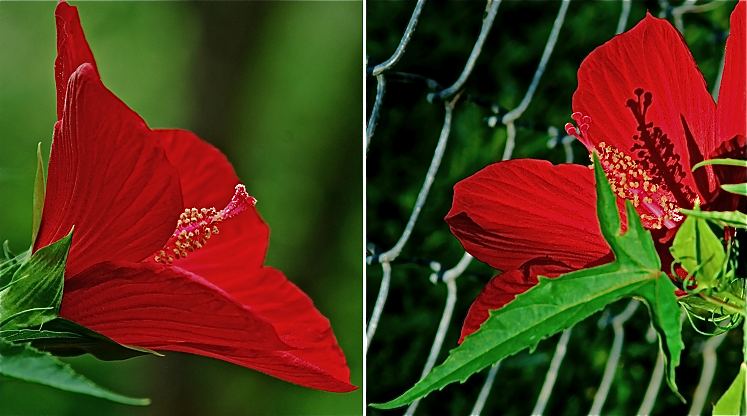
A swamp mallow is she in the photograph, and like her name she is one of the stars of our hot Texas summers.  Her scientific name is Hibiscus coccineus, but here in the Lone Star state she is commonly called the Texas Star Swamp Hibiscus. The Star can grow as tall as 7 feet and puts on stunning four inch crimson blossoms.  Another perk is that she attracts hummingbirds, butterflies, and other avian visitors.  However, according to some she can be as big a challenge as the state she’s named after.  In my garden, however, I’ve found her surprisingly easy to manage, and I love that her season runs from June to October and provides lush summer and fall color.

Your ways, God, are Holy.  ~Psalm  77:13  ✝