295. Of all God’s gifts to the sighted man, color is the holiest, the most divine… ~John Ruskin

In the house of words was a table of colors.
They offered themselves in great fountains,
and each poet took the color he needed:
lemon yellow or sun yellow,
ocean blue or smoke blue,
crimson red, blood red, wine red.
~Eduardo Galeano
Image

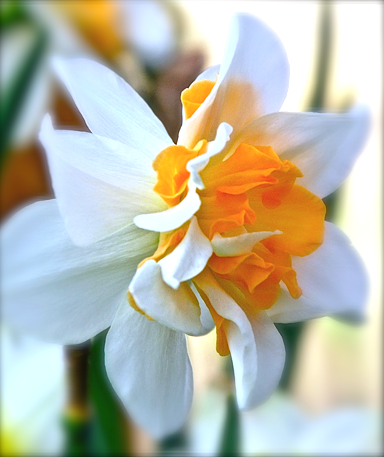
What a glorious tangerine and white dream is the daffodil in the photograph, and holiness indeed is written all over it!  As God speaks to mankind through the Bible and Creation, we can see that He values color, the intent of which seems, like all else, to be that its hallowed voice draw His children closer to Him.  Color appears first in holy writ in the opening pages of Genesis when God fathered the whiteness of light on day 1 of the Creation story.  Then on the second day the Lord created expanses to separate water from water, and both the sky and the reflection of the heavens in it are shades of blue.  On day 3 He created earth’s green vegetation.  Day 4 brought the placement of lights that governed the heavens, and day’s greater light, the sun, is yellow; up close pictures of the sun also show reds and oranges in its make up.  Fish and great sea monsters swam the seas and birds took flight on the fifth day, and whales and sharks have been seen as hallmarks of an ancient pagan idol symbolized by the color orange.  The sixth day brought the creation of man and animals; the name Adam means red and the blood that courses through the veins of man and beast alike is red.  Day 7, the Sabbath, was sanctified by God whose robes and glory are perennially symbolized by white, and later when atoning for man’s sins His son, Jesus, wore a purple robe.

“And to every beast of the earth, and to every bird of the air, and to everything that creeps on the earth, everything that has the breath of life, I have given every green plant for food.” And it was so.  God saw everything that he had made, and indeed, it was very good.  Genesis 1:30-31  ✝
214. Angels descending, bring from above, echoes of mercy, whispers of love. ~Fanny J. Crosby

Ever felt an angel’s breath
in the gentle breeze?
A teardrop in the falling rain?
Hear a whisper among the rustle of leaves?
Or been kissed by a lone snowflake?
Nature is an angel’s favorite hiding place.
~Carrie Latet

Image

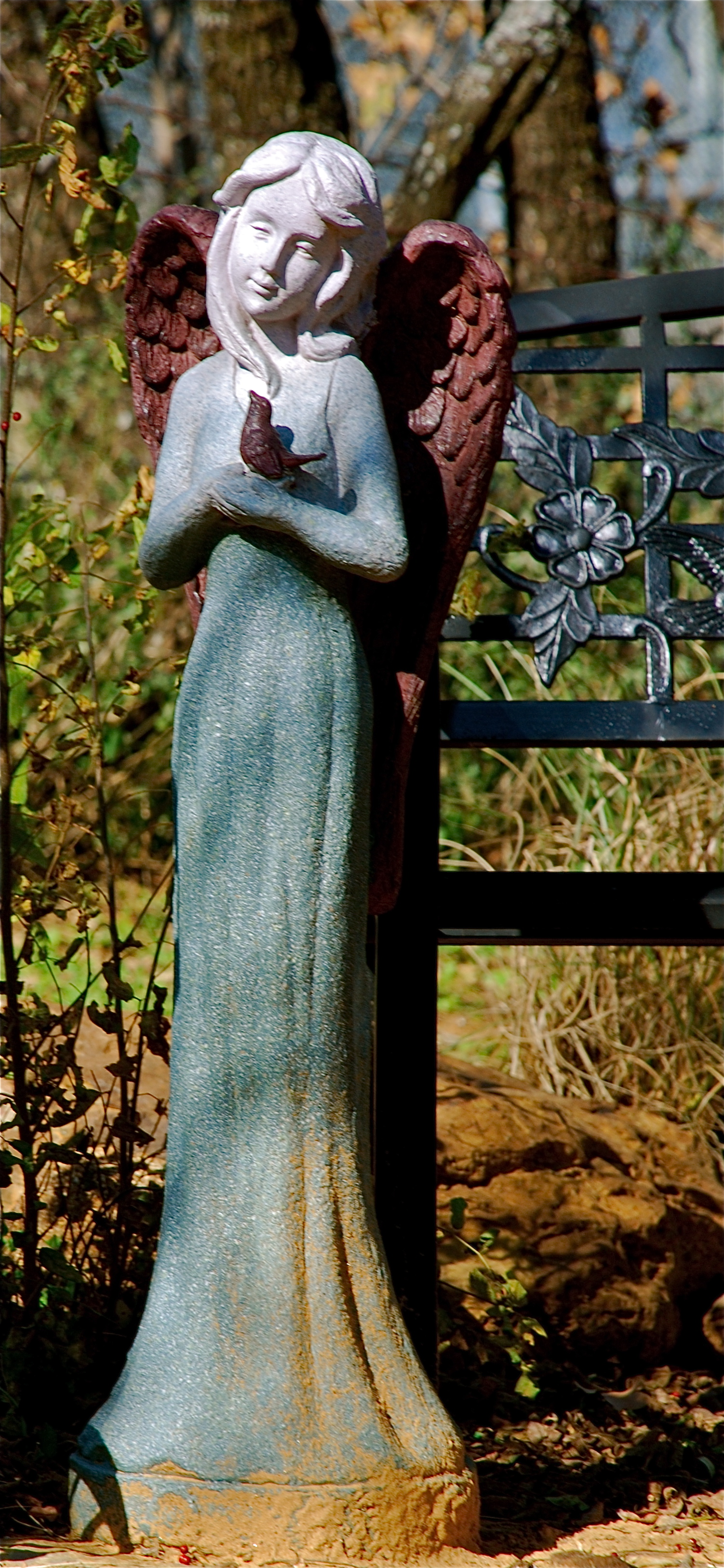
Standing amid the remains of a dying year and clothed in a dress splattered with mud this garden angel retains every bit of her vibrant elegance.  Even in the high winds of last week’s arctic storm she held her ground, waiting and watching, as quietly as the trees and dormant roses around her.  And the angel will keep on watching over this garden while my friend, inside the house, continues to busy herself attempting to heal hurting, human hearts; for you see, my friend, like an angel, is a also guardian.  She guards the secrets of her clients who entrust the painful realities of their pasts to her keeping.  Both she and her garden angel then are reminders of the Lord’s love and watchfulness over Creation and His children.  The fruits of the Holy Spirit with which my friend is gifted are what she draws upon to sustain her clients while she speaks words of wholeness in their wounded spirits.  Why is speaking the tool of her trade?  The Lord spoke the world and all that live in it into being; therefore, the spoken word in all of us who are created in His image has great power, power for good and for evil.  When any of us choose to speak loving, affirming words they fall on mortal ears like the sweet breath of an angel whispering incantations of healing benedictions.  So it is that my friend’s loving words of understanding and compassion and wisdom can be to the soul of her clients what water, in this dry and arid land, is to her garden.

Then God said, “Let us make mankind in our image, in our likeness, so that they may rule over the fish in the sea and the birds in the sky, over the livestock and all the wild animals, and over all the creatures that move along the ground.  ~Genesis 1:26  ✝

174. The greatness of a nation and its moral progress can be judged by the way its animals are treated. ~Mahatma Ghandi

If all the beasts were gone,
men would die from a great loneliness of spirit,
for whatever happens to the beasts
also happens to the man.
All things are connected.
Whatever befalls the Earth befalls the sons of Earth.
~Chief Seattle of the Suquamish Tribe

Image

The creatures of earth, sea and sky came forth “out of the waters of God’s life.”   And their arrival was yet another manifestation of the visible from the invisible–another disclosure of the mystery of God.  In addition, “with the birth of the creatures there is the emergence of seeing, hearing, smelling, tasting, and touching.  The light of the sun and the whiteness of the moon can now be seen.  The wind blowing through the leaves of trees and the crashing of ocean waves can be heard.  The early morning fragrance of the earth can be smelled.  Its fruit can be tasted, and its textures touched,” writes J. Philip Newell.  It has even been said that if one wants to know the Creator, one of the ways to gain insight is to know His creatures, and I think that’s especially true when it comes to examining the sensory aspect of their coming.  For does not the ability to see, that the creatures brought, teach mankind to see with the eyes of the heart?  In the silences of humanity’s reality does not the ability to hear teach men to listen for the “echo of the spheres” and the still, small voice of God?  Do not the abilities to smell, taste, and touch help mortals meet their Savior, Jesus, through the holy sacrament of the Eucharist (Communion)?

And to all the beasts of the earth and all the birds in the sky and all the creatures that move along the ground–everything that has the breath of life in it–I give every green plant for food.”  And it was so.  ~Genesis 1:30

170. Ones sees clearly only with the heart. Anything essential is invisible to the eyes. ~From THE LITTLE PRINCE by Antoine de Saint Exupéry

Every man knows well enough
that he is a unique being, only once on this earth;
and by no extraordinary chance will such
a marvelously picturesque piece of diversity in unity,
ever be put together again a second time.
~Friedrich Nietzsche

Image

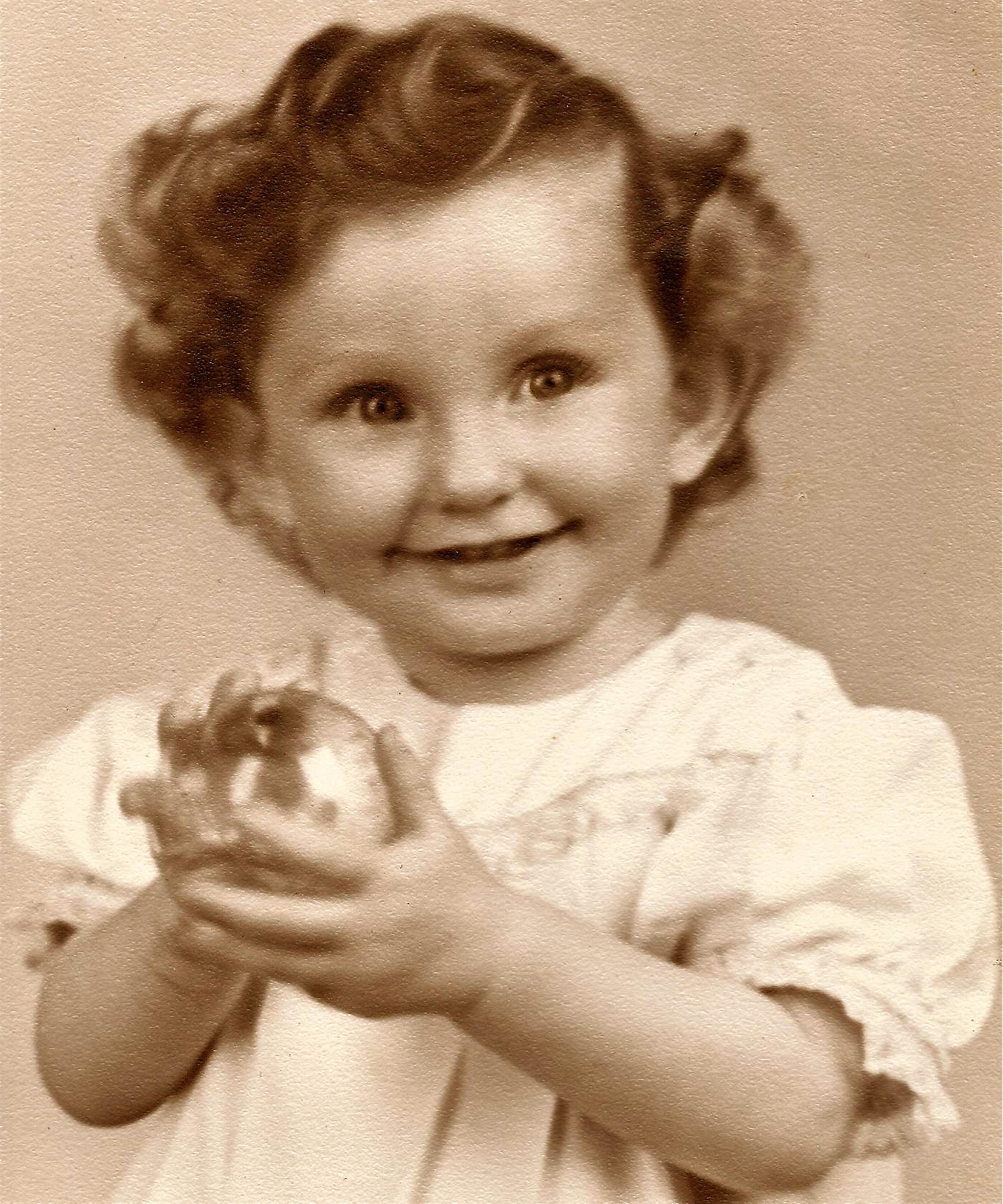
Like the child in the photograph holds her ball, God holds us in the palm of His mighty hands.  And since His Word tells us we are made in His image, that speaks to me of the vast and diverse abilities of our Maker.  It tells me He is bigger and more powerful than I could ever imagine.  It tells me there is a distinct reason for the uniqueness of every created entity.  And because we are made in the image of a loving and good God, it tells me I am meant to be in relationships that deepen my reverence and affection for others and my Creator.  It tells me that what my eyes see should be filtered first through my heart of hearts and not through bias or preconceived notions.  It tells me that what I am matters only in the light of what I do for everyone and everything that crosses my path, be they flowers, or creatures, or people.  If not so, then why do things and people I cherish remain tied to my heart in some way even when they are not in sight, and why is it that what’s tied to my heart is far more than just the sight of them.

When I consider Your heavens, the work of Your fingers, the moon and the stars which You have set in place, what is mankind that You are mindful of them, human beings that You care for them?  ~Psalm 8:3-4  ✝

164. Is not this a true autumn day? Just the still melancholy that I love — that makes life and nature harmonize. ~George Eliot

Delicious autumn!
My very soul is wedded to it,
and if I were a bird I would fly about the earth
seeking the successive autumns.
~George Eliot

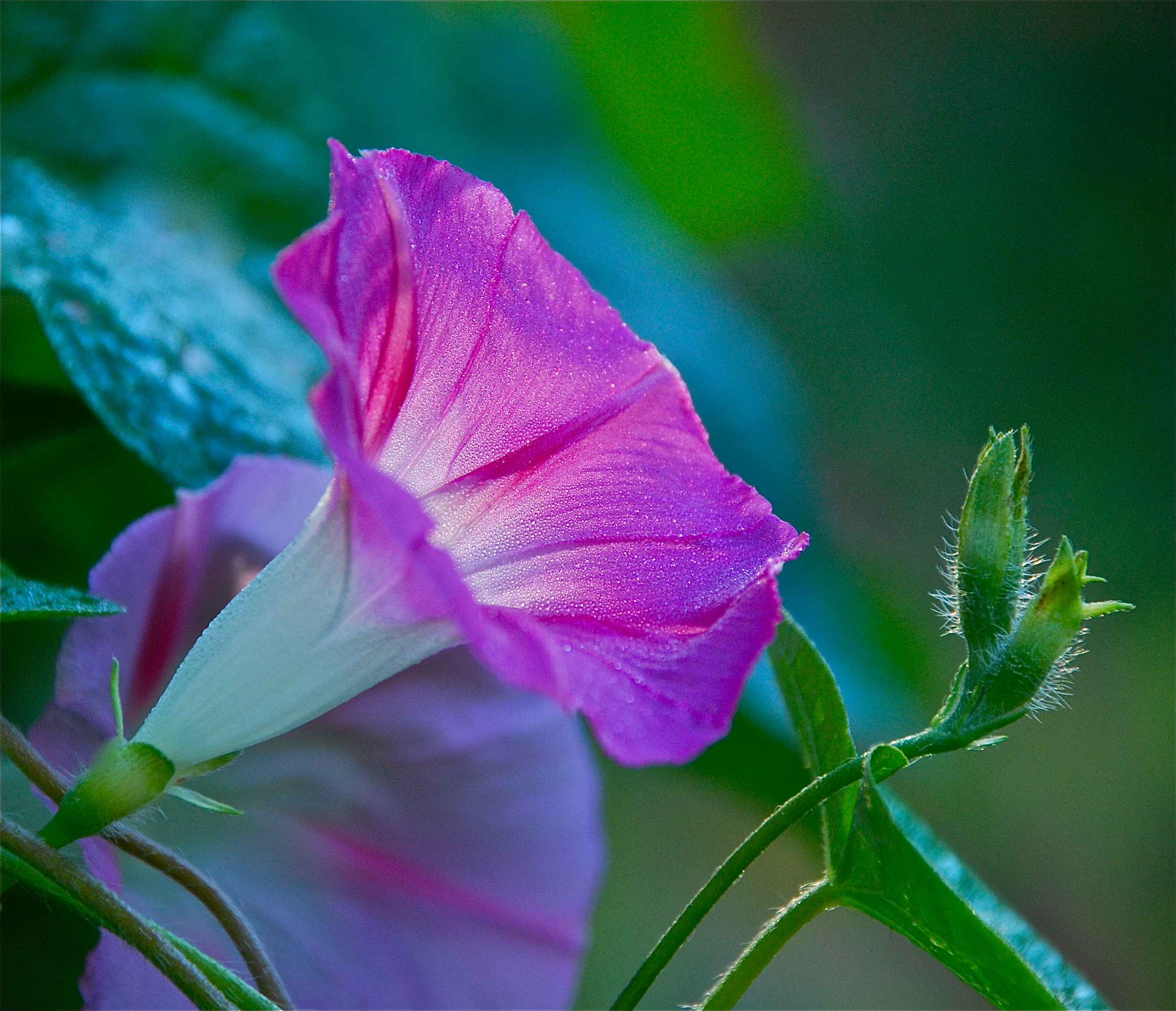
**I was hoping you could see that the morning glory below, heavy with dew after the rain, was an awesome, pink delight to behold, but the image is too smalll here for you to see its alluring sparkle.

Image

Northerly winds in the night blew our gray, rain-bearing clouds away, and the day dawned under a fresh, China blue sky.  Layers of dust that had been blowing in on southerly winds for weeks were washed away, sent back to the soil from whence they came.  As a result heaven’s dome along with the landscape looked sparkling clean and pristine.  In the day’s early light growing green things shined greener, new growth pushed up on rose canes, seedlings appeared in soil once parched and cracked by summer’s fiendish assaults.   Wildlife, though always smaller in number in October, flew, crawled, and buzzed with renewed energy and enthusiasm in the aftermath of the recent slow, soaking rains.  And so with a bit of an almost frosty nip in the air, this day evolved into our first quintessential, autumn day.  How, then, on such a day, could the early call to venture out in the yard, camera in hand, have been ignored?  Or how could it have been a surprise that the vignettes I found were so exquisite that all I could muster, with eyes blurred by joyful tears, was praise for the Holy One whose presence amidst the glory was sweetly palpable?

Let them give thanks to the Lord for His unfailing love and his wonderful deeds for mankind.  Let them sacrifice thank offerings and tell of his works with songs of joy.  ~Psalm 107:21-22  ✝

136. The bee is more honored than other animals, not because she labors, but because she labors for others. ~Saint John Chrysostom

His Labor is a Chant–
his idleness–a Tune–
oh, for a Bee’s experience
of Clovers, and of Noon!
~Emily Dickinson

Image

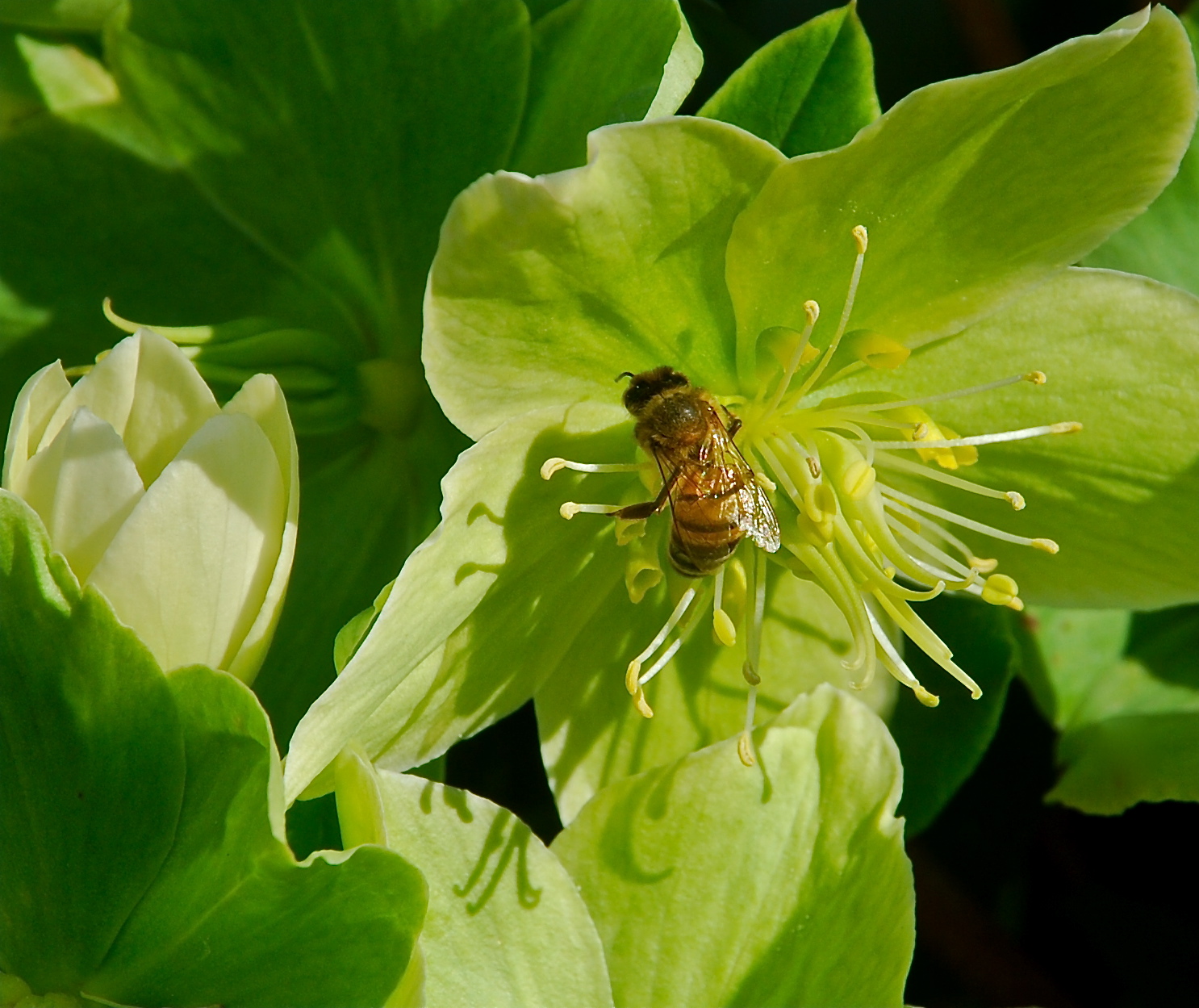
Honey bees and bumblebees, it seems, find a flower’s countenance as irresistible as I, and that “irresistibility” is of holy intent.  In the passage of Scripture that follows, we see that the Lord’s plan involved an interconnectedness of all life as well as a dependency, one on the other.  The poet, Kahlil Gibran, explains that connectedness in this way: “a flower is a fountain of life” for the bee, and to the bee and flower “the giving and receiving is a need and an ecstasy.”  But wait, how is any of this relevant in the 21st century?  In the age of incredible and still advancing technology should anyone care about flowers and bees?  Indeed all of us should care because bees are absolutely essential pollinators, and sadly there are now alarming reports which indicate that one fourth of the northern hemisphere’s honeybee population mysteriously vanished by the spring of 2007.  Then by the end of 2008, one in three hives was left lifeless.  Simply put, the honeybee is disappearing at an alarming rate across the entire globe.  The worst part is that those in the know are not sure why this is happening, but they do know that should the increasing catastrophe not be addressed and solutions to the problem not found, the complete loss of honeybees as pollinators would mean the end of agriculture as we know it.  Since much of what we wear and one third of what we eat depends on the pollinating activity of honeybees, our way of life and civilization would be threatened.  In fact one report said the situation is so dire that mankind would survive only 4 years after the complete collapse of the honeybee population.

Then God said, “I give you every seed-bearing plant on the face of the whole earth and every tree that has fruit with seed in it. They will be yours for food.  And to all the beasts of the earth and all the birds of the air and all the creatures that move on the ground—everything that has the breath of life in it—I give every green plant for food.”  And it was so.  ~Genesis 1:29-30   ✝

46. A Robin Redbreast in a cage puts all Heaven in a rage. ~William Blake, English poet, painter and printmaker

When father takes his spade to dig
then Robin comes along;
And sits upon a little twig
And sings a little song.
~Laurence Alma-Tadema

Image

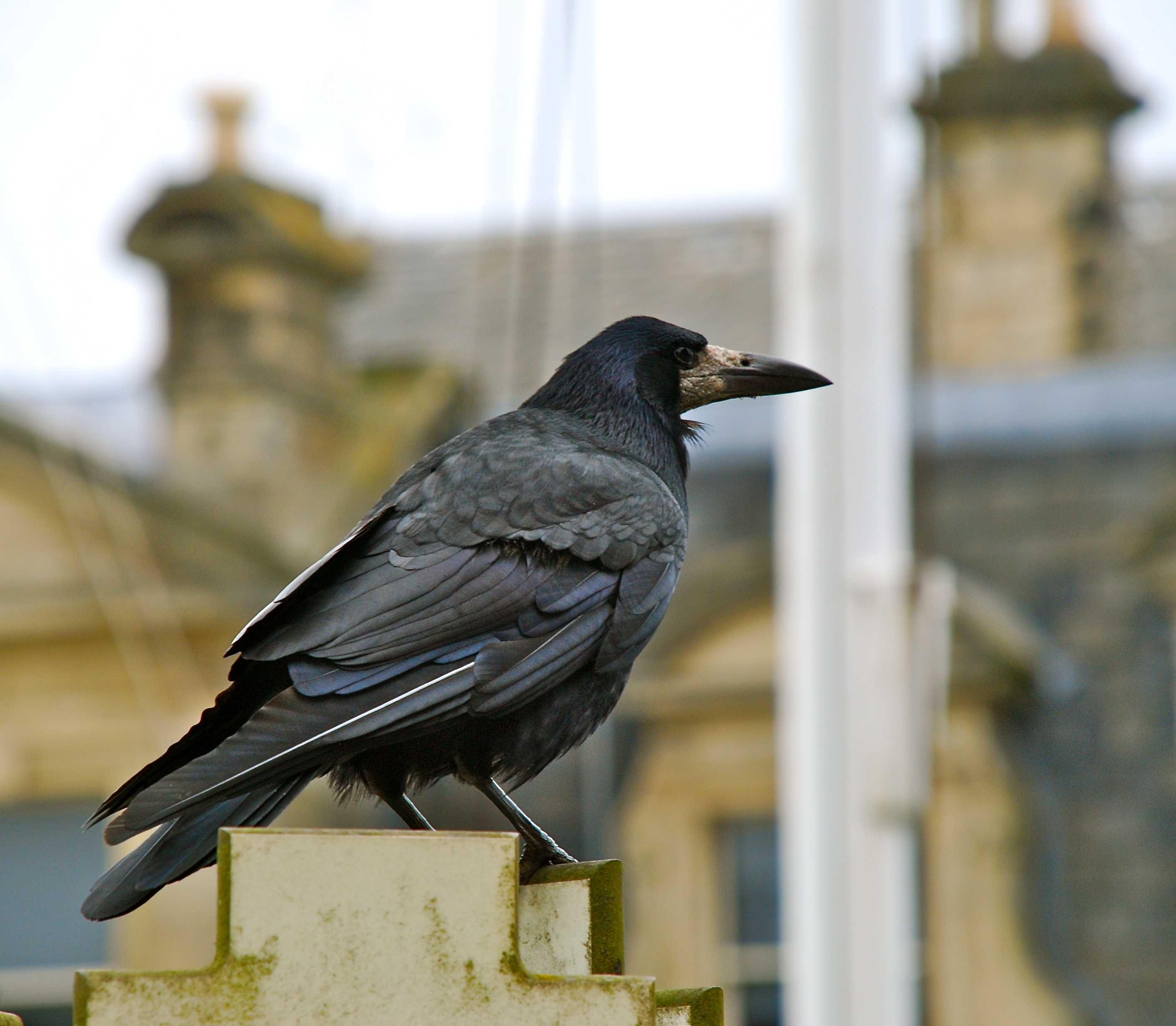
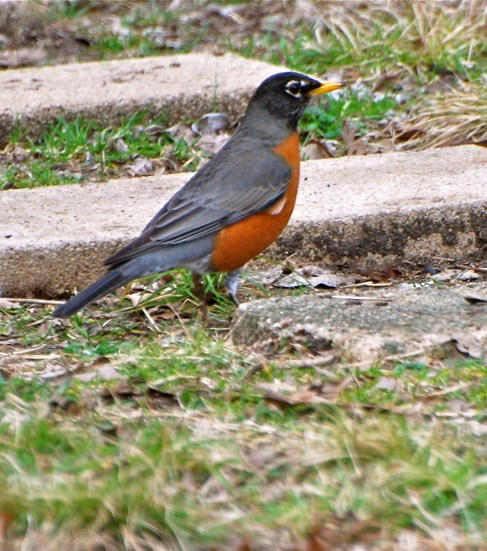
The introductory line is from Blake’s “Auguries of Innocence,” a somewhat lengthy poem consisting of a series of paradoxes in which Blake juxtaposes innocence with evil and corruption. The word augury in the title means omen or token, and the robin is the poem’s first noted “augury of innocence.”  The robin’s song, personality, and countenance are such that it’s obvious why the poet saw the act of putting one in a cage as not only an enraging violation but also as a profound perversion of holiness.  The sweet song and colorful markings of a robin make the bird a delightful harbinger of spring’s infancy and innocence.  Looking forward to its coming is one of my favorite rites in spring’s passage, and like “all heaven” I’d be incensed if the bird’s freedom were taken away and its song silenced.  Below is a legend about the robin that again ties the bird to the blameless and sacred.  Although the truthfulness of legends is questionable, I’m fascinated that somehow, somewhere, and in some way the robin was connected to the Messiah.

The Legend of the First Robin

One day, long ago, a little bird in Jerusalem saw a large crowd gathered around a man carrying a heavy wooden cross.  On the man’s head was a crown made from a thorn branch.  The thorns were long and sharp.  The little bird saw that the thorns were hurting the man.  It wanted to help Him, so it flew down and took the longest, sharpest thorn in its tiny beak.  The bird tugged and pulled until the thorn snapped from the branch.  Then a strange thing happened.  A drop of blood fell onto the bird’s breast, staining it bright red.  The stain never went away.  And so today the robin proudly wears a red-breast, because it helped a man named Jesus.  

“But ask the animals, and they will teach you, or the birds of the air, and they will tell you; or speak to the earth, and it will teach you, or let the fish of the sea inform you.  Which of all these does not know that the hand of the LORD has done this?  In His hand is the life of every creature and the breath of all mankind. . .”  ~Job 12:7-10   ✝

40. Spring shows what God can do with a drab and dirty world. ~Virgil Kraft

Awake, thou wintry earth –
fling off thy sadness!
Fair vernal flowers, laugh forth –
your ancient gladness!
~Thomas Blackburn

Image

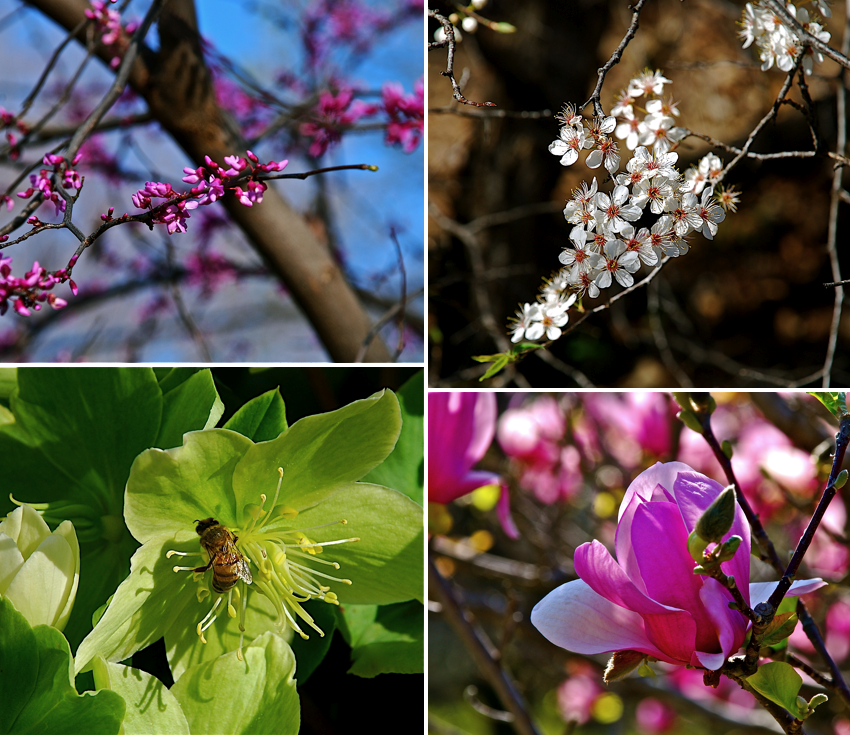
Leaf by leaf, bud by bud, and blossom by blossom the spring of the year advances.   On warmish days, earth casts off its wintry gloom, and breezes broadcast sweetly-scented aromas.  The first butterflies then dare to soar and the hungry bees hum amid the glad laughter issuing forth from flowering bulbs and trees.  As a result the year’s initial poetry of rebirth is penned by the pollinating, aerial whirring of dainty wings.  In the meantime as I hurry about trying to taking photos of the blossoming narratives and their paramours, I often find myself asking the same question Walt Whitman once did.  “Why are there trees I never walk under but large and melodious thoughts descend upon me?”  The answer I’ve decided is that the arms of trees reach towards the heavens to gather sacred messages meant to draw mankind near to “the living Word of God in nature” as well as what is read in Scripture.

In our area the first verses of  “tree” poetry come from Saucer Magnolias.  Their big, goblet-shaped flowers pen exquisite couplets in pink and white.  Soon to follow are the brilliant white blossoms of Star Magnolias.  Though not quite enough lines to form a fourteen-lined sonnet, their twelve exquisite, “petal-poesy” lines form rhyming schemes as lovely as any Shakespearean sonnet.  Next and in perfect rhyming sequences come the double samaras.  Samaras, the scarlet, dual winged fruits of the Red Maple, look like long, slender fairy wings as they dance choric rhymes writ by the winds.  Then come the Eastern Redbuds and Bradford Pears that compose stunning free-verse stanzas in purple and white, each resplendent branch, a psalm written in praise of its Maker.  For a pollinator now there’s no quandary about where sweet nectaries are to be found for stanza after stanza they and I are lead in springtime to earth’s most festive and delicious banquets.

He has taken me to the banquet hall, and His banner over me is love.  ~Song of Songs 2:4

16. The trees reflected in the river– they are unconscious of a spiritual world so near to them. So are we. ~Nathaniel Hawthorne

A Ming vase can be well-designed
and well-made and is beautiful for that reason alone.
I don’t think this can be true for photography.
Unless there’s is something a little
incomplete and a little strange,
it will simply look like a copy of something pretty.
~John Loengard

Image

The annual beauty in a garden once spent is gone forever, except in memory, if not captured in some way.  A camera is one of the ways we who love nature’s fleeting glory take it captive.  Unlike Loengard, I believe photos can be more than just an uninteresting copy of a beautiful thing.  For example part of what you see in the photograph above started out as that of a single rose.  However, as an experiment with some computer technology, I turned the image into something “a little strange,” as Leongard suggests, and it added another level of interest.  If one looks carefully at the altered image, fragmented pieces of what used to be negative spaces in the original photograph now have merged into engaging patterns, and so what can be seen raises questions about how much one really sees.  “While there is perhaps a province in which the photograph can tell us nothing more than what we see with our own eyes, there is another in which it proves to us how little our eyes permit us to see,” claimed documentary photographer and photojournalist, Dorothea Lange. So it is that Hawthorne’s idea could be applied to my rose or his trees or to the reflection of anything, and it would speak a profound truth. We often don’t see what is right under our proverbial noses.  The eternal underlies everything mankind sees, tastes, hears, touches, and smells, so much so that all things seem to quiver from the Divine energy emitted from them.  But it’s only when the Lord’s demure presence is acknowledged that it becomes more and more keenly perceptible.

So we fix our eyes not on what is seen, but on what is unseen. For what is seen is temporary, but what is unseen is eternal.  ~2 Corinthians 4:18   ✝