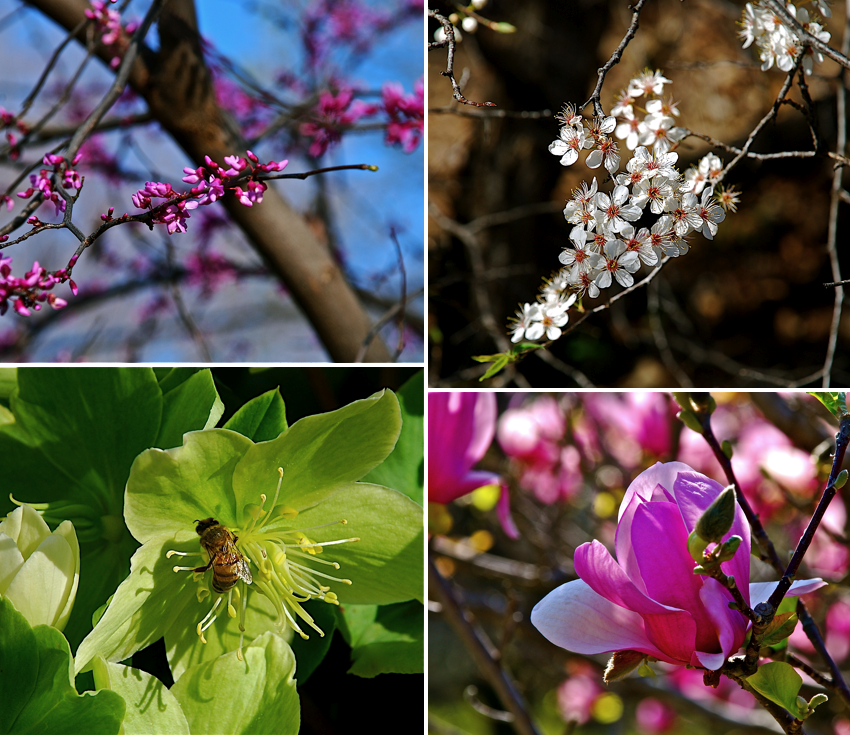
200. For flowers that bloom about our feet; for tender grass, so fresh, so sweet; for song of bird, and hum of bee; for all things fair we hear or see, Father in heaven, we thank Thee! ~Ralph Waldo Emerson

Thanksgiving is the holiday of peace,
the celebration of work and the simple life. . .
a true folk-festival that speaks
the poetry of the turn of the seasons,
the beauty of seedtime and harvest,
the ripe product of the year –
and the deep, deep connection
of all these things to God.
~Ray Stannard Baker (David Grayson)
Image

At the beginning of time the Lord set the wheels in motion for the making of continual banquets for man and creature alike.  And so in light of His abundant provisions and as the Canticle of Creation plays on, it is time to pause and give thanks to our gracious Benefactor.  The year is drawing to its appointed end and before it sinks into winter, the Sabbath of the year, we must look around and take stock of the Lord’s never-ending activity in Creation and be thankful for the constancy of His love and beneficent involvement in each of our lives.  W. J. Cameron said, “. . .a thankful heart hath a continual feast,” and so with beholden hearts, let us give praise and thanks for our Heavenly Father, His Grace, and His goodness.  I pray that this be a blessed time of thanksgiving for all of you and those you love; may all the roads you travel be, now and forever, filled with grace and peace and love.

If I have enjoyed
the hospitality of the Host of the universe,
Who daily spreads a table in my sight,
surely I cannot do less
than acknowledge my dependence.
~G. A. Johnston Ross

Enter His gates with thanksgiving and His courts with praise; give thanks to Him and praise His name.  ~Psalm 100:4  ✝

Music’s Mystery

Image

I’ve heard it said that only human beings have been given the gift of music; that only people create songs, sing and serenade their souls with this most magical and uplifting form of communication and communion. Yet, should we not consider the song of the lark? The haunting ballads of the whales? The mournful call of the wolf? The robin’s lyrical laugh at dawn and dusk? The crickets that serenade the nighttide? The burbles of monkeys swaying in the trees? The laughing of the hyena?

Who is to say that in their melodic tunes, caterwauls, howls, wails, and other worldly vocalizations there is not some measure of music. Why should we be the only ones to sing praise, to croon our love, and to bewail our distress? How can we know, in truth, in honesty, that the deliberate scree of the hawk, the piercing bugle of the elk, the chattering of raccoon and ferret, and the murmurings of infrasonic elephant calls is not music to their ears?

Music is a form of communication that lifts the soul, expresses emotion, and brings one being into contact with another being. If this is, indeed, the definition of music (of which it is a form) then can that being not be one other than human? Does not one wolf join another when it sings? Does not the whale song change season to season and year to year, picked up by another whale to be carried on? Does not one roaring lion inspire the entire pride by its lusty cry?

Consider what the morning would sound like without the sweet music of the birds. Contemplate what the summer night might be when not a single chirrup, trill, drone or buzz lilted through the air. Ponder how deep and lonely the oceans would be without the drifting, breathtaking songs of the whales. Can you even imagine a mountain landscape without hearing the echoing howl of a wolf or the bubbling laugh of the loon?

If these sounds, that can captivate us and uplift our thoughts, our hearts and even our souls, are not music and do not do the same for all those who hear them, regardless of race, than perhaps, we must follow that course of logic and say that cave paintings are not art, tap is not dance, improvisation is not acting and free verse is not poetry.

Or perhaps, Music Teaches the Soul what the Heart Feels and Guides the Heart with what only the Soul can Truly Know.

Music’s Mystery is by Morgan at:  http://booknvolume.com

40. Spring shows what God can do with a drab and dirty world. ~Virgil Kraft

Awake, thou wintry earth –
fling off thy sadness!
Fair vernal flowers, laugh forth –
your ancient gladness!
~Thomas Blackburn

Image

Leaf by leaf, bud by bud, and blossom by blossom the spring of the year advances.   On warmish days, earth casts off its wintry gloom, and breezes broadcast sweetly-scented aromas.  The first butterflies then dare to soar and the hungry bees hum amid the glad laughter issuing forth from flowering bulbs and trees.  As a result the year’s initial poetry of rebirth is penned by the pollinating, aerial whirring of dainty wings.  In the meantime as I hurry about trying to taking photos of the blossoming narratives and their paramours, I often find myself asking the same question Walt Whitman once did.  “Why are there trees I never walk under but large and melodious thoughts descend upon me?”  The answer I’ve decided is that the arms of trees reach towards the heavens to gather sacred messages meant to draw mankind near to “the living Word of God in nature” as well as what is read in Scripture.

In our area the first verses of  “tree” poetry come from Saucer Magnolias.  Their big, goblet-shaped flowers pen exquisite couplets in pink and white.  Soon to follow are the brilliant white blossoms of Star Magnolias.  Though not quite enough lines to form a fourteen-lined sonnet, their twelve exquisite, “petal-poesy” lines form rhyming schemes as lovely as any Shakespearean sonnet.  Next and in perfect rhyming sequences come the double samaras.  Samaras, the scarlet, dual winged fruits of the Red Maple, look like long, slender fairy wings as they dance choric rhymes writ by the winds.  Then come the Eastern Redbuds and Bradford Pears that compose stunning free-verse stanzas in purple and white, each resplendent branch, a psalm written in praise of its Maker.  For a pollinator now there’s no quandary about where sweet nectaries are to be found for stanza after stanza they and I are lead in springtime to earth’s most festive and delicious banquets.

He has taken me to the banquet hall, and His banner over me is love.  ~Song of Songs 2:4

19. Let us love winter, for it is the spring of genius. ~Pietro Aretino

We need a renaissance of wonder.
We need to renew, in our hearts and in our souls,
the deathless dream, the eternal poetry, the perennial sense
that life is miracle and magic.
~E. Merrill Root

Image

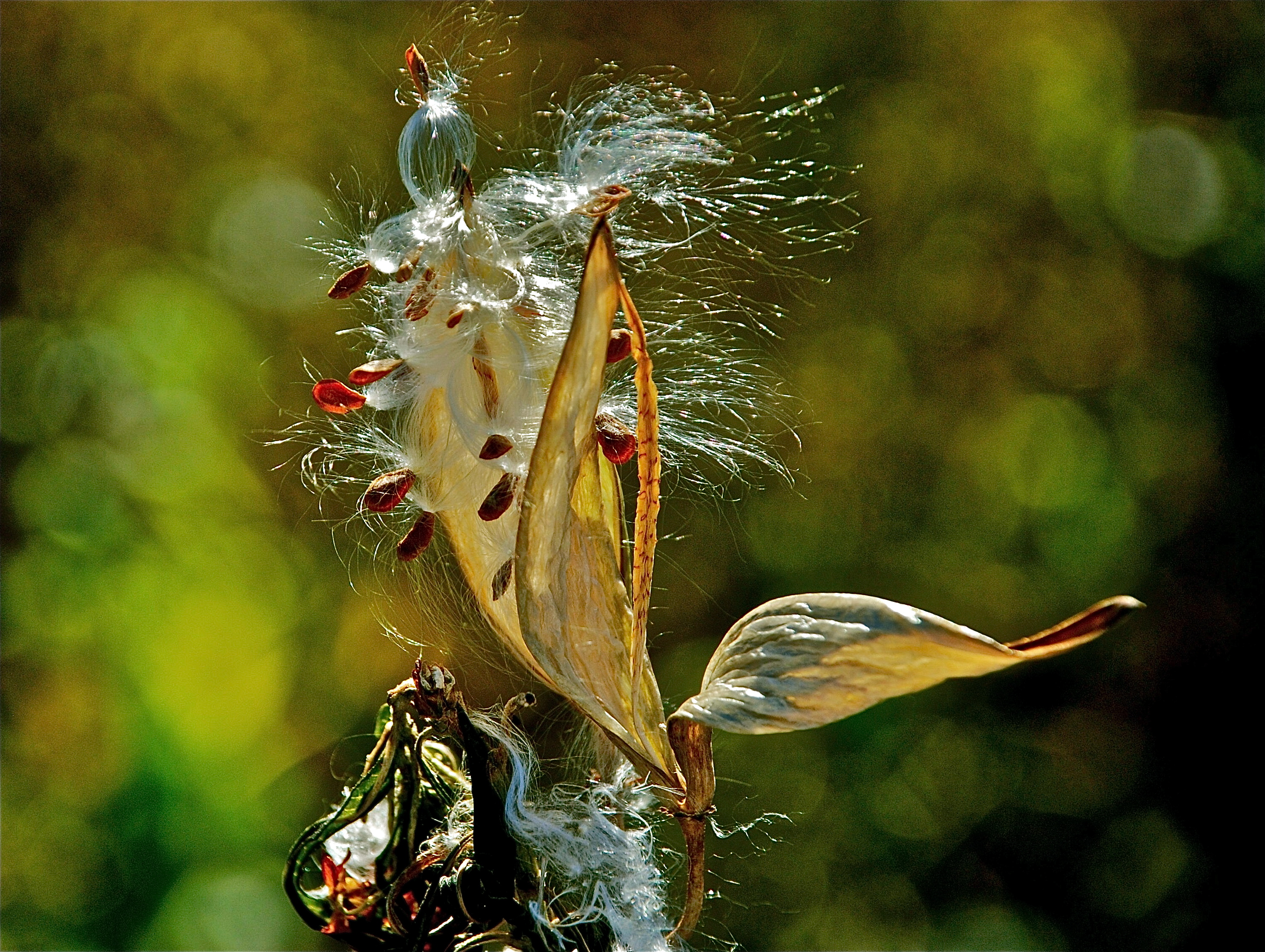
Since it is year’s end, we have entered the season of somber gardens, short days, low temperatures, and more-gray-than-blue skies.  The reckless abandon of the growing seasons has yielded to deepening winter’s, unadventurous restraint.  But, while looking out a window brings into view only the barrenness of winter, an actual venture out into its domain can expose wondrous sights like the seed pod in the photograph.  What a treat to see wondrous silken filaments that look like angel hair releasing seeds that are proof of a continuously running thread in Creation’s tapestry.  Such finds are tangible fragments of God’s imagination buried deep in the mystery of nature, and the aura of holiness that surrounds them often leaves onlookers amazed and awestruck.  These miraculous strands are the same kind of threads that govern the ceaseless ebbing and flowing of oceanic waves, the waxing and waning of the moon, the rising and setting of the sun, the birth and death of life forms, and the endless repetition of the seasons.

The most beautiful thing we can experience is the mysterious.
It is the source of all true art and all science.
He to whom this emotion is a stranger, who can no longer pause to wonder
and stand rapt in awe, is as good as dead: his eyes are closed.
~Albert Einstein

Rediscovering awe helps us appreciate the vast wonders of what the Creator’s mind imagined, what His words spoke, and what His hands created.  It bring us closer to God and restores our childlike joy and zeal for life.  The unfathomable mysteries of life are sacred benedictions; their blessings encourage us to stay in the Lord’s keeping and continue searching for His intent for our lives.

Who among the gods is like you, LORD?  Who is like you—majestic in holiness, awesome in glory, working wonders?  ~Exodus 15:11   ✝

**”if an object or expression can bring about, within us, a sense of serene melancholy and a spiritual longing, then that object could be said to be wabi-sabi.” “Wabi-sabi nurtures all that is authentic by acknowledging three simple realities: nothing lasts, nothing is finished, and nothing is perfect.”  The photo of the seed pod is a excellent example of Wabi Sabi.