172. Over everything connected with autumn there lingers some golden spell–some unseen influence that penetrates the soul with its mysterious power. ~Northern Advocate

O Autumn, laden with fruit, and stain’d
With the blood of the grape, pass not, but sit
Beneath my shady roof; there thou may’st rest,
And tune they jolly voice to my fresh pipe,
And all the daughters of the year shall dance!
Sing now the lusty song of fruits and flowers.
~William Blake, English poet
Image

*Photo courtesy Mike Bizeau

Lusty indeed is the dance of the year’s 4th child!  Escalating as she goes, she regales herself in glorious colors, and whilst strutting her hour upon earth’s stage, she reigns in majesty.  As she prepares the land for its Sabbath, her chariot enters the eastern sky at dawn with pink and purple banners flying high or she comes veiled in gray from a fog or torrents of rain.  Then after day is done she exits on the western horizon in mellow twilight, or in a blaze of red and gold, or swallowed up in the wetness of massive clouds.  When not thundering “mournful melodies” for all to hear, she’s belting out songs of joyfulness until she perishes in deep December softly playing “the harps of leafless trees.”

There is pleasure in the pathless woods,
There is rapture in the lonely shore,
There is society where none intrudes,
By the deep sea, and music in its roar;
I love not man less, but Nature more,
~Lord Byron, English poet

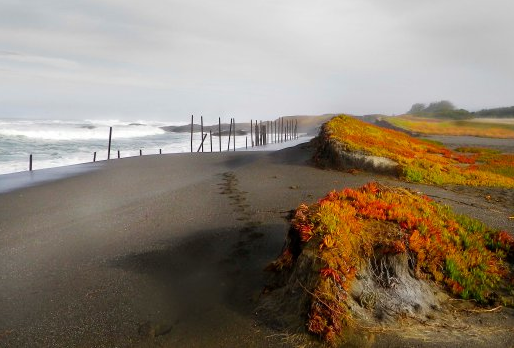
It wasn’t until Mike Bizeau posted this photo of fall-colored succulents along a beach north of Mendocino, California, that I realized lusty autumn not only sings in forests and gardens but also in places on the “lonely shore.”  What a splendid artist is the holy Yahweh!

Sing to Him, sing praise to Him; tell all of His wonderful acts.  ~1 Chronicles 16:9  ✝
149. It would be worthwhile having a cultivated garden if only to see what autumn does to it. ~Alfred Austin, British poet laureate

Lord, it is time.
The summer was very big.
Lay thy shadow on the sundials,
and on the meadows let the winds go loose.
~Ranier Maria Rilke

Image

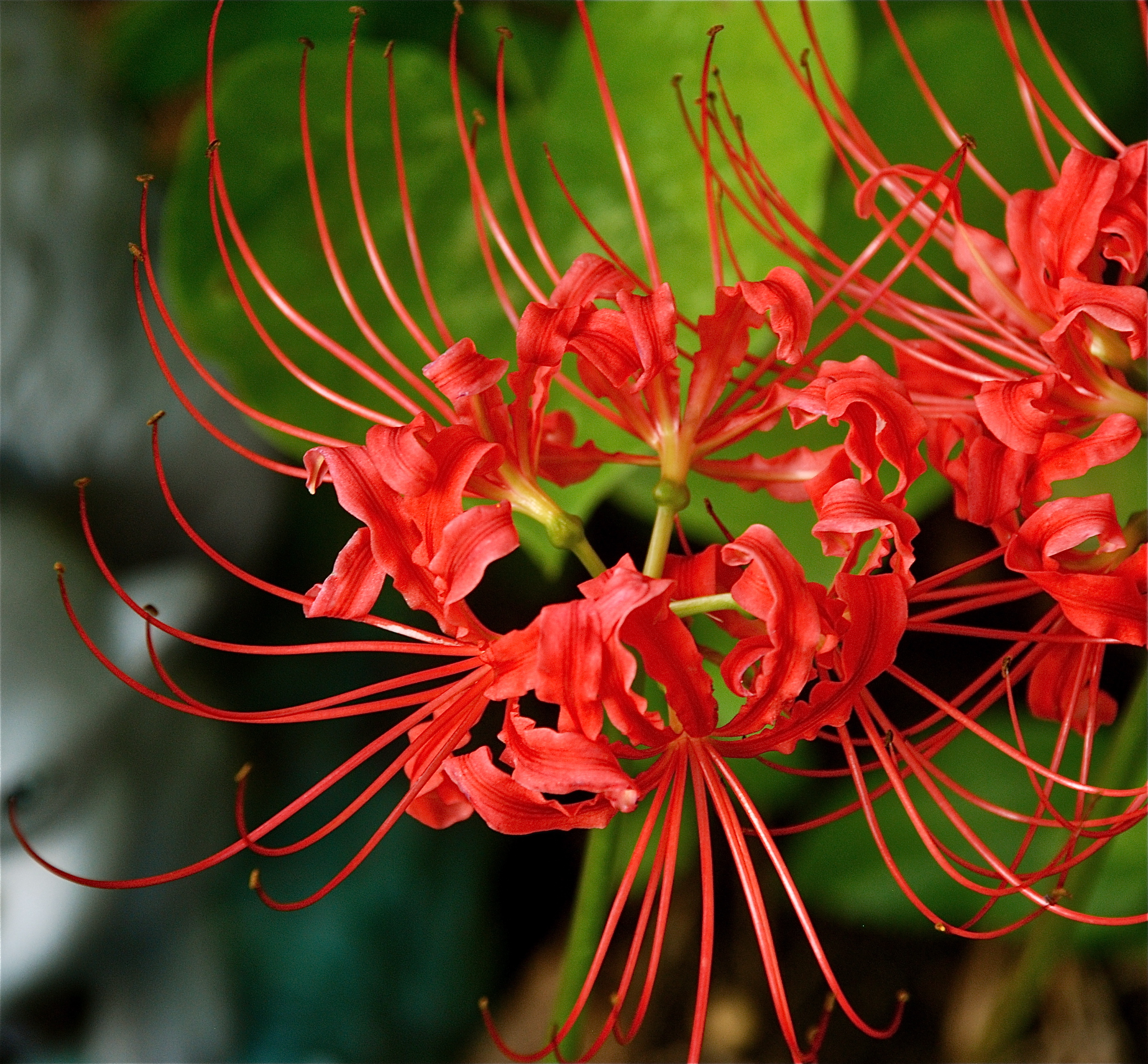
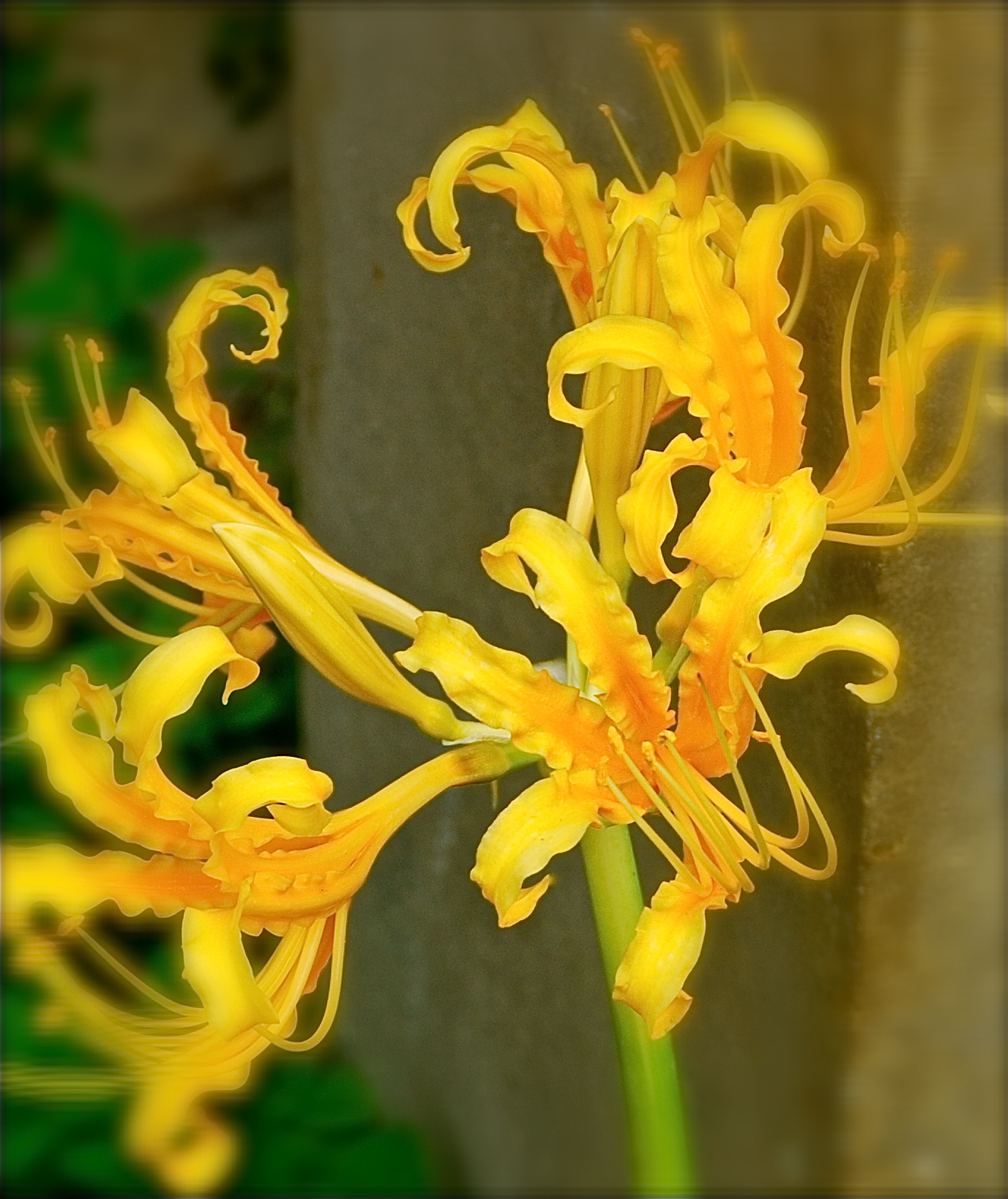
The beauty in the photo above, like the summer sun, is the color of gold.  And her petals have slightly wavy edges that seem to mimic the summer’s waves of heat that lead up to her appearance in the garden where she winks at people passing by with her long, wispy eyelash-like stamen.  In Latin the word “stamen” means “thread of the warp,” and it was Emerson who birthed the idea that “days are made on a loom whereof the warp and woof are past and future time.”  Apparently what he said ‘tis true since these threads of the warp are definitely forerunners of the future.  When they appear in the garden, hurricane season has begun and autumn is drawing near.  But who is she, this fair maiden dressed so elegantly in gold?  She and others like her are called Golden Spider Lilies, Naked Lilies, Surprise Lilies, Golden Hurricane Lilies, and/or Lycoris.  But whatever one calls them, they’re always dressed in their rich, apricot-yellow-orange finery, and their blooms which appear late in the summer after their leaves have disappeared create a lovely sweeping quality in the garden.  The official name of the species is Lycoris aurea, and it originated in China where it is known as “Hudixiao” (Suddenly The Soil Shines).  But she is not an only child; for she has an amazing sibling, Lycoris radiata, the Red Spider Lily.

Image

Now look again at the yellow one.  I deliberately blurred the outer edges of the photograph so the heart she was forming in the middle was more noticeable.

Acknowledge and take to heart this day that the Lord is God in Heaven above and on earth below.  There is no other.  ~Deuteronomy 4:39  ✝

142. Red is the ultimate cure for sadness. ~Bill Blass

May you be blessed with
warmth in your home,
peace in your soul
and joy in your life.
~Irish blessing

Image

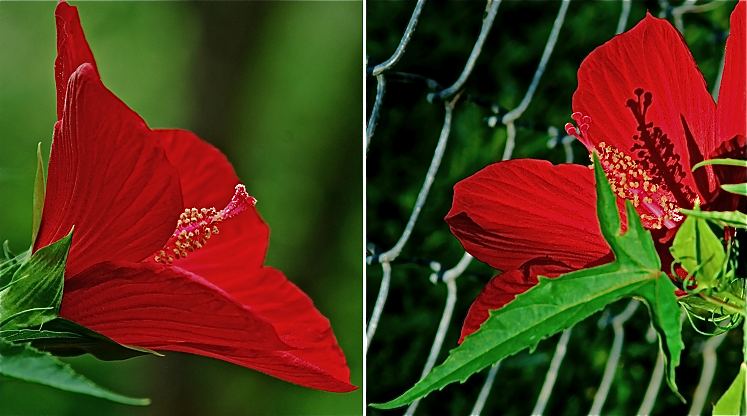
A swamp mallow is she in the photograph, and like her name she is one of the stars of our hot Texas summers.  Her scientific name is Hibiscus coccineus, but here in the Lone Star state she is commonly called the Texas Star Swamp Hibiscus. The Star can grow as tall as 7 feet and puts on stunning four inch crimson blossoms.  Another perk is that she attracts hummingbirds, butterflies, and other avian visitors.  However, according to some she can be as big a challenge as the state she’s named after.  In my garden, however, I’ve found her surprisingly easy to manage, and I love that her season runs from June to October and provides lush summer and fall color.

Your ways, God, are Holy.  ~Psalm  77:13  ✝

46. A Robin Redbreast in a cage puts all Heaven in a rage. ~William Blake, English poet, painter and printmaker

When father takes his spade to dig
then Robin comes along;
And sits upon a little twig
And sings a little song.
~Laurence Alma-Tadema

Image

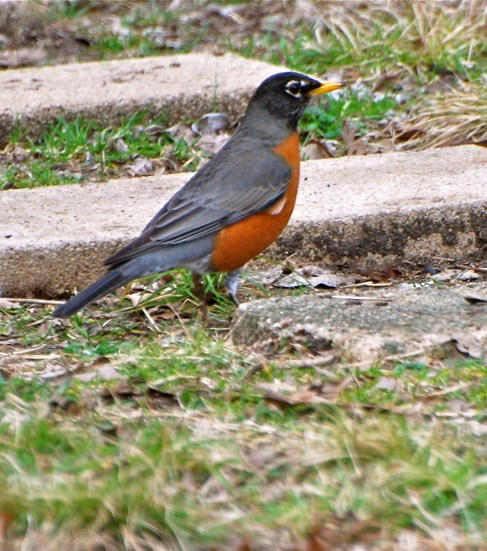
The introductory line is from Blake’s “Auguries of Innocence,” a somewhat lengthy poem consisting of a series of paradoxes in which Blake juxtaposes innocence with evil and corruption. The word augury in the title means omen or token, and the robin is the poem’s first noted “augury of innocence.”  The robin’s song, personality, and countenance are such that it’s obvious why the poet saw the act of putting one in a cage as not only an enraging violation but also as a profound perversion of holiness.  The sweet song and colorful markings of a robin make the bird a delightful harbinger of spring’s infancy and innocence.  Looking forward to its coming is one of my favorite rites in spring’s passage, and like “all heaven” I’d be incensed if the bird’s freedom were taken away and its song silenced.  Below is a legend about the robin that again ties the bird to the blameless and sacred.  Although the truthfulness of legends is questionable, I’m fascinated that somehow, somewhere, and in some way the robin was connected to the Messiah.

The Legend of the First Robin

One day, long ago, a little bird in Jerusalem saw a large crowd gathered around a man carrying a heavy wooden cross.  On the man’s head was a crown made from a thorn branch.  The thorns were long and sharp.  The little bird saw that the thorns were hurting the man.  It wanted to help Him, so it flew down and took the longest, sharpest thorn in its tiny beak.  The bird tugged and pulled until the thorn snapped from the branch.  Then a strange thing happened.  A drop of blood fell onto the bird’s breast, staining it bright red.  The stain never went away.  And so today the robin proudly wears a red-breast, because it helped a man named Jesus.  

“But ask the animals, and they will teach you, or the birds of the air, and they will tell you; or speak to the earth, and it will teach you, or let the fish of the sea inform you.  Which of all these does not know that the hand of the LORD has done this?  In His hand is the life of every creature and the breath of all mankind. . .”  ~Job 12:7-10   ✝

40. Spring shows what God can do with a drab and dirty world. ~Virgil Kraft

Awake, thou wintry earth –
fling off thy sadness!
Fair vernal flowers, laugh forth –
your ancient gladness!
~Thomas Blackburn

Image

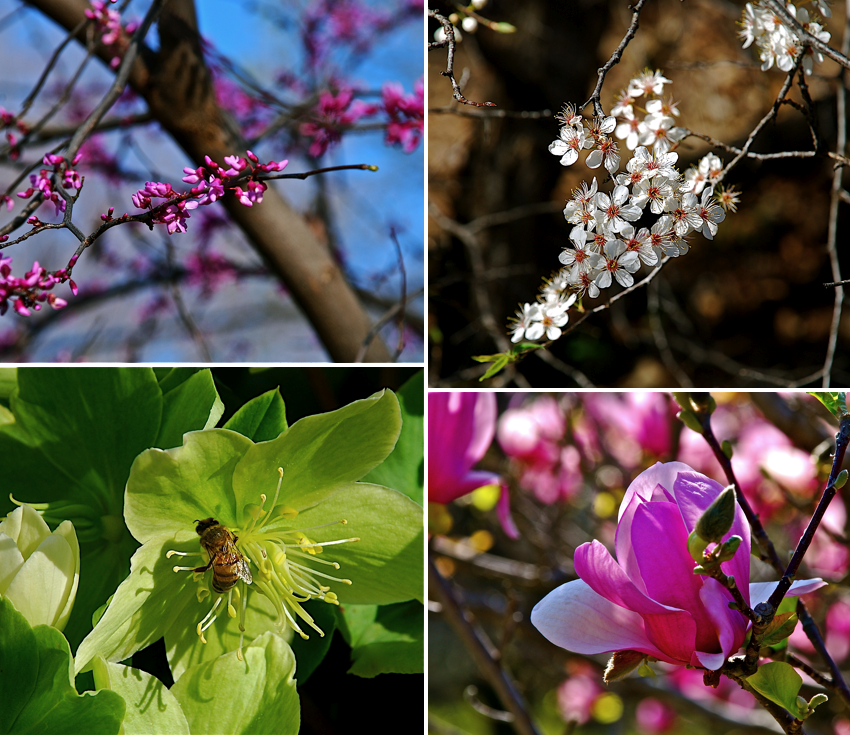
Leaf by leaf, bud by bud, and blossom by blossom the spring of the year advances.   On warmish days, earth casts off its wintry gloom, and breezes broadcast sweetly-scented aromas.  The first butterflies then dare to soar and the hungry bees hum amid the glad laughter issuing forth from flowering bulbs and trees.  As a result the year’s initial poetry of rebirth is penned by the pollinating, aerial whirring of dainty wings.  In the meantime as I hurry about trying to taking photos of the blossoming narratives and their paramours, I often find myself asking the same question Walt Whitman once did.  “Why are there trees I never walk under but large and melodious thoughts descend upon me?”  The answer I’ve decided is that the arms of trees reach towards the heavens to gather sacred messages meant to draw mankind near to “the living Word of God in nature” as well as what is read in Scripture.

In our area the first verses of  “tree” poetry come from Saucer Magnolias.  Their big, goblet-shaped flowers pen exquisite couplets in pink and white.  Soon to follow are the brilliant white blossoms of Star Magnolias.  Though not quite enough lines to form a fourteen-lined sonnet, their twelve exquisite, “petal-poesy” lines form rhyming schemes as lovely as any Shakespearean sonnet.  Next and in perfect rhyming sequences come the double samaras.  Samaras, the scarlet, dual winged fruits of the Red Maple, look like long, slender fairy wings as they dance choric rhymes writ by the winds.  Then come the Eastern Redbuds and Bradford Pears that compose stunning free-verse stanzas in purple and white, each resplendent branch, a psalm written in praise of its Maker.  For a pollinator now there’s no quandary about where sweet nectaries are to be found for stanza after stanza they and I are lead in springtime to earth’s most festive and delicious banquets.

He has taken me to the banquet hall, and His banner over me is love.  ~Song of Songs 2:4

3. Winter is an etching, spring a watercolor, summer an oil painting and autumn a mosaic of them all. ~Stanley Horowitz

O Autumn, laden with fruit, and stain’d
With the blood of the grape, pass not, but sit
Beneath my shady roof; there thou may’st rest,
And tune thy jolly voice to my fresh pipe,
And all the daughters of the year shall dance!
Sing now the lusty song of fruits and flowers.
~William Blake, English poet

Image

Lusty indeed is the dance of the year’s 4th child; regaled in glory and reigning in majesty, she’s a darling of the gardener.  Because fruitfulness and love run through her “thrilling veins,” those who choose to work the soil know they’ve got one last chance now before year’s end to plant, “to interact with nature, to share, to find sanctuary, to heal, to honor the earth, to leave a mark.”  So it is when autumn’s chariots, with pink and purple banners flying or veiled in a gray fog or torrents of rain, enter the eastern sky at dawn, the gardener’s heart is electrified.  Then when her crisp days are done and her carriage exits on the western horizon in a blaze of red and gold or is swallowed in the wetness of massive dark clouds, the gardener is left with the satisfied feeling that he’s conjured up or added yet another stroke or two to his beloved work of art.   As for what Blake called her “jolly voice,” autumn often sings gladsome odes to joy, but there are days when it belts out threatening, thunderous refrains or croons “mournful melodies.”  Regardless of what autumn vocalizes, it’s not until it plays “the harps of leafless trees” and sings the somber song of deep December that both the garden and gardener rest knowing that it’s time to let the Lord and Creation alone perform their miracles, God from on high and the earth from beneath the soil.

A common feast has been prepared at Creation’s hearty tables.  Food for the soul, spirit, and mind has been prepared and offered up for all of us.  So, come, dine with me there in the coming weeks.